The Music of Ordinary Lives: The Short Stories of Anton Chekhov
In one breath
After Dostoevsky's thunder and Tolstoy's vast canvases, Chekhov's short stories seem quiet: country doctors, lonely cab drivers, disappointed teachers. Yet he finds depth in ordinary life, observes without judging, implies rather than explains and leaves endings open, true to life itself.
On this page
After the thunder of Dostoevsky and the vast canvases of Tolstoy, Anton Chekhov can seem, at first, almost too quiet. His short stories contain no murders to solve, no grand philosophical debates, no sweeping historical drama. They are about ordinary people, a country doctor, a lonely cab driver, a disappointed teacher, living ordinary lives, and often nothing much “happens” in them at all. And yet Chekhov is one of the greatest writers who ever lived, and his apparent simplicity conceals an art of extraordinary depth and compassion. Reading him taught me that the most profound literature need not shout, that the quiet music of an ordinary life, attended to closely enough, contains everything.
Here is what Chekhov’s stories taught me about finding depth in the everyday, about compassion without judgment, and about the art of restraint.
Key takeaways
- Ordinary life is the subject; Chekhov finds depth in the everyday.
- He observes without judging, extending compassion to every character.
- “Show, don’t tell”: he implies rather than explains, trusting the reader.
- Stories often lack neat resolution, true to the open-endedness of life.
- Small moments carry the full weight of human longing and loss.
The depth of the everyday
What Chekhov discovered, and made his own, is that you do not need dramatic events to write profound literature. His stories find their power in the texture of ordinary existence: a misunderstanding between a husband and wife, a servant’s small humiliation, the quiet disappointment of a life that did not turn out as hoped. In “Misery,” a cab driver who has just lost his son cannot find a single person willing to listen to his grief, and ends up pouring out his sorrow to his horse. Nothing “happens,” and yet the story is devastating. Chekhov teaches that the deepest human dramas are usually invisible, unfolding in the small, unremarked moments of everyday life, and that the writer’s task is to attend to them closely enough to reveal the depth that was always there.
Compassion without judgment
The quality I treasure most in Chekhov is his compassion, and the remarkable absence of judgment that goes with it. Chekhov, who was a practising doctor as well as a writer, looks at his characters the way a wise physician looks at patients: with clear-eyed understanding, neither idealising nor condemning them. He shows us weak people, foolish people, cruel and self-deceiving people, and somehow we understand them all, because he understands them all. He does not tell us what to think or whom to blame; he simply shows us human beings as they are, in all their muddle, and trusts us to feel the sympathy he feels. This refusal to judge, combined with such deep insight, gives his stories their unique warmth. He is the least preachy of the great writers, and perhaps the most humane.
The art of restraint
Chekhov is the master of saying less. He famously advised that if you describe the moonlight, do not explain it, just show the glint of light on a piece of broken glass. He implies rather than states, suggests rather than spells out, and trusts the reader to feel what he leaves unsaid. His stories rarely offer neat resolutions or tidy morals; they often end quietly, unresolved, the way real life refuses to wrap itself up. This restraint can frustrate readers expecting drama, but it is the source of his realism and his power. By withholding, Chekhov leaves space for the reader to enter, to feel, to recognise their own life in his. He understood that what is left unsaid can carry more weight than what is spelled out, and that the truest endings are often the ones that simply stop, as life does.
What I’m taking with me
Chekhov taught me to listen for the quiet music of ordinary lives, and I came away changed as a reader and, I hope, as a person. What I am taking from his stories is the revelation that profound literature need not be loud, that the everyday holds all the depth one could want; his model of compassion without judgment, looking at human beings clearly and loving them anyway; and his art of restraint, the trust that what is shown and left unsaid can move us more than any explanation. After Chekhov, I notice the small dramas around me more, the unspoken griefs and quiet disappointments, and I am gentler with them, because he taught me how.
Frequently asked questions
What are Chekhov’s short stories about?
They are about ordinary people living ordinary lives, finding profound depth, compassion, and quiet drama in everyday moments rather than in grand events.
Why is Chekhov considered a master of the short story?
For his compassion, psychological insight, and restraint. He shows rather than tells, observes without judging, and trusts readers to feel what he leaves unsaid, shaping the modern short story.
Why do Chekhov’s stories often lack a clear ending?
Because he aimed for realism. Life rarely offers neat resolutions, so his stories often end quietly and unresolved, faithful to the open-endedness of real experience.
References & further reading
- Chekhov, Anton. Selected Stories. (Translated by Constance Garnett; or Ronald Hingley, Oxford University Press.)
- Hingley, Ronald. A New Life of Anton Chekhov. Oxford University Press, 1976.
- Rayfield, Donald. Chekhov: A Life. HarperCollins, 1997.
Watch: others on this book

Read along with me
Book notes, philosophy and the ideas that shape how we build. New essays every month, no spam.
Related reading notes
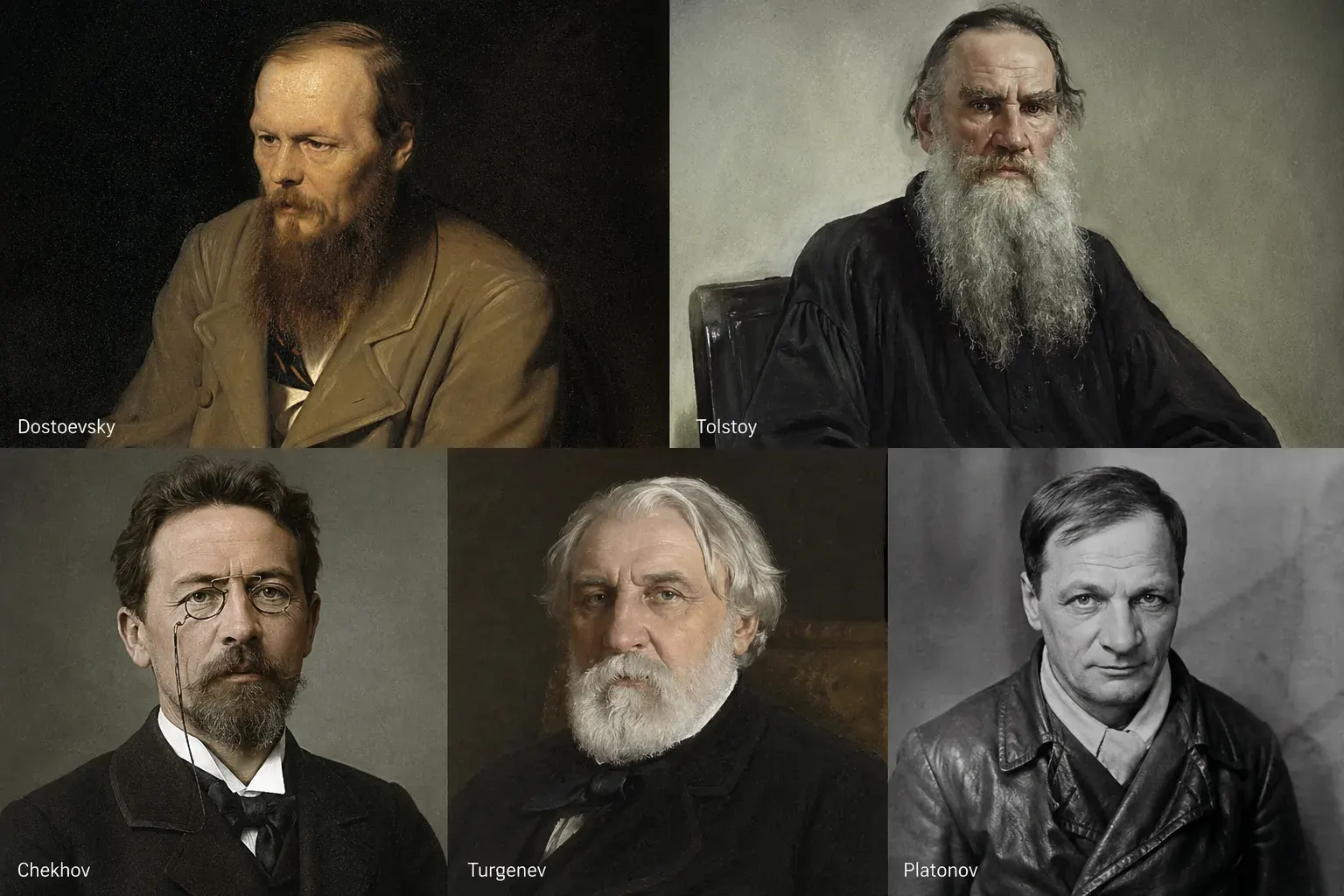
Dostoevsky, Tolstoy, Chekhov, Turgenev and Platonov
Where to start with Russian literature: essential works by Dostoevsky, Tolstoy, Chekhov, Gogol, Turgenev and Platonov, and why each is worth reading.
The Man Who Would Not Rise: Goncharov's "Oblomov"
Goncharov's Oblomov: the kindly man who cannot get off his couch, what Oblomovism means and why this comedy of inertia is a gentle tragedy.
The Devil Comes to Moscow: Bulgakov's "The Master and Margarita"
Bulgakov's The Master and Margarita: the Devil in Soviet Moscow, satire under Stalin, "manuscripts don't burn" and redemption through love.
Comments
No comments yet. Start the conversation.