Security Awareness Training That Works
Why most security awareness programs fail to change anything - and how to build one that actually moves human behavior.
TL;DR
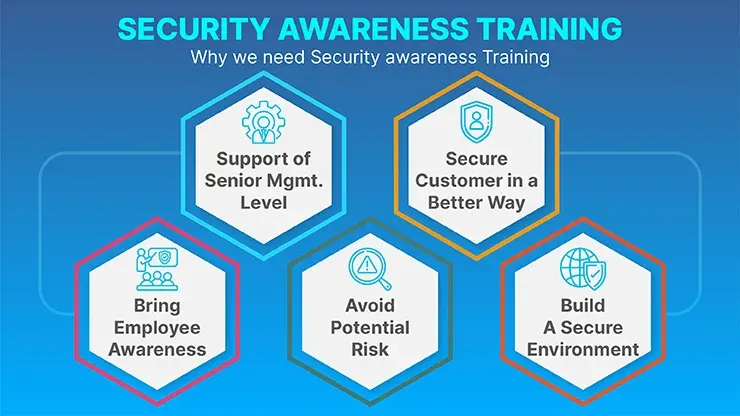
Most security awareness programs measure completion, not behavior change. Training works when it is treated as behavior change: short, frequent and relevant, with phishing simulations used as drills rather than traps, metrics leadership cares about such as reporting rates, and a culture where people feel safe reporting mistakes.
On this page
Every year, organizations spend enormous sums hardening their machines, and every year, the breach reports come back with the same uncomfortable finding: the large majority of incidents involve a human element. Someone clicked. Someone reused a password. Someone wired the money. It is tempting to conclude that people are the weakest link and to treat them as a problem to be managed around. That conclusion is both wrong and expensive. People are only the weakest link when we leave them untrained, uninformed, and unsupported. Train them well, and the same workforce becomes the largest sensor network you own - thousands of eyes catching the attacks your tools miss.
The catch is that most security awareness training does not train anyone to do anything. It informs, briefly, once a year, and then measures its own success by how many people sat through the slides. That is the central failure, and it is worth naming plainly.
The Completion Trap
Ask a typical security team how their awareness program is doing and you will hear a number: ninety-four percent completion. It sounds like progress. It measures nothing that matters. Completion tells you people attended; it says nothing about what they will do when a convincing phish lands on a busy Tuesday. The only outcome worth caring about is behavior - did the person hesitate, verify, and report? - and completion is a poor proxy for behavior, often no proxy at all.
This is the difference between awareness, training, and culture, three words the industry uses interchangeably and shouldn’t. Awareness is knowing a risk exists. Training is having a skill you can perform. Culture is when the secure behavior is simply how things are done here. A poster creates awareness. A guided exercise builds a skill. A team that thanks people for reporting mistakes has culture. Programs that optimize for completion stall at awareness and wonder why nothing changes.
Treat It as Behavior Change, Not Content Delivery
The fix is to stop thinking like a course author and start thinking like a marketer or a coach. Behavior change has rules, and they are well understood. Adults learn what is relevant to their actual jobs, delivered in their own time, made practical, and justified with a real reason rather than “because policy.” They forget the rest.
The single most powerful lever is frequency. Attackers reach your people every single day; one annual session cannot possibly compete. Replace the big yearly event with a steady drumbeat of small touches - microlearning, two to five minutes each, one idea at a time, in rotating formats so it never becomes wallpaper. A short video this month, a two-question scenario the next, a poster, a team huddle, a simulated phish. Repetition with variety is how a message moves from heard-once to second-nature.
Story matters as much as frequency. A real, anonymized account of how a colleague nearly wired ninety thousand dollars to a fraudster will outlive any bullet list of phishing indicators. And the most reliable behavior change of all comes not from willpower but from removing friction: if reporting a suspicious message takes one button, people will do it; if it requires forwarding headers to an obscure address, they will not. Make the safe path the easy path and you will not have to train for half of what you used to.
The Simulation, Used as a Drill and Not a Trap
Phishing simulations are the most powerful tool in the kit and the easiest to ruin. Their entire value lies in the teachable moment: when someone clicks a safe fake, they land immediately on a friendly page that says, in effect, this was a drill, here is what to watch for, here is how to report the real thing. Learning tied to your own action, delivered the instant you are most receptive, beats any classroom.
That value evaporates the moment a simulation becomes a gotcha. Dangle a fake bonus or a layoff notice, then name and shame the people who fell for it, and you will harvest a high click rate and a workforce that no longer trusts you. The reporting rate - the metric that actually protects you - collapses, because people learn that admitting a mistake is dangerous. The rule is simple and absolute: a simulation is a fire drill, not a fire. Teach, never trap. Start easy, raise difficulty slowly, brief the help desk so they don’t scramble a real incident response, coordinate with HR and legal, use work-relevant pretexts that are not emotionally cruel, and report results by group, never by name.
Measure What Leadership Should Actually Care About
If you measure activity - modules completed, hours logged, posters printed - you prove the program happened. To prove it worked, measure behavior and risk. Two numbers carry the story. The phish-prone rate, the share of people who take the unsafe action, should trend down. The reporting rate, the share who flag the suspicious message, should trend up, ideally faster. When both move in the right direction together, your human layer is genuinely getting stronger, and that is a sentence any executive understands.
This reframing matters because most programs are born to satisfy a regulation, and compliance is a floor, not a ceiling. You can be fully compliant and deeply vulnerable, because everyone-completed-the-module can be true in a place where no one changed. Tell leadership about risk reduced - fewer account takeovers, faster detection - not boxes checked. Show them the phish-prone curve bending down quarter over quarter. Ask them to participate visibly: to take the same training, to admit a phish they nearly fell for. Visible executive participation does more for culture than any campaign.
The Quiet Work of Culture
In the end, metrics tell you where you are and culture decides where you stay. A strong security culture treats reporting as heroic, responds to it fast and kindly, and refuses to shame the person who clicked. It is slow to build and easy to wreck - one public humiliation can undo a year of patient effort - so it must be protected on purpose. Celebrate the reporters. Thank every flag, even the false alarms. Keep the content fresh so it never fades into background noise.
Security awareness training that works is not a course you run; it is a campaign you sustain - the right topics taught deeply, delivered short and often and relevant, tested with simulations that teach instead of trap, measured by behavior under leadership that shows up. Build that, and the people everyone calls the weakest link quietly become the strongest defense you have.
Key takeaways 5
- Completion rates don't prove changed behavior.
- Treat awareness as behavior change, not content delivery.
- Use phishing simulations as drills, not gotchas.
- Track reporting rate and time-to-report, not just click rate.
- A no-blame culture turns staff into a sensor network.
Watch & learn

Frequently asked questions
Why does security awareness training often fail?
It is often an annual compliance course focused on completion. People forget it quickly, and punitive phishing tests create fear instead of better habits.
What metrics show security awareness is working?
Rising phishing report rates, faster reporting times, fewer repeat clickers and fewer real incidents caused by human error.
Are phishing simulations a good idea?
Yes, when used to teach: realistic but fair scenarios, immediate learning moments and praise for reporting, rather than public shaming of people who click.
Go deeper with the free masterclass
Workshop, PDF handbook and curated resources for “Security Awareness Training That Works”.
Related articles
Phishing & Social Engineering Defense
The most dangerous hack of all does not target your computer. It targets you, and the defense is simpler than you think.

Cybersecurity Fundamentals: CIA Triad & Threats
You do not need to be a hacker to stay safe online, you just need to understand three ideas and a handful of habits.
Password Security & MFA
Most account break-ins do not require clever hacking - they exploit ordinary habits. Here is how to fix yours in an afternoon.
Comments
No comments yet. Start the conversation.