Kanban for Knowledge Work
Knowledge work hides in tickets, inboxes, and people's heads. Kanban drags it into the light, caps how much you juggle at once, and lets the math of flow do the rest.
TL;DR
Knowledge work hides in tickets, inboxes and people's heads. Kanban makes it visible on a board, limits work in progress so teams stop starting and start finishing, and uses the math of flow (Little's Law) to cut lead times. Measure flow rather than busyness and improve in small steps.
On this page
Ask a team how much work they have in progress right now and you will usually get a shrug. The tasks are scattered across tickets, chat threads, half-finished documents, and the quiet promises people made in hallways. Nobody can see the whole picture, so nobody can manage it. This is the problem Kanban was built to solve, and it solves it without asking you to reorganize, rename anyone’s job, or adopt a thick new process on Monday morning.
Kanban borrows its name and its central idea from lean manufacturing, where a kanban was a signal card telling an upstream step to produce more only when a downstream step needed it. In a factory you can walk the floor and see the inventory piling up. In knowledge work the inventory is invisible, which is exactly why so many teams feel busy and slow at the same time. Kanban’s first move is therefore almost embarrassingly simple: make the work visible.
Put the work on a wall
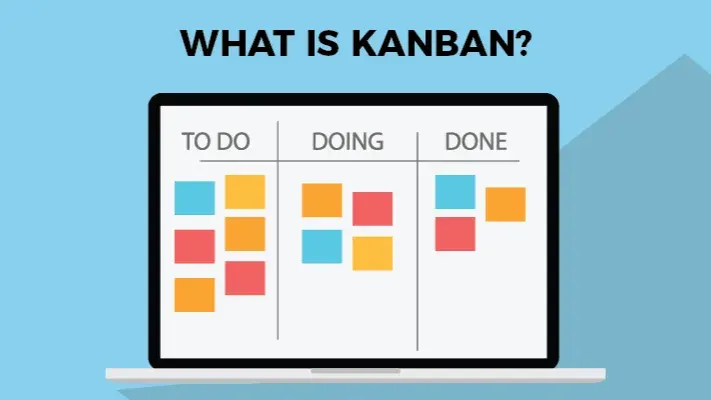
You do this by drawing a board whose columns are the real stages your work passes through, from the moment you accept a request to the moment you deliver it. Each item becomes a card; each column is a state. The discipline is to capture reality, not a tidy ideal. If items routinely sit waiting for review, then waiting for review is a real stage and it earns its own column. A board that hides the queues cannot help you shorten them.
The moment the board is honest, things you used to argue about become things you can simply look at. The pile of cards stuck before “review” is the bottleneck. The card with a red dot has been blocked for three days. The person doing six things at once is visibly doing six things at once. Visibility alone changes conversations, but it is only the setup for the move that gives Kanban its power.
Then stop starting and start finishing
That move is the work-in-progress limit: an explicit cap on how many cards a column may hold at once. Write “max 3” at the top of a column, fill it, and the rule is plain. Nobody may start a fourth item. If you have spare capacity, you must instead help finish something already in flight. With one number you have converted a push system, where work is dumped in whenever it arrives, into a pull system, where work is drawn in only when there is room.
It feels backwards that doing fewer things at once makes work go faster, but three forces make it true. First, every task switch costs reloading time, and fewer items in flight means less switching. Second, a full downstream column blocks the one before it, so bottlenecks can no longer hide under a heap of started-but-unfinished work; they announce themselves and get attention. Third, and most rigorously, there is a law.
The math that makes it work
Little’s Law comes from queuing theory. For a stable system observed over the long run, the average number of items in the system equals the average arrival rate times the average time an item spends in the system, written compactly as L equals lambda times W. Rearranged into the form teams actually use, average cycle time is approximately average work in progress divided by average throughput.
Read that again, because it is the whole argument in one line. If your throughput, the number of items you finish per week, stays roughly constant, then the only lever left for shortening how long each item takes is to carry less work in progress. A team finishing ten items a week while juggling twenty has an average cycle time of two weeks. Cut the work in progress to ten, change nothing else, and the cycle time falls to one week. Same output rate, half the wait, purely from carrying less at once.
A fair caveat keeps you honest: Little’s Law is exact only for long-run averages of a stable system, one where work arrives at about the rate it departs. It will not predict any single item’s journey or survive a chaotic burst. But as an intuition pump it is unbeatable, and it explains why the simple act of writing a small number atop a column produces real, measurable speed.
Measure flow, not busyness
Because every item is a card with a start and an end, you can measure your system instead of guessing about it. Three numbers are enough to begin: throughput, the items finished per week; work in progress, the items currently in flight; and cycle time, the calendar days each item takes from start to finish. Measure in wall-clock time, including the weekends and the waiting, because that is what customers actually experience and because most delay in knowledge work is waiting, not working. A cumulative flow diagram, which simply stacks the daily count of items in each state, turns these numbers into a picture where current work in progress, lead time, and growing bottlenecks are all visible at a glance.
Improve a little at a time
None of this is a one-off installation. Kanban runs on light rhythms: a short daily standup read right to left, asking what is stopping work from finishing; a weekly replenishment meeting where the team pulls new items onto the board only as far as the limits allow; and a periodic review where you look at the metrics and pick one thing to improve. Improvement itself is a loop of small, reversible experiments. Notice that cards linger in review, guess that a tighter review limit will help, try it for two weeks, and check whether cycle time actually moved. Keep what works, revert what does not.
That is the quiet genius of the method. It does not demand a revolution. It asks only that you make the work visible, limit how much you carry, measure how it flows, and change a little at a time. Start where you are today, and let the next small step be guided by what the board and the numbers are telling you.
Key takeaways 5
- Make all work visible on a shared board.
- Limit work in progress: stop starting, start finishing.
- Little's Law: less work in progress means shorter lead times.
- Measure flow, lead time and throughput, not busyness.
- Improve gradually without reorganizing the team.
Watch & learn

Frequently asked questions
What is Kanban?
Kanban is a method for managing work by visualizing it on a board, limiting work in progress and improving the flow of work through each stage, originally inspired by lean manufacturing.
Why limit work in progress?
Multitasking slows everything down. WIP limits force the team to finish items before starting new ones, which shortens lead times and exposes bottlenecks.
What is the difference between Kanban and Scrum?
Scrum uses fixed-length sprints, set roles and planned batches of work. Kanban is continuous flow with WIP limits and no required sprints or roles, so teams can adopt it on top of how they already work.
Go deeper with the free masterclass
Workshop, PDF handbook and curated resources for “Kanban for Knowledge Work”.
Related articles

OEE & Real-Time Production Monitoring
OEE turns the messy reality of a production line into one honest number - and real-time monitoring turns that number into daily improvement. Here is how the metric works and how to make it actually move.
Business Process Mapping & Optimization
Before you buy software to fix a slow process, draw it. A simple map of how work really flows will show you more than any vendor demo - and stop you from automating a mess.

Leading Remote & Distributed Teams
The hardest part of leading people you never see is unlearning everything the office quietly did for you.
Comments
No comments yet. Start the conversation.