Industrial Communication Protocols (Modbus & Profinet)
Modbus and PROFINET sit at opposite ends of the industrial network spectrum - one ancient and universal, one fast and deterministic. Here is how each thinks, and why most plants run both.
TL;DR
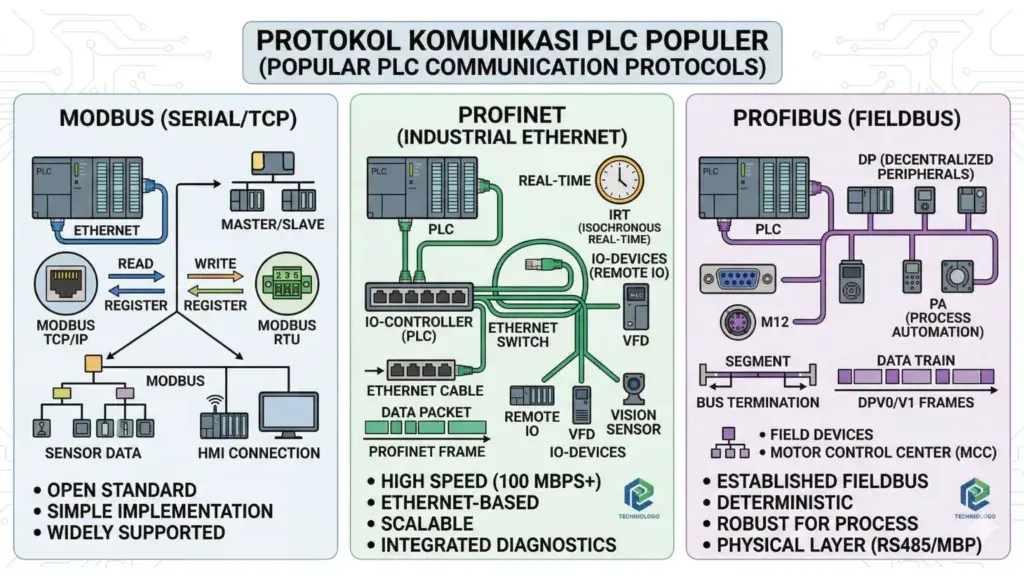
Fieldbuses replaced bundles of point-to-point wiring with shared digital networks. Modbus, simple and universal since 1979, polls registers over serial or TCP. PROFINET is fast, deterministic industrial Ethernet for real-time I/O and motion. Most plants run both, each where it fits.
On this page
Every automated machine has a hidden nervous system. Sensors report, controllers decide, actuators move - and all of that depends on devices being able to talk to each other reliably. For decades, that conversation happened over bundles of point-to-point wire, one pair per signal. A machine with five hundred I/O points meant five hundred cable runs back to the controller, plus the terminal blocks, labels, and wiring diagrams to match. It worked, and it was miserable to build and maintain.
Fieldbuses ended that. The idea is simple: replace the bundle with one shared digital cable and let devices take turns talking. Instead of pulling a wire for every limit switch, the controller asks a remote I/O block for the state of all its inputs in a single message. Less copper, faster commissioning, and - crucially - built-in diagnostics that bare wires could never offer. The question stopped being “how do I wire this signal” and became “which protocol should these devices speak.”
Two answers dominate that question today, and they could hardly be more different in spirit.
The universal one: Modbus
Modbus was published in 1979, which in industrial terms makes it ancient - and that age is exactly why it is everywhere. The specification is open and royalty-free, the data model is flat and easy to grasp, and a competent programmer can implement a working slave in an afternoon. If a device speaks any fieldbus at all, the odds are good it speaks Modbus.
Its model is strict master/slave. One device, the master, initiates every transaction; the slaves never speak unless asked. The master sends a request, the addressed slave answers, and that is the whole conversation. Because nothing happens unless the master asks, there are no collisions to manage - a kind of determinism by simplicity.
All Modbus data lives in just four tables: single-bit coils and discrete inputs for digital signals, and 16-bit input and holding registers for measured values, setpoints, and parameters. To read a value you send a function code - 03 to read holding registers, 04 to read input registers, 16 to write a block of them - along with a start address and a quantity. The slave replies with the raw numbers.
Those raw numbers hide the two traps that catch every newcomer. The first is addressing: a manual may call the first holding register “40001,” but the address actually sent on the wire is zero. The leading digit names the table; the real address is the reference minus the base, minus one. The second is scaling: Modbus carries plain integers, so a reading of 215 might mean 21.5 degrees Celsius. The protocol will not tell you where the decimal point goes - only the device manual will.
Modbus comes in two transports that share an identical message body. Modbus RTU is the binary serial form, running over rugged RS-485 wiring with a CRC check on each frame. Modbus TCP wraps the same message in a small header and sends it over ordinary Ethernet on port 502, dropping the CRC because TCP already guarantees integrity. Because the core is the same, porting a device from serial to Ethernet is mostly a change of plumbing, not of logic.
What Modbus does not give you is speed or richness. It is polled, so latency depends on how fast the master loops through its slaves. It has no native security, no device discovery, and no standard way to describe engineering units. For slow process values it is unbeatable. For coordinated, high-speed motion, something else has to take over.
The fast one: PROFINET
That something, across much of Europe and increasingly the world, is PROFINET. Where Modbus is the lowest common denominator, PROFINET is industrial Ethernet built for performance and diagnostics.
The clever part is that PROFINET runs on completely ordinary Ethernet hardware - the same cables, switches, and chips as an office network. Plain Ethernet, though, is best-effort: it delivers data when it can, which is fine for email and fatal for a servo loop that must update on time. PROFINET adds determinism by splitting traffic into channels that share one cable. Routine configuration and diagnostics ride the standard TCP/IP stack. Normal cyclic I/O uses prioritized real-time frames that skip that stack to reach a few milliseconds. And demanding motion uses isochronous real-time, which reserves precise hardware time slots for sub-millisecond delivery with almost no jitter.
PROFINET also rethinks how devices are managed. Each one ships with a GSDML file - an XML datasheet describing its modules, data, parameters, and diagnostics - which you import once into the engineering tool. Devices are addressed by a name assigned at commissioning rather than a hand-set IP address. When a device fails, you give its replacement the same name and the controller adopts it automatically, no laptop required. That single feature saves real hours on a plant floor.
The cost of all this is complexity. PROFINET devices are more expensive than Modbus ones, they need managed industrial switches for the fastest modes and for redundancy, and commissioning means managing device names, GSDML imports, and network topology. You get speed and diagnostics, but you work harder to set them up.
Why you end up running both
It is tempting to treat this as a contest, but in the field it almost never is. The two protocols solve different problems, and a typical line uses each where it fits. A PROFINET (or EtherNet/IP) backbone ties the PLCs and drives together with fast, deterministic, diagnosable communication. Meanwhile, the individual instruments hanging off that line - a power meter, a flow sensor, a temperature transmitter - very often speak only Modbus RTU, and they reach the backbone through a small gateway that acts as a slave on one side and a device on the other.
So the real skill is not picking a winner. It is reading a register map and spotting the 40001-versus-zero offset, deciding when polled Modbus is enough and when you need real-time Ethernet, wiring an RS-485 bus as a properly terminated daisy-chain, and troubleshooting from the bottom of the stack upward when a device goes quiet. Master those, and the protocol on the label stops mattering. You are simply making devices talk - which, in the end, is the whole job.
Key takeaways 5
- Fieldbuses replaced hundreds of point-to-point wires with one network.
- Modbus is simple, open and almost universally supported.
- Modbus uses a master-slave (client-server) polling model over registers.
- PROFINET is real-time industrial Ethernet for fast, deterministic control.
- Plants typically use Modbus for simple devices and PROFINET for control.
Watch & learn

Frequently asked questions
What is the difference between Modbus and PROFINET?
Modbus is a simple request-response protocol for reading and writing registers, over serial lines or TCP. PROFINET is an industrial Ethernet standard with real-time and deterministic communication for I/O and motion control.
Is Modbus still used today?
Yes. Modbus remains extremely common because it is simple, free to implement and supported by almost every industrial device, especially meters, drives and sensors.
What is PROFINET RT and IRT?
PROFINET RT (Real-Time) handles typical cyclic I/O exchange; IRT (Isochronous Real-Time) uses scheduled communication for precise timing in motion control.
Go deeper with the free masterclass
Workshop, PDF handbook and curated resources for “Industrial Communication Protocols (Modbus & Profinet)”.
Related articles
SCADA Systems Essentials
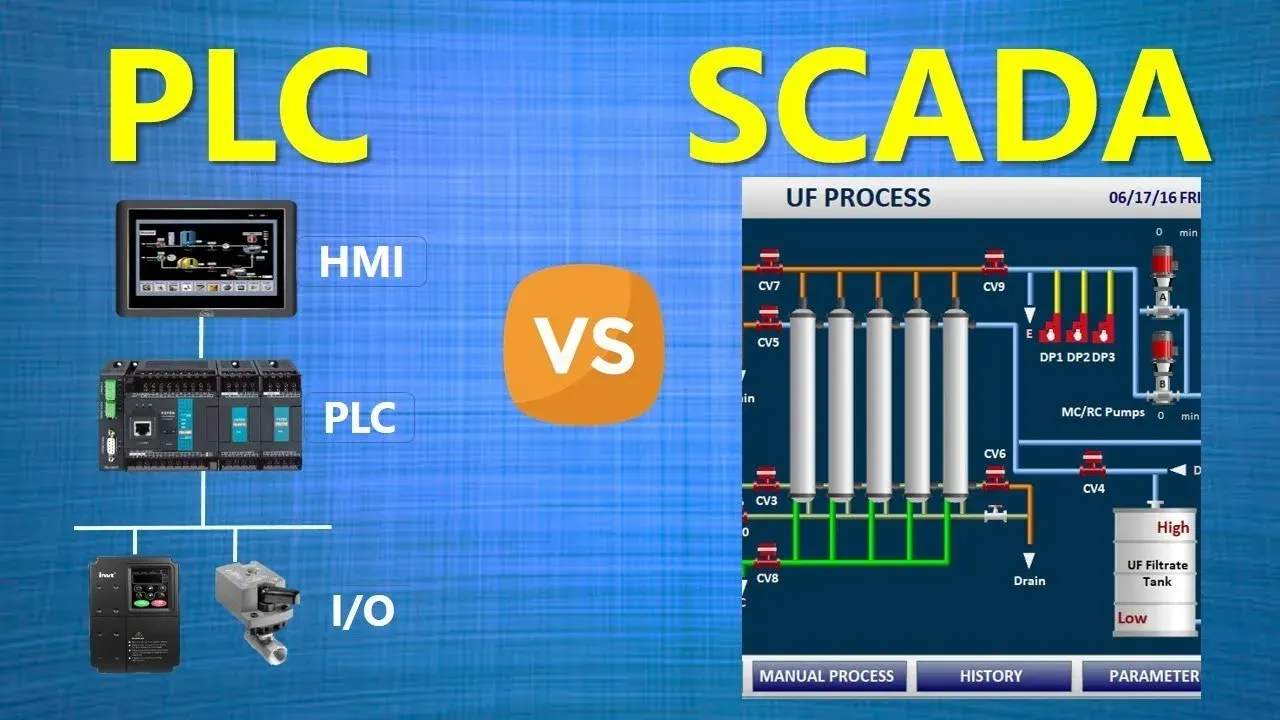
SCADA is the quiet supervisory layer that lets a handful of operators watch and steer processes spread across an entire region. Here is what every control engineer should understand about how it works.
Robotics Integration on the Line
A robot is the easy part. The hard, valuable, and underestimated work is everything around it - the cell, the handshake, and the line it has to fit into.
Sensors & Actuators in Automation
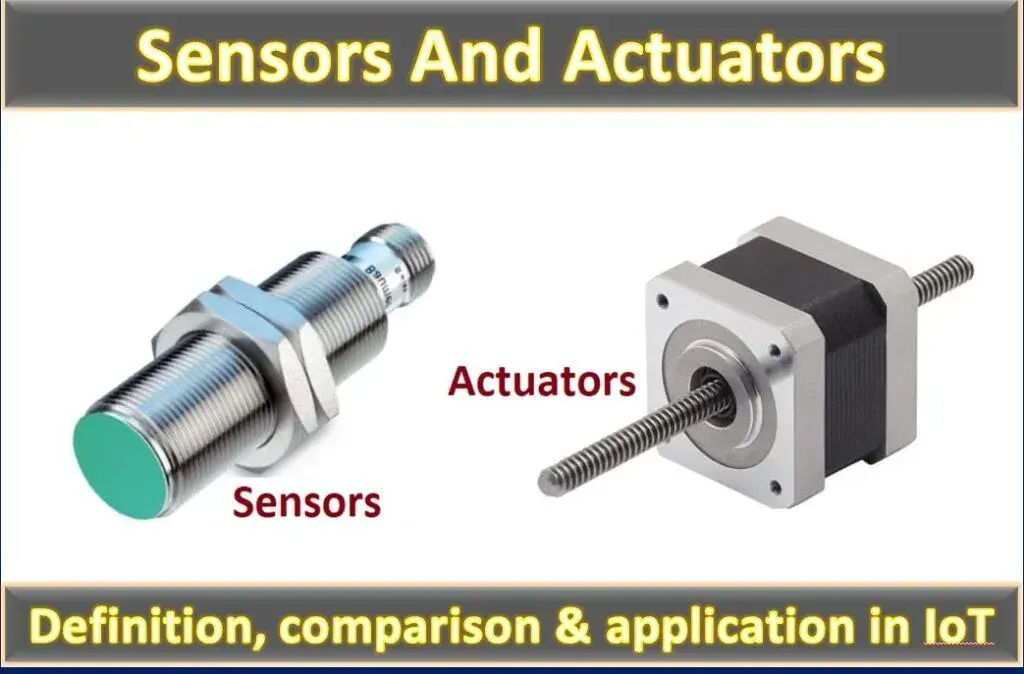
Every automated machine runs on the same three-beat rhythm. Learn the sensors that perceive, the signals that carry the message, and the actuators that act, and you can read almost any machine on the floor.
Comments
No comments yet. Start the conversation.