Cloud Security Posture Basics
The cloud did not make you less secure. It made misconfiguration faster, more visible, and one click away from the entire internet. Here is how to see your own account the way an attacker already does.
TL;DR
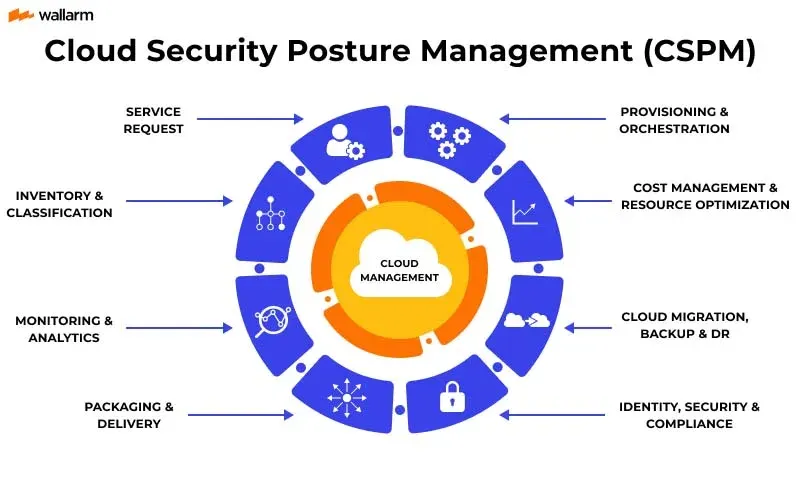
Most cloud breaches are boring: a public storage bucket, an open firewall rule, a leaked access key. Under the shared responsibility model these settings are yours. Cloud security posture management measures misconfigurations continuously, triages what matters and prevents repeats with guardrails and policy as code.
On this page
The breach you will have is boring
When people picture a cloud breach they imagine something cinematic - a nation-state cracking the provider’s hypervisor, a genius exploit chained across a dozen services. The reality is duller and far more common: someone set a storage bucket to public to test something, and forgot. Someone opened a firewall rule to debug a problem at 2am and never closed it. Someone committed an access key to a repository. None of these are exploits. They are settings. And settings are where the overwhelming majority of cloud incidents actually begin.
Gartner’s much-quoted line - that nearly all cloud security failures through 2025 would be the customer’s fault - keeps getting repeated because the breach reports keep proving it. The provider’s half of the stack is run by people who patch hypervisors and harden data centres for a living, and their failures are rare enough to make headlines. Your half is provisioned in seconds by dozens of teams clicking consoles and running pipelines, and every one of those actions is a chance to leave a door open.
The line you are responsible for
Every cloud account runs on a single governing idea: shared responsibility. The provider secures the cloud - the hardware, the host, the physical building. You secure what you put in the cloud. Exactly where that line falls shifts with the service model, but one part never moves: identity, access, and data are always yours. You can outsource the data centre. You cannot outsource the decision to make a bucket public.
Once you internalise that, your security job clarifies enormously. You are not trying to out-engineer a trillion-dollar provider. You are trying to keep your own configuration sane across an environment that changes constantly and exposes its mistakes to the entire internet within minutes. That, and nothing more grandiose, is what “cloud security posture” means.
Posture is a measurement problem
Here is the uncomfortable truth most teams discover on their first audit: nobody actually knows what they have. A mid-sized organisation runs thousands of resources across multiple accounts, regions, and sometimes providers, created by people who have long since moved on. Shadow infrastructure - the instance someone span up for a demo and forgot - is exactly where breaches hide.
So posture starts with the least glamorous step in security: building an inventory. What compute, what storage, what databases, what network rules, what identities and keys - and crucially, how each one is configured. You cannot secure what you cannot see, and you cannot improve what you cannot measure. This is why Cloud Security Posture Management exists as a discipline. It is not the fire brigade fighting a live attack; it is the building inspector and the smoke detector. It continuously answers three questions: what do I have, is any of it misconfigured, and has anything changed since I last looked?
That last question matters more than people expect. A resource is rarely born insecure and left that way. It is configured correctly, then drifts - opened by a hotfix, loosened by a copy-pasted template, granted broad access “just for now.” The point-in-time audit you passed last quarter tells you nothing about today. Posture has to be continuous, because in the cloud a snapshot ages out in hours, not months.
You already know what the scan will find
The remarkable thing about cloud misconfigurations is how few of them there are. Across every provider and every year, the same handful dominate: public storage buckets, security groups open to the world on management ports, missing MFA on admin accounts, wildcard IAM policies, unencrypted data, and logging quietly switched off. Learn those six and you have learned most of what any scanner will ever flag.
And you do not flag them by hand. Open-source tools like Prowler and ScoutSuite read your account through its APIs and grade it against the CIS Benchmarks - free, consensus-built configuration baselines that come with a rationale and a remediation for every check. A first run takes a one-line install and returns a wall of red. The skill is not running the scan; it is what you do with the results.
Triage, then prevent
The first scan of any real account is demoralising. Hundreds of findings, all marked important by the tool. Fix them top to bottom and you will exhaust yourself on the wrong things. The discipline is triage on two axes: how severe is the misconfiguration, and how exposed is the resource. A public bucket of customer data is an emergency you fix today; an unencrypted internal scratch volume is housekeeping for the backlog. Both are “findings.” Only one will end up in a breach report.
Then comes the move that separates a real program from a noise machine: prevention. A scanner detects a public bucket after it exists. A guardrail - an account-level block, an organisation policy that denies the action outright - means it can never be created in the first place. And if the resource came from Infrastructure-as-Code, you fix the Terraform, not just the live setting, then add a scan to the pull request so the same mistake cannot ship again. That is posture maturing: from finding problems, to fixing their source, to making them impossible.
The number that actually matters
The goal is not a perfect score on one heroic audit. New resources guarantee new findings; a zero is a fiction. Good posture looks like a short, falling list of unaddressed high-severity items and a score that trends upward week after week, because measuring and remediating have become routine rather than a fire drill. The cloud gave you the power to break things at scale in seconds. A posture program gives you the power to see and correct at the same speed. Keep that loop turning, and your account stays defensible no matter how fast it grows.
Key takeaways 5
- Most cloud incidents start with misconfiguration, not sophisticated exploits.
- The provider secures the platform; your configuration is your responsibility.
- Posture is a measurement problem: scan continuously, not once a year.
- Fix the riskiest exposures first, then prevent repeats with guardrails.
- Track time-to-fix for critical issues as the key metric.
Watch & learn

Frequently asked questions
What is cloud security posture management (CSPM)?
CSPM is the practice and tooling for continuously checking cloud configurations against security best practices and policies, to find and fix risky misconfigurations.
What are the most common cloud misconfigurations?
Publicly accessible storage, overly permissive firewall rules, unused or over-privileged identities, exposed access keys, disabled logging and unencrypted data.
How do I prevent cloud misconfigurations?
Use infrastructure as code with policy checks, preventive guardrails such as service control policies, secure defaults and automated alerts when risky changes happen.
Go deeper with the free masterclass
Workshop, PDF handbook and curated resources for “Cloud Security Posture Basics”.
Related articles

Cloud Security & IAM Deep Dive
The firewall is not your perimeter anymore. A credential is. Once you accept that, cloud security stops being a checklist and becomes a single discipline - getting identity right.
SSL/TLS & Web Security Basics
The padlock is not a trophy. It is a promise about exactly three things, and understanding what it does and does not cover is the difference between a site that is secure and one that merely looks it.
Object Storage & Data in the Cloud
A bucket is the cheapest thing in the cloud to create and one of the easiest to get wrong. Here is the story of one folder of holiday photos, and how it quietly teaches you everything that matters about storing data in the cloud.
Comments
No comments yet. Start the conversation.