Cloud Cost Optimization (FinOps)
Cloud bills don't spiral because engineers are careless. They spiral because the cloud removed every brake that used to slow spending down. FinOps is how you put the brakes back without killing the speed.
TL;DR
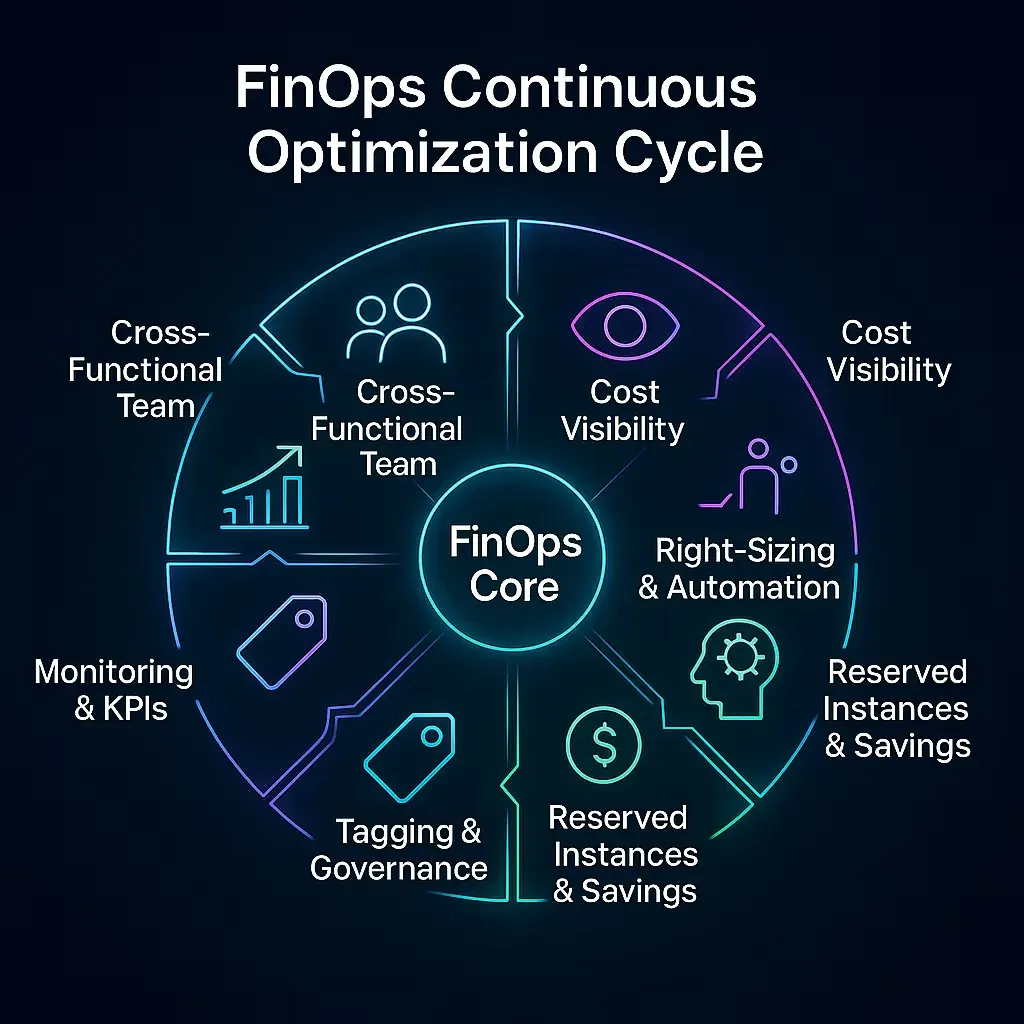
Cloud costs spiral not because engineers are careless but because the cloud removed the purchase orders and procurement that once slowed spending. FinOps restores control through shared cost visibility, ownership, rightsizing, commitments and cleanup, without overcorrecting into cuts that slow the business.
On this page
The friction that disappeared
There was a time when spending more on infrastructure required a purchase order, a procurement cycle, a loading dock, and a person with a screwdriver. That friction was annoying. It was also, in retrospect, a financial control system. Every dollar of new capacity passed through a checkpoint where someone with budget authority had to say yes.
The cloud deleted that checkpoint. Today any engineer with credentials can provision a cluster of expensive machines in seconds, from a laptop, at midnight, with no approval and no visible price tag. This is precisely what makes the cloud powerful: capacity arrives at the speed of thought. It is also precisely why cloud bills behave the way they do. We did not get worse at managing money. We removed the mechanism that used to manage it for us.
FinOps is the discipline that rebuilds that mechanism for a world of self-service, consumption-based, decentralized spending. The name fuses Finance and DevOps, and the fusion is the whole point: financial accountability has to move at the same speed and live in the same place as engineering decisions, because that is where the money is actually spent.
Why finance can’t fix this alone
The instinctive organizational response to a runaway cloud bill is to hand it to finance and ask them to cut it. This fails, predictably, every time. Finance can read the invoice, but they cannot rightsize a database, schedule a dev environment to shut down at night, or refactor a chatty set of microservices that are quietly racking up cross-zone transfer charges. The knowledge required to optimize cloud spend lives almost entirely in the engineering teams that created it.
So the central move of FinOps is not analytical, it is cultural. It puts cost data in front of the people who generate the cost and gives them the ownership to act on it. The central FinOps team does not police spending; it enables it - building the tooling, the benchmarks, the shared vocabulary, and the dashboards that let each team see and manage its own footprint. Accountability is distributed to the edge, where the decisions are made.
The order of operations
Once a team can actually see its spend - which requires disciplined tagging, honest cost allocation, and ideally a unit-cost metric that ties dollars to customers or transactions - the optimization itself follows a sequence that matters more than most people realize.
You delete waste first: the unattached disks, the forgotten snapshots, the idle load balancers, the proof-of-concept stack someone spun up in March and never touched again. Then you rightsize, matching machines to the work they actually do rather than the work someone nervously guessed they might do. Then you schedule non-production resources to stop running on nights and weekends, which alone can erase the majority of a dev environment’s cost. Then you tier storage so cold data stops paying hot-data prices.
Only after all of that do you reach for commitment discounts - reserved instances, savings plans, committed use - which trade a one or three year promise for a substantial cut in the rate. The sequence is not arbitrary. Commitment discounts lock you into a baseline. If you commit before you have shrunk that baseline, you have simply purchased a multi-year subscription to your own waste. The cheapest reserved instance is the one you never had to buy because you turned the machine off.
The trap on the other side
Here is where many cost-optimization efforts go wrong in the opposite direction. Having discovered the satisfaction of cutting, teams keep cutting. They strip reliability margins, they refuse capacity that would capture revenue, they spend expensive engineering hours saving trivial amounts, and they turn every architecture review into a penny-pinching negotiation that drains morale.
This is the race to the bottom, and it misunderstands the entire purpose of the practice. The cheapest possible infrastructure is the one running nothing at all - serving no customers, generating no revenue, advancing nothing. That is not a victory. FinOps is not about minimizing the bill; it is about maximizing value per dollar. Sometimes the correct, disciplined, financially rigorous decision is to spend more - to add the capacity that captures a market, or to pay for the managed service that frees your best engineers from babysitting infrastructure.
The real deliverable
The output of a mature FinOps practice is not a smaller number on an invoice. It is a conversation that finally makes sense. Finance gets forecasts they can plan around. Engineering gets the freedom to move fast without fear of an ugly surprise at month-end. Leadership gets to distinguish, at a glance, between a bill that grew because the business is thriving and a bill that grew because something is broken.
That distinction - efficient growth versus quiet waste - is invisible without the visibility, allocation, and unit economics that FinOps insists upon. Put the brakes back, but keep your foot near the accelerator. The goal was never to slow down. It was to know exactly how fast you are going, and what each mile is worth.
Key takeaways 5
- The cloud removed the friction that used to act as spending control.
- Finance can't fix cloud costs alone; engineers make the spending decisions.
- Start with visibility and tagging, then optimize, then commit.
- Rightsizing, cleanup and reserved or savings plans cut most waste.
- Don't overcorrect; the goal is value per dollar, not the lowest bill.
Watch & learn

Frequently asked questions
What is FinOps?
FinOps is a practice that brings engineering, finance and business teams together to manage cloud spending, making costs visible, assigning ownership and optimizing for business value.
How can I reduce my cloud bill?
Tag resources to see who spends what, shut down idle resources, rightsize oversized instances, use autoscaling and buy reserved instances or savings plans for steady workloads.
Who is responsible for cloud costs?
Everyone shares responsibility: engineers make day-to-day spending decisions, finance tracks budgets and forecasts, and leadership sets priorities. FinOps creates the shared visibility to make this work.
Go deeper with the free masterclass
Workshop, PDF handbook and curated resources for “Cloud Cost Optimization (FinOps)”.
Related articles
Cloud Foundations for Engineers
The old joke says the cloud is just someone else's computer. It is right - and once you take that literally, everything about cloud engineering starts to make sense.

Technical SEO: Making Your Site Crawlable & Indexable
Great content can be invisible to search engines if the plumbing is broken. Technical SEO is that plumbing -- here is how crawling, indexing, speed, and structured data decide whether your pages exist at all.
IIoT: Sensor-to-Cloud Data Pipelines
Everyone wants the dashboard and the digital twin. Almost nobody wants to talk about the pipes that feed them - which is exactly why so many Industry 4.0 projects stall.
Comments
No comments yet. Start the conversation.