When the Center Cannot Hold: Achebe's "Things Fall Apart"
In one breath
Chinua Achebe's Things Fall Apart tells African history from an African viewpoint. In an Igbo village in what is now Nigeria, proud and rigid Okonkwo rises by his own efforts, but his flaws and the arrival of British missionaries and administrators destroy both him and the rich society around him.
On this page
Chinua Achebe’s Things Fall Apart is one of the most important and widely read novels to come out of Africa, a landmark work that did something revolutionary: it told the story of African society and the coming of European colonialism from the African point of view, in all its dignity, complexity, and tragedy. Set in an Igbo village in what is now Nigeria, it follows Okonkwo, a proud, strong, deeply flawed man, a great wrestler and warrior who has risen by his own efforts to a position of respect in his community. Through Okonkwo’s story, and the arrival of British missionaries and colonial administrators, Achebe shows a rich, ordered, fully human African world, and then the tragedy of its disruption and destruction. The title, from Yeats, captures it: “things fall apart; the centre cannot hold.”
Here is what Things Fall Apart taught me about a world rendered whole, about the tragedy of cultural collapse, and about reclaiming the African story.
Key takeaways
- Pre-colonial Igbo society is shown as rich, complex, and fully human, not “primitive.”
- Okonkwo is a proud, flawed, tragic hero whose rigidity destroys him.
- Colonialism brings cultural disruption, and “things fall apart.”
- Achebe writes back against colonial literature, telling the story from within.
- Tragedy is both personal and collective, Okonkwo’s fall and his society’s.
A world rendered whole
The first and most important achievement of Things Fall Apart is the way it presents pre-colonial Igbo society as a rich, complex, fully realised human world, with its own customs, religion, governance, art, proverbs, humour, and moral order. Achebe takes great care to show this society in all its texture and depth, neither idealising it (he depicts its harshnesses, its treatment of outcasts and twins, its violence) nor reducing it to the “primitive,” “savage” caricature that colonial literature had so long imposed. He shows a functioning, sophisticated civilisation, with a real and coherent way of life. This was a profound corrective. Generations of Western readers had encountered Africa only through the distorting lens of colonial fiction, where Africans appeared as a faceless backdrop. Achebe insisted on the full humanity and complexity of his people, and in the first half of the novel, simply and powerfully, he shows us their world as it was, from the inside.
The tragedy of collapse
The novel’s drama is the tragedy of this world’s disruption, enacted through the personal tragedy of Okonkwo. Okonkwo is a classic tragic hero: strong, proud, accomplished, but driven by a deep fear of weakness (he is haunted by the memory of his gentle, “failed” father) into a rigidity, harshness, and inflexibility that are ultimately his undoing. When British missionaries and then colonial administrators arrive, they begin, at first gradually and then decisively, to dismantle the fabric of Igbo society, its religion, its authority, its way of life. Okonkwo, unable to bend or adapt, unable to bear the humiliation of his world’s subjugation, is destroyed. His personal tragedy, driven by his own flaws, mirrors and embodies the larger tragedy of his society’s collapse under colonialism. The two are inseparable: the rigid man and the disrupted world fall together. Achebe achieves something rare, a tragedy that is at once deeply personal and historically vast.
Reclaiming the story
The deepest significance of Things Fall Apart lies in its act of reclamation, of telling the African story from the African side. Achebe was responding directly to the colonial literary tradition, above all to works like Conrad’s Heart of Darkness, which had portrayed Africa as a dark, savage, voiceless backdrop for European drama. By writing a novel that placed a complex African society and a fully human African protagonist at the centre, told with dignity and from within the culture, Achebe wrested the narrative back. The novel’s very ending makes this explicit and devastating: after Okonkwo’s tragedy, the colonial District Commissioner muses that the whole story might make an interesting paragraph in the book he is writing, to be titled “The Pacification of the Primitive Tribes of the Lower Niger.” In that single, chilling stroke, Achebe shows how colonialism reduces a rich human tragedy to a footnote in the coloniser’s self-serving account, and, by having told the full story himself, refutes that reduction. He gives the silenced their voice. It is the same reclamation I found in Salih and Said: the insistence that the colonised are subjects with their own stories, not objects in someone else’s.
What I’m taking with me
Things Fall Apart is a foundational work of world literature, and its power and importance are undiminished. What I am taking from Achebe is his rendering of pre-colonial African society as a rich, complex, fully human world, a vital corrective to colonial caricature; the double tragedy of Okonkwo and his society, personal and collective, falling together; and above all the act of reclaiming the story, telling it from within, refusing to let the colonised remain a voiceless backdrop in someone else’s tale. Achebe gave Africa, and world literature, a novel that insists, with dignity and tragic power, on the full humanity of a people the dominant story had erased.
Frequently asked questions
What is Things Fall Apart about?
It is Chinua Achebe’s landmark novel about Okonkwo, a proud Igbo man in pre-colonial Nigeria, and the disruption of his society by British colonialism. It tells the African story from the inside, with dignity and tragic power.
What does the title “Things Fall Apart” mean?
It comes from Yeats’s poem “The Second Coming” (“things fall apart; the centre cannot hold”) and refers to the collapse of Igbo society’s order and cohesion under the disruptive impact of colonialism.
Why is Things Fall Apart so important?
Because it tells the story of African society and colonialism from the African point of view, presenting a rich, complex human world and reclaiming the narrative from colonial literature that had reduced Africa to a savage, voiceless backdrop.
References & further reading
- Achebe, Chinua. Things Fall Apart. William Heinemann, 1958.
- Achebe, Chinua. “An Image of Africa: Racism in Conrad’s Heart of Darkness.” 1977.
- Innes, C. L. Chinua Achebe. Cambridge University Press, 1990.
Watch: others on this book


Read along with me
Book notes, philosophy and the ideas that shape how we build. New essays every month, no spam.
Related reading notes
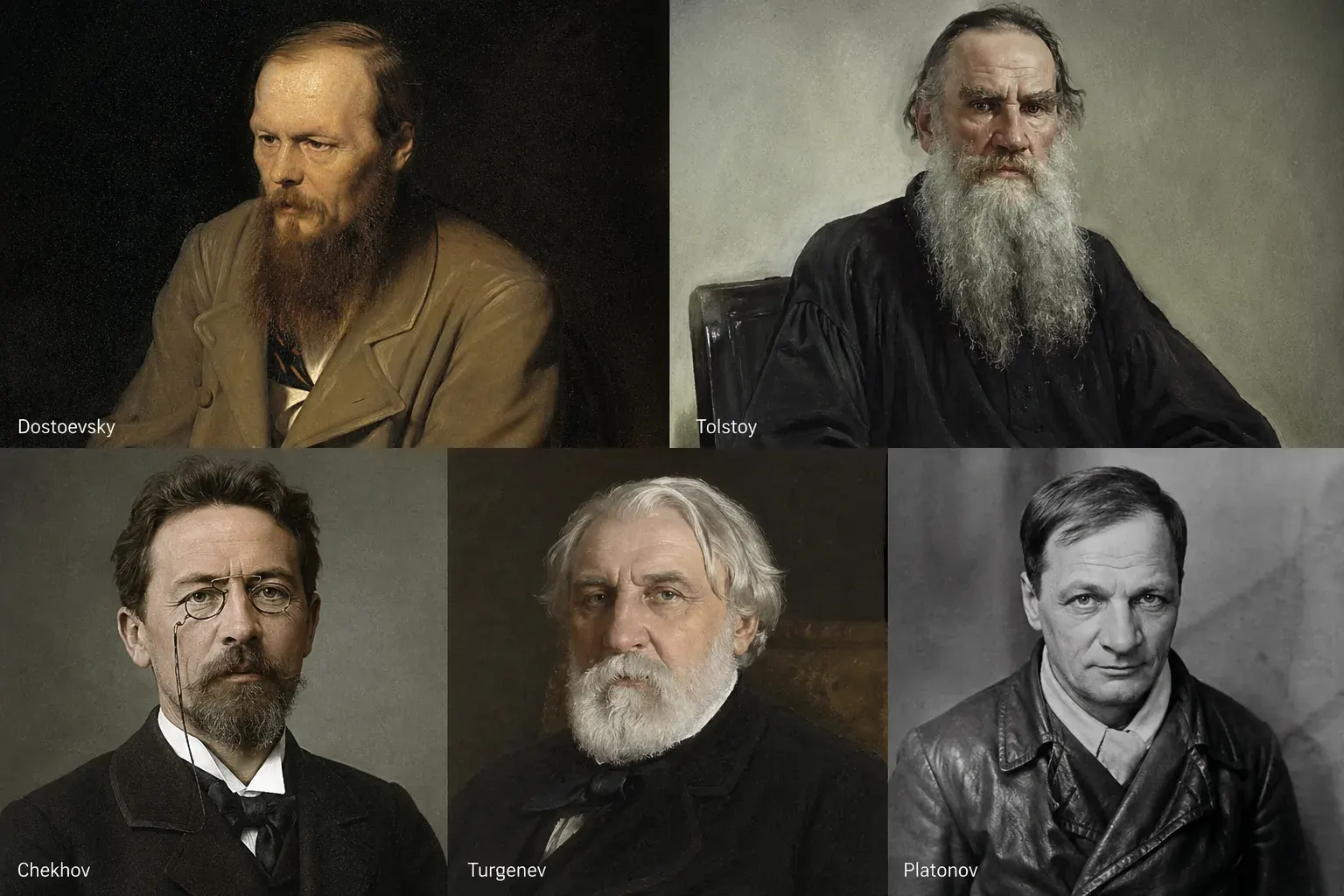
Dostoevsky, Tolstoy, Chekhov, Turgenev and Platonov
Where to start with Russian literature: essential works by Dostoevsky, Tolstoy, Chekhov, Gogol, Turgenev and Platonov, and why each is worth reading.
The Man Who Would Not Rise: Goncharov's "Oblomov"
Goncharov's Oblomov: the kindly man who cannot get off his couch, what Oblomovism means and why this comedy of inertia is a gentle tragedy.
The Starving Mind: Knut Hamsun's "Hunger"
Knut Hamsun's Hunger (1890): a starving writer's mind in Kristiania, the birth of the psychological novel and the strange pride of the destitute.
Comments
No comments yet. Start the conversation.