Tilting at Windmills: Idealism and Madness in Cervantes' "Don Quixote"
In one breath
Don Quixote, often called the first modern novel, follows an aging gentleman who reads so many chivalric romances that he becomes a knight-errant, charging windmills he takes for giants with his earthy squire Sancho Panza. Beneath the comedy, Cervantes finds both folly and dignity in the impossible dream.
On this page
Miguel de Cervantes’s Don Quixote is often called the first modern novel, and four centuries after its publication it remains one of the funniest, saddest, and most profound books ever written. It tells of an aging country gentleman who has read so many tales of chivalry that he loses his wits, takes the name Don Quixote, dons a rusty suit of armour, and rides out to revive knight-errantry, righting wrongs and serving his idealised lady, Dulcinea. Accompanied by his earthy squire, Sancho Panza, he charges windmills he believes are giants, mistakes inns for castles, and is beaten and mocked at every turn. Beneath the comedy lies a deep meditation on idealism and reality, madness and wisdom, that has never stopped giving.
Here is what Don Quixote taught me about idealism and madness, about the dance between Quixote and Sancho, and about the dignity of impossible dreams.
Key takeaways
- Idealism and madness are entangled in the figure of Don Quixote.
- Quixote and Sancho embody the eternal pair of dreamer and realist.
- “Tilting at windmills” became the image of doomed, idealistic struggle.
- The book launched the modern novel, with its rich, self-aware realism.
- There is dignity in the impossible dream, even when the world calls it folly.
Idealism and madness
Don Quixote is mad, there is no doubt; he genuinely believes the windmills are giants, the flock of sheep an enemy army, the peasant girl a noble lady. And yet his madness is of a peculiar, noble kind. He is mad because he believes the world should be better than it is, that there should be honour, justice, chivalry, and beauty, and he is willing to act on that belief whatever the cost, however the world laughs. Cervantes plays a subtle, shifting game with us. We laugh at Quixote’s delusions, and yet we come to admire, even love, the idealism beneath them. Is it pure folly to insist that the world live up to our ideals? Or is there something heroic, something more truly human, in the refusal to accept the world as it is? The novel never quite lets us settle the question, and that is its genius. The line between the fool and the visionary is thinner than we think.
The dreamer and the realist
At the heart of the book is one of literature’s great partnerships: the tall, gaunt, idealistic Don Quixote and his short, round, earthy squire Sancho Panza. Quixote is all soaring imagination and lofty ideals, living in a world of his own making; Sancho is all common sense and bodily reality, concerned with food, comfort, and the donkey, forever pointing out that the giants are only windmills. They are the eternal pair, the dreamer and the realist, idealism and pragmatism, the spirit and the flesh, and the comedy and the wisdom both flow from their endless interplay. But Cervantes does something wonderful as the novel goes on: the two slowly influence each other. Sancho becomes a little more idealistic, even quixotic; Quixote, at moments, more lucid. Neither alone holds the whole truth; each needs the other. In their friendship, head and heart, dream and reality, find a kind of balance no single person could achieve.
The dignity of the impossible dream
What lingers most, after all the comedy, is the strange dignity of Don Quixote’s hopeless quest. He is defeated again and again, beaten, mocked, disillusioned; the world refuses, every time, to be the chivalric romance he wants it to be. And yet there is something magnificent in his refusal to give up the dream, in his insistence on living by a nobler code than the shabby world around him deserves. The phrase “tilting at windmills” has come to mean a foolish, doomed struggle against imaginary enemies, and so it is. But Cervantes leaves us suspecting that a life without any such impossible dream, a life of pure Sancho-like realism, would be smaller, meaner, less human. The most poignant moment comes at the end, when Quixote regains his sanity, renounces his dreams, and promptly dies, as if a life without the dream were no longer worth living. There is a deep question here about whether we should let the world cure us of our ideals.
What I’m taking with me
Don Quixote is endlessly rich, comic and tragic, simple and profound, and it has lost none of its power in four hundred years. What I am taking from Cervantes is the entangling of idealism and madness in his unforgettable hero, and the genuine question of whether insisting the world be better is folly or nobility; the eternal dance of the dreamer Quixote and the realist Sancho, each incomplete without the other; and above all the strange dignity of the impossible dream. I come away laughing at Quixote and, somehow, wanting to be a little more like him, to keep a windmill or two worth charging, and not to let the world cure me entirely of my ideals.
Frequently asked questions
What is Don Quixote about?
It follows an aging gentleman who, maddened by tales of chivalry, becomes the knight Don Quixote and rides out with his squire Sancho Panza to revive knight-errantry, charging windmills he believes are giants. It is a profound comedy about idealism and reality.
What does “tilting at windmills” mean?
It comes from the famous episode where Quixote attacks windmills believing them to be giants. The phrase now means fighting a foolish, doomed battle against imaginary or unbeatable enemies.
Why is Don Quixote called the first modern novel?
For its psychological depth, its realistic and self-aware storytelling, its complex characters who change over time, and its rich interplay of comedy, tragedy, and philosophical reflection, qualities that shaped the novel as a form.
References & further reading
- Cervantes, Miguel de. Don Quixote. (1605/1615; translated by Edith Grossman, Ecco, 2003; or J. M. Cohen, Penguin, 1950.)
- Nabokov, Vladimir. Lectures on Don Quixote. Harcourt Brace Jovanovich, 1983.
- Bloom, Harold. The Western Canon. Harcourt Brace, 1994.
Watch: others on this book


Read along with me
Book notes, philosophy and the ideas that shape how we build. New essays every month, no spam.
Related reading notes
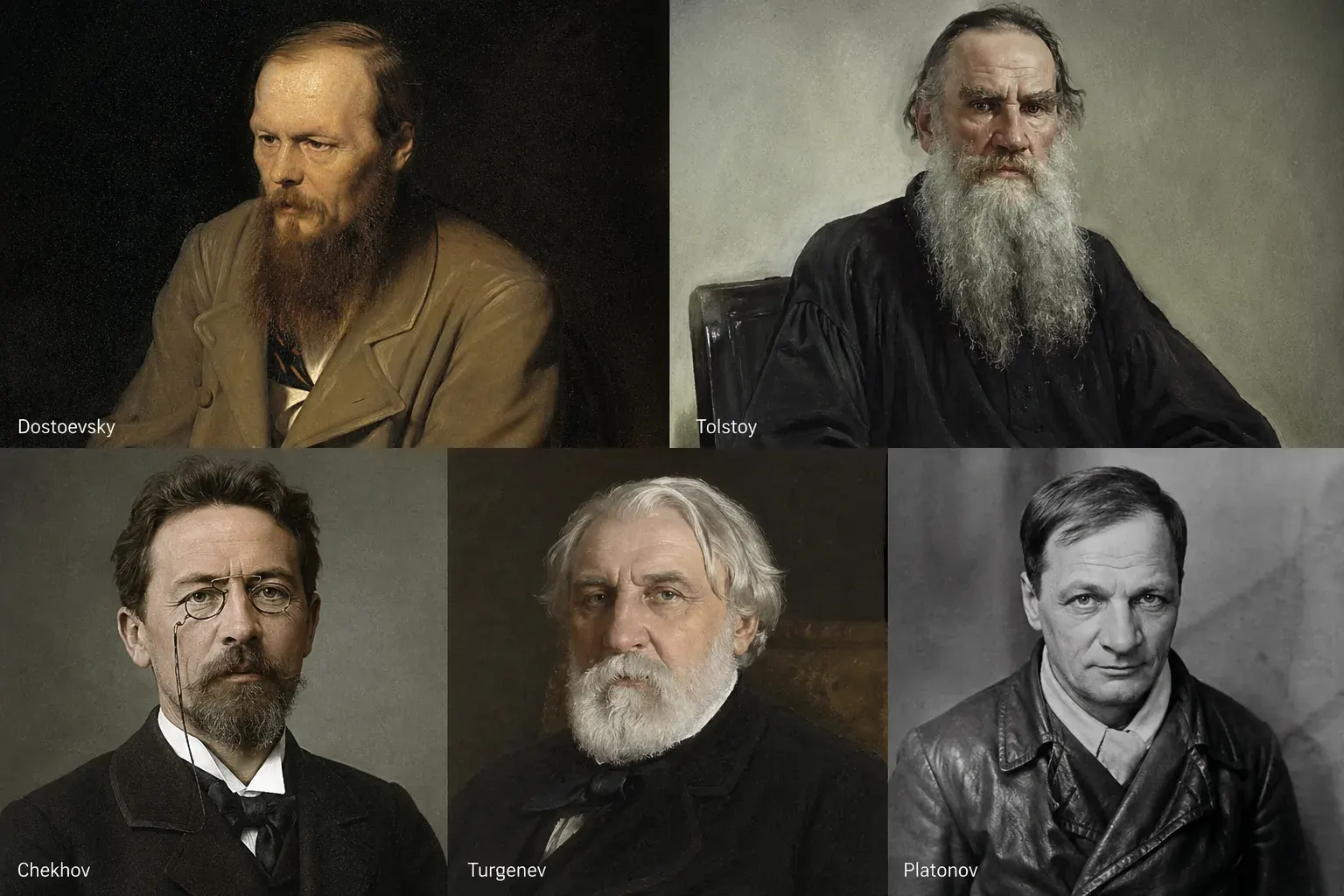
Dostoevsky, Tolstoy, Chekhov, Turgenev and Platonov
Where to start with Russian literature: essential works by Dostoevsky, Tolstoy, Chekhov, Gogol, Turgenev and Platonov, and why each is worth reading.
The Man Who Would Not Rise: Goncharov's "Oblomov"
Goncharov's Oblomov: the kindly man who cannot get off his couch, what Oblomovism means and why this comedy of inertia is a gentle tragedy.
The Starving Mind: Knut Hamsun's "Hunger"
Knut Hamsun's Hunger (1890): a starving writer's mind in Kristiania, the birth of the psychological novel and the strange pride of the destitute.
Comments
No comments yet. Start the conversation.