The Wheel of Fortune: Boethius and the Consolation of Philosophy
In one breath
Boethius wrote The Consolation of Philosophy in prison awaiting execution. Philosophy, appearing as a noble woman, argues him out of despair: Fortune is a turning wheel, what it gives was never truly ours, true happiness lies in the highest good, not wealth or power, and philosophy consoles by changing how we see our fate.
On this page
Boethius wrote The Consolation of Philosophy in a prison cell, awaiting execution on charges he believed were false. He had been one of the most powerful men in the late Roman world, learned, wealthy, honoured, and now he had lost everything and was waiting to die. Out of that extremity came not a cry of rage but a calm, luminous dialogue, in which Philosophy herself appears to him as a noble woman and gently argues him back from despair. Knowing the circumstances of its writing, I could not read this book as a dry exercise. It is a man talking himself out of terror, and succeeding.
Here is what Boethius taught me about the turning of Fortune’s wheel, about where true happiness cannot be found, and about the strange consolation that thought can offer in the worst of times.
Key takeaways
- Fortune is a turning wheel; raising and lowering us is simply what it does.
- What Fortune gives was never truly ours, so losing it is no real loss of self.
- True happiness is not in external goods, wealth, fame, or power, but in the highest good itself.
- Evil, in the end, is a kind of weakness, and the wicked harm themselves most of all.
- Philosophy can console even where it cannot rescue, by changing how we see our fate.
The wheel of Fortune
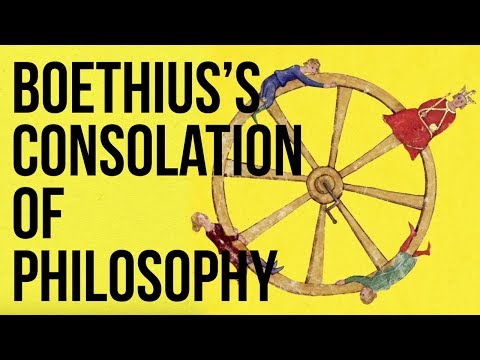
Boethius begins in self-pity, lamenting how cruelly Fortune has treated him. Philosophy answers with the image the whole Middle Ages would inherit: Fortune is a wheel, forever turning, and to ride it up is to accept that it will also carry you down. This is the game, and Fortune plays it openly; she promised nothing else. To complain that she has taken back what she lent is to misunderstand the whole arrangement. I found this oddly steadying. So much of my own distress comes from a hidden assumption that good fortune is owed to me, that I am entitled to keep what I have gained. Boethius reminds me that everything Fortune gives is on loan, and that expecting otherwise is the root of needless grief.
Where happiness really lives
Philosophy then leads Boethius through the usual candidates for happiness, wealth, status, power, fame, pleasure, and shows that each is partial and unstable, unable to deliver the complete and lasting satisfaction we are really after. They are not happiness itself but scattered, broken images of it. True happiness, she argues, must be found in the highest good, the unchanging source from which all lesser goods borrow their value, and which alone cannot be taken away by the turning of the wheel. Whatever one makes of the theology, the underlying observation is shrewd: the things we chase to feel secure are precisely the things most easily lost, which is why they can never make us secure.
Consolation as a change of vision
What moves me most about this book is what kind of help it offers. Philosophy does not get Boethius out of prison. She does not stop the execution. What she changes is his vision, his understanding of his situation, until the same facts no longer crush him. This is consolation in its deepest sense, not the removal of suffering but the transformation of how it is borne. There is a lesson here about the real power and the real limit of thought. It cannot always alter our circumstances. It can alter the person who meets them, and sometimes that is the only freedom left, and enough.
What I’m taking with me
The Consolation of Philosophy is one of the most quietly courageous books I have read, precisely because of where and how it was written. What I am taking from it is the image of Fortune’s wheel as a cure for entitlement, the reminder that lasting happiness cannot be built on things that can be seized from me, and the deeper consolation that even when I cannot change what is happening, I can change how I understand and bear it. Boethius died not long after finishing it. The book outlived his executioners by fifteen hundred years.
Frequently asked questions
What is The Consolation of Philosophy about?
Written by Boethius while imprisoned and awaiting execution, it is a dialogue in which Philosophy consoles him by explaining the nature of fortune, the instability of worldly goods, and where true happiness is found.
What is the “wheel of Fortune” in Boethius?
An image of how luck constantly raises and lowers people. Since rising and falling is simply what Fortune does, we should not be shocked when it takes back what it once gave.
Why is the book still important?
It was one of the most influential works of the Middle Ages, bridging classical philosophy and Christian thought, and it remains a profound meditation on how to face loss, injustice, and death.
References & further reading
- Boethius. The Consolation of Philosophy. (Translated by V. E. Watts, Penguin Classics, 1969; or Richard Green, 1962.)
- Chadwick, Henry. Boethius: The Consolations of Music, Logic, Theology, and Philosophy. Oxford University Press, 1981.
- Lewis, C. S. The Discarded Image. Cambridge University Press, 1964.
Watch: others on this book

Read along with me
Book notes, philosophy and the ideas that shape how we build. New essays every month, no spam.
Related reading notes
Ancient Wisdom Meets Modern Psychology: Haidt's "The Happiness Hypothesis"
Haidt's The Happiness Hypothesis tests ancient wisdom about happiness against modern psychology: the elephant and the rider, relationships and meaning.
Philosophy as Spiritual Exercise: Pierre Hadot's "Philosophy as a Way of Life"
Pierre Hadot's Philosophy as a Way of Life: ancient philosophy as spiritual exercises for transforming the self, and how to recover that practice.
The Greatest Happiness Principle: Mill's "Utilitarianism"
John Stuart Mill's Utilitarianism is the classic defence of one of the most influential, and most intuitive, moral theories ever devised.
Comments
No comments yet. Start the conversation.