The Starry Heavens and the Moral Law: Kant's "Critique of Practical Reason"
In one breath
In the Critique of Practical Reason, Kant builds the full structure of his ethics. The moral law is a fact of reason known through duty; because we ought to act morally, we must be free; morality requires postulating freedom, immortality and God; and awe before the moral law within matches awe before the starry heavens.
On this page
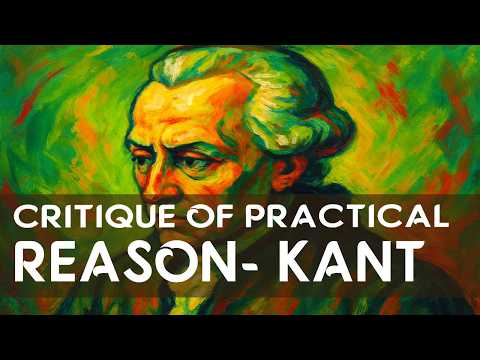
Immanuel Kant’s Critique of Practical Reason is his great work on morality and freedom, and it contains one of the most beautiful sentences any philosopher ever wrote: two things fill the mind with ever new and increasing admiration and awe, the starry heavens above me and the moral law within me. That single line captures Kant’s whole sense of wonder, that the same human being who is a tiny speck beneath the vast indifferent cosmos is also the bearer of a moral law of absolute dignity and authority. Where the Groundwork laid out the basics of his ethics, this book builds the full structure, and asks what morality requires us to believe about freedom, the soul, and God.
Here is what the Critique of Practical Reason taught me about the reality of freedom, about morality as the voice of reason, and about the awe Kant felt before the law within.
Key takeaways
- The moral law is a fact of reason, known directly through our sense of duty.
- “Ought implies can”: because we ought to act morally, we must be free.
- Freedom, immortality, and God are postulates that morality requires.
- Morality is autonomy: giving the law to ourselves through reason.
- Awe before the moral law within matches awe before the starry sky.
The fact of the moral law
Kant’s starting point is bold. We cannot prove the moral law the way we prove a theorem, but we do not need to, because we encounter it directly, as what he calls a “fact of reason.” When I feel the pull of duty, the inner conviction that I ought to do something even against my interests and desires, I am experiencing the moral law itself, immediately and undeniably. This sense of obligation is not derived from anything else; it is the bedrock. Whatever our theories, we all know the experience of the inner “ought,” the voice that says “you should” even when every inclination says “you would rather not.” Kant builds his entire ethics on taking that experience seriously, as a genuine deliverance of reason rather than a mere feeling.
The argument for freedom
From this fact of moral obligation, Kant draws his most important conclusion: that we must be free. His reasoning is captured in the famous principle that “ought implies can.” It makes no sense to say I ought to do something unless I am able to do it; obligation presupposes the capacity to choose. Since I genuinely experience moral obligation, I must therefore be genuinely free, free to act against my desires and inclinations, free to determine myself by reason. This is Kant’s answer to the threat of a purely mechanical universe in which everything, including us, is determined by prior causes. The moral law within is the proof, he argues, that we are more than cogs in that machine. Our very experience of duty testifies to our freedom.
The postulates of morality
Kant then makes a striking move. There are certain things, he says, that we cannot prove by theoretical reason but that morality requires us to postulate, to assume as conditions of the moral life. Freedom is one; without it, morality is meaningless. He also argues for the immortality of the soul, since the moral perfection we are commanded to pursue cannot be completed in one finite life, and for the existence of God, as the power that can finally unite virtue with happiness. These are not proofs in the ordinary sense; they are, Kant says, postulates of practical reason, beliefs that the moral life rationally requires. I find this a fascinating reversal. Having limited what theoretical reason can know, Kant argues that morality opens a door, on practical grounds, to the very things metaphysics could not establish.
What I’m taking with me
The Critique of Practical Reason is demanding, but its spirit is captured in that one luminous image of the starry heavens and the moral law. What I am taking from Kant is his profound respect for the inner sense of duty as a fact to be reckoned with rather than explained away; his argument that our experience of obligation testifies to our freedom; and above all his vision of morality as autonomy, as the dignity of a being who gives the law to itself through reason. Kant looked up at the indifferent stars and inward at the moral law, and felt the same awe at both. After reading him, so do I.
Frequently asked questions
What is Kant’s Critique of Practical Reason about?
It is Kant’s systematic account of morality and freedom, arguing that the moral law is a fact of reason, that this obligation proves we are free, and that morality requires us to postulate freedom, immortality, and God.
What does “ought implies can” mean?
Kant’s principle that we can only be obligated to do what we are able to do. Since we genuinely experience moral obligation, we must therefore be genuinely free to act on it.
What did Kant mean by “the starry heavens above and the moral law within”?
His expression of awe at two things: the vast physical universe that dwarfs us, and the moral law inside us that gives us dignity. The same small human being belongs to both.
References & further reading
- Kant, Immanuel. Critique of Practical Reason. (1788; translated by Lewis White Beck, 1956.)
- Beck, Lewis White. A Commentary on Kant’s Critique of Practical Reason. University of Chicago Press, 1960.
- Korsgaard, Christine M. Creating the Kingdom of Ends. Cambridge University Press, 1996.
Watch: others on this book

Read along with me
Book notes, philosophy and the ideas that shape how we build. New essays every month, no spam.
Related reading notes
The Categorical Imperative: Kant on Duty and the Moral Law
Kant's categorical imperative explained: the good will, universal laws, treating people as ends in themselves and the foundation of human dignity.
The Power of Intellectual Enjoyment: What I Learned from Kant's Critique of Pure Reason
When I first picked up Immanuel Kant's Critique of Pure Reason, I had no idea how profoundly it would shape my understanding of intellectual fulfillment.
Freedom and Responsibility: Simone de Beauvoir's "The Ethics of Ambiguity"
Simone de Beauvoir's The Ethics of Ambiguity: how existentialist freedom grounds an ethics of responsibility and willing the freedom of others.
Comments
No comments yet. Start the conversation.