Freedom and Responsibility: Simone de Beauvoir's "The Ethics of Ambiguity"
In one breath
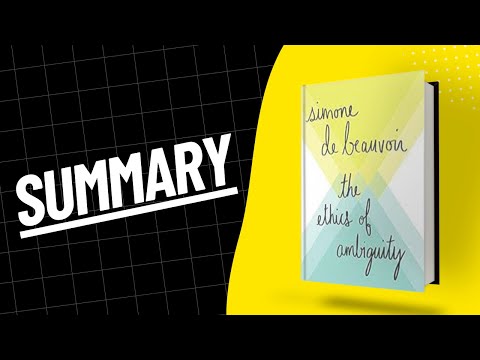
If we are radically free and there are no given values, can there be ethics? In The Ethics of Ambiguity, Simone de Beauvoir answers better than Sartre: we are both free and limited, and authentic freedom requires willing the freedom of others, which makes oppression the great wrong.
On this page
Simone de Beauvoir’s The Ethics of Ambiguity takes on a problem that haunts existentialism: if we are radically free and there are no pre-given values, as Sartre argued, then how can there be any ethics at all? Doesn’t total freedom mean anything goes? Beauvoir, a brilliant philosopher in her own right and too often treated as merely Sartre’s companion, answers this question more convincingly than Sartre himself did. She accepts the existentialist starting point, our freedom and the absence of given meaning, and shows that, far from making ethics impossible, it is the very ground of a genuine ethics, one built on freedom, responsibility, and our deep entanglement with the freedom of others.
Here is what The Ethics of Ambiguity taught me about embracing the ambiguity of our condition, about willing the freedom of others, and about the ways we flee from freedom.
Key takeaways
- The human condition is “ambiguous”: we are both free subjects and limited, embodied objects.
- An authentic ethics embraces this ambiguity rather than denying it.
- My freedom requires willing the freedom of others; we are interdependent.
- Oppression is the great wrong: it denies others their freedom.
- There are ways of fleeing freedom, from the “sub-man” to the “serious man.”
Embracing ambiguity
Beauvoir’s central insight is in her title. The human condition, she argues, is fundamentally ambiguous: we are at once free, conscious subjects who transcend our circumstances, and finite, embodied, mortal beings limited by our bodies, our history, and the world. We are neither pure freedom nor mere things, but an uncomfortable mixture of both. Most ethical systems and most people try to escape this ambiguity, fleeing into one side or the other. Beauvoir’s bold claim is that an authentic ethics must instead embrace the ambiguity, accept that we are both free and limited, and build a way of living on that honest foundation. This struck me as wiser than the cleaner systems. Real human life is ambiguous, and an ethics that pretends otherwise will be false to who we actually are.
Willing the freedom of others
Beauvoir’s most important ethical move is to show why freedom is not the license for selfishness it might seem. My own freedom, she argues, is not an isolated thing; it is bound up with the freedom of everyone else. I cannot meaningfully pursue my own projects and freedom in a vacuum; I need a world of other free people, and my freedom is realised through and alongside theirs. Therefore, to will my own freedom authentically is also to will the freedom of others. This is how Beauvoir derives an ethics from existentialism: genuine freedom commits me to supporting, not crushing, the freedom of my fellow human beings. From this follows her powerful condemnation of oppression, which is precisely the denial of others’ freedom, the great ethical wrong. Far from “anything goes,” existentialist freedom turns out to demand solidarity and a fierce opposition to tyranny.
The ways we flee freedom
Beauvoir offers a fascinating gallery of the ways people evade their freedom, the various forms of inauthentic existence. There is the “sub-man,” who flees freedom into apathy and indifference, refusing to engage with life at all. There is the “serious man,” perhaps the most common, who escapes the burden of choosing his own values by absolutising some external cause, nation, religion, ideology, money, treating it as an unquestionable absolute and surrendering his freedom to it. And there are others, the nihilist, the adventurer, each a different strategy for avoiding the anxious responsibility of genuine freedom. I recognised the “serious man” especially; it is so tempting to hand my freedom over to some external absolute that will make my choices for me. Beauvoir’s typology is a mirror, and not always a comfortable one.
What I’m taking with me
The Ethics of Ambiguity is, to my mind, the most successful attempt to build a positive ethics on existentialist foundations, and Beauvoir deserves to be read as the major philosopher she was. What I am taking from it is the wisdom of embracing rather than denying the ambiguity of being both free and limited; the crucial insight that my freedom is bound up with the freedom of others, so that authentic freedom demands solidarity and opposition to oppression; and her sharp catalogue of the ways we flee our own freedom, especially the “serious man” who hides behind an absolute. Beauvoir shows that freedom, rightly understood, is not an excuse for selfishness but a profound responsibility, to ourselves and to one another.
Frequently asked questions
What is The Ethics of Ambiguity about?
It is Simone de Beauvoir’s attempt to build an ethics on existentialist foundations, arguing that our radical freedom, rather than making ethics impossible, grounds a morality based on responsibility and willing the freedom of others.
What does Beauvoir mean by “ambiguity”?
That human beings are at once free, conscious subjects and finite, embodied, limited beings. An authentic ethics, she argues, embraces this dual condition rather than denying either side.
How does Beauvoir derive ethics from freedom?
By showing that my freedom depends on and is realized alongside the freedom of others. To will my own freedom authentically is to will theirs too, which is why oppression, the denial of others’ freedom, is the central wrong.
References & further reading
- Beauvoir, Simone de. The Ethics of Ambiguity. (1947; translated by Bernard Frechtman, Philosophical Library, 1948.)
- Bair, Deirdre. Simone de Beauvoir: A Biography. Summit Books, 1990.
- Warnock, Mary. Existentialism. Oxford University Press, 1970.
Watch: others on this book

Read along with me
Book notes, philosophy and the ideas that shape how we build. New essays every month, no spam.
Related reading notes
One Is Not Born a Woman: Simone de Beauvoir's "The Second Sex"
Simone de Beauvoir's The Second Sex: woman as the Other, "one is not born a woman" and the foundation it laid for modern feminism.

Condemned to Be Free: Sartre's "Existentialism Is a Humanism"
Sartre's Existentialism Is a Humanism explained: existence precedes essence, condemned to be free, bad faith and choosing for all humanity.
Bad Faith and the Look of the Other: Sartre's "Being and Nothingness"
Sartre's Being and Nothingness explained: bad faith, the Look of the Other and why we are condemned to be free, and how these ideas show up every day.
Comments
No comments yet. Start the conversation.