Private Wealth, Public Squalor: Galbraith's "The Affluent Society"
In one breath
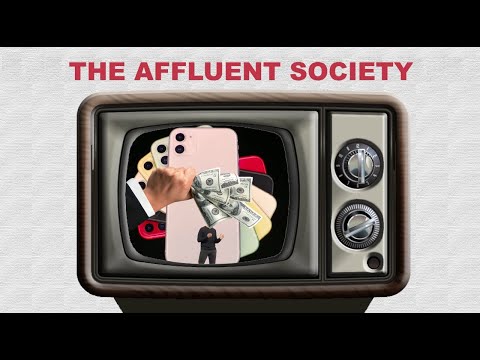
In The Affluent Society, John Kenneth Galbraith argues that rich post-war societies solved mass scarcity but kept thinking as if they hadn't. The result is private opulence and public squalor: abundant private goods, neglected public ones, and wants manufactured by advertising. He asks what affluence is for.
On this page
John Kenneth Galbraith’s The Affluent Society is a landmark of economic thought, an elegant, witty, and influential book that challenged the assumptions of post-war prosperity and gave us several phrases, including the very title, that have entered common usage. Galbraith, one of the most readable economists who ever lived, argued that the rich societies of the mid-twentieth century had reached a historic turning point: for the first time, mass poverty was no longer the central economic problem, and yet economic thinking and policy remained trapped in the assumptions of an age of scarcity. The result, he argued, was a society of enormous private wealth alongside neglected, impoverished public goods, a striking imbalance he memorably called “private opulence and public squalor.” It is a book that questions what affluence is really for, and its central questions remain strikingly relevant.
Here is what The Affluent Society taught me about the “conventional wisdom,” about private opulence and public squalor, and about questioning the purpose of affluence.
Key takeaways
- The “conventional wisdom” persists even when reality has changed.
- Affluent societies have largely solved the old problem of mass scarcity.
- “Private opulence and public squalor”: rich in private goods, poor in public ones.
- Wants are manufactured by production itself, through advertising.
- We should ask what affluence is for, and invest in the public realm.
The conventional wisdom
Galbraith gave us the phrase “the conventional wisdom,” and the concept is one of the book’s most useful tools. The conventional wisdom is the body of familiar, comfortable, widely accepted ideas, the things “everybody knows”, that dominate economic and social thinking. Its great flaw, Galbraith argues, is that it tends to persist long after the conditions that gave rise to it have changed, because it is comfortable, reassuring, and serves established interests, not because it remains true. People cling to familiar ideas and resist new ones, even when reality has moved on. Galbraith’s central charge is that the conventional economic wisdom of his day was still shaped by the age of scarcity, by the assumption that the overriding economic problem is producing enough to overcome want, when in fact the rich societies had largely solved that problem. The lesson is a permanently valuable one: to be wary of “what everybody knows,” to ask whether our accepted ideas still fit the world as it actually is, or merely flatter our habits and interests. It is a call to examine our assumptions rather than mistake the familiar for the true.
Private opulence and public squalor
The book’s most famous and powerful argument concerns the imbalance between private and public wealth. Galbraith observed that affluent societies poured their resources and ingenuity into the production of private consumer goods, ever more cars, gadgets, and luxuries, while starving the public realm of investment. The result was a jarring contrast: private opulence alongside public squalor. He painted the unforgettable picture of a family riding in a sleek, well-appointed automobile, filled with private comforts, through cities of decaying public infrastructure, past underfunded schools, polluted air, litter-strewn parks, and neglected public services, to picnic by a polluted stream. Tremendous private wealth, shabby public goods. Galbraith argued that this imbalance was neither natural nor rational but a product of our priorities and our outdated thinking, which valued private production above all and neglected the public investments, in education, infrastructure, health, the environment, on which a genuinely good society depends. The phrase has lost none of its force; the contrast between gleaming private wealth and crumbling public goods is one anyone can recognise in many prosperous societies today, and Galbraith’s challenge to rebalance the two remains pointed.
Questioning the purpose of affluence
Underlying these arguments is a deeper, almost philosophical questioning of what affluence is actually for. Galbraith challenged the assumption that ever-increasing production of private goods is the proper and unquestionable goal of economic life. He argued, provocatively, that in an affluent society many of our “wants” are not genuine or urgent needs but are manufactured by the production process itself, created by advertising and salesmanship to ensure that the goods produced will be bought, the “dependence effect,” in which production creates the very wants it then satisfies. If many of our wants are artificially generated to keep the machine running, then the endless pursuit of more private production loses its obvious justification, and we are free to ask harder questions: what is all this affluence for? Once a society is rich enough to meet real needs, should it keep pouring everything into manufacturing new private wants, or should it redirect its wealth toward the public goods, the leisure, the quality of life, the genuine human flourishing that money might actually serve? Galbraith pressed his society, and presses us, to stop taking the goal of ever-more private consumption for granted, and to ask what we truly want our wealth to achieve.
What I’m taking with me
The Affluent Society is a witty, humane, and bracing book, and its central insights feel remarkably undated. What I am taking from Galbraith is the useful, skeptical concept of “the conventional wisdom,” and the discipline of asking whether our accepted ideas still fit reality; his memorable diagnosis of “private opulence and public squalor,” the imbalance between lavish private wealth and neglected public goods; and his deeper challenge to question what affluence is really for, rather than assuming ever-more private production is the goal. In our own age of great private wealth alongside strained public services and manufactured wants, Galbraith’s questions feel pressing: whether we have our priorities right, what we are neglecting in the public realm, and what, in the end, we actually want our prosperity to be for.
Frequently asked questions
What is The Affluent Society about?
It is John Kenneth Galbraith’s 1958 critique of post-war prosperity, arguing that affluent societies cling to outdated ideas from the age of scarcity, neglect public goods in favour of private wealth (“private opulence and public squalor”), and pursue manufactured wants without asking what affluence is for.
What does “private opulence and public squalor” mean?
Galbraith’s phrase for the imbalance in affluent societies between abundant private consumer goods and neglected, underfunded public goods like schools, infrastructure, and the environment.
What is the “dependence effect”?
Galbraith’s idea that in affluent societies many wants are not genuine needs but are manufactured by the production process itself, through advertising, so that production creates the very wants it then satisfies.
References & further reading
- Galbraith, John Kenneth. The Affluent Society. Houghton Mifflin, 1958.
- Galbraith, John Kenneth. The New Industrial State. Houghton Mifflin, 1967.
- Veblen, Thorstein. The Theory of the Leisure Class. 1899.
Watch: others on this book

Read along with me
Book notes, philosophy and the ideas that shape how we build. New essays every month, no spam.
Related reading notes
Conspicuous Consumption: Veblen's "The Theory of the Leisure Class"
Veblen's The Theory of the Leisure Class: conspicuous consumption, conspicuous leisure and why status, not need, drives so much of what we buy.
Exploring Marxism: Lessons from Richard D. Wolff's "Understanding Marxism
Lessons from Richard D. Wolff's Understanding Marxism: class struggle, capitalism's contradictions and worker ownership as economic democracy.
Why Poverty Grows With Progress: Henry George's "Progress and Poverty"
Henry George's Progress and Poverty: why poverty persists amid progress, land and rent, the single tax on land values and unearned wealth.
Comments
No comments yet. Start the conversation.