Faith, Doubt, and the Grand Inquisitor: Dostoevsky's "The Brothers Karamazov"
In one breath
The Brothers Karamazov is a family drama and murder mystery that becomes literature's deepest exploration of faith and doubt. Ivan rebels against a world where innocent children suffer, the Grand Inquisitor argues people prefer security to freedom, and Dostoevsky answers not with logic but with active love.
On this page
The Brothers Karamazov was Dostoevsky’s last and greatest novel, and many readers, myself among them, consider it one of the supreme achievements of the human mind. On the surface it is a family drama and a murder story: an odious father, Fyodor Karamazov, and his three very different sons, and the question of who killed him. But underneath it is the deepest exploration in all of literature of faith and doubt, of whether morality is possible without God, of suffering, freedom, and love. Dostoevsky pours his whole soul into it, and the famous chapter of the Grand Inquisitor alone would secure the book’s immortality.
Here is what The Brothers Karamazov taught me about the problem of suffering, about the terrible bargain offered by the Grand Inquisitor, and about the answer Dostoevsky gives not in argument but in love.
Key takeaways
- The three brothers embody reason and doubt (Ivan), faith and love (Alyosha), and passion (Dmitri).
- Ivan’s rebellion: the suffering of innocent children is the hardest objection to faith.
- The Grand Inquisitor argues that people prefer security to the burden of freedom.
- “If God does not exist, everything is permitted” haunts the whole novel.
- Dostoevsky answers doubt not with logic but with active, humble love.
Ivan’s unanswerable question
The intellectual heart of the novel is the doubter, Ivan Karamazov, and his challenge is the most powerful statement of the problem of evil I have ever read. Ivan does not argue that God does not exist; he says that even if God does exist, he cannot accept a world built on the suffering of innocent children. He recounts, in unbearable detail, real cruelties inflicted on the helpless, and asks: what future harmony, what heavenly reward, could possibly justify the torture of even one innocent child? He “returns his ticket” to such a world. Dostoevsky, a believer, gives the case against God its fullest and most searing expression, refusing to make the objection weak so that faith can win easily. That honesty is part of the book’s greatness.
The Grand Inquisitor
Ivan then tells his brother a “poem,” the legend of the Grand Inquisitor, which may be the most profound few pages in all of fiction. Christ returns to earth during the Spanish Inquisition and is arrested by the old Cardinal, who tells him, astonishingly, that the Church has corrected his work and that he must not return. Christ’s gift of freedom, the Inquisitor argues, was too heavy for ordinary people, who do not want freedom but bread, security, and someone to bow down to. So the Church has taken freedom from them and given them happiness instead, the happiness of obedient children. It is a chilling, brilliant argument, and its power is that it is half true. Dostoevsky saw, long before the totalitarian century, how willingly human beings trade their freedom for comfort and certainty.
The answer of love
How does Dostoevsky respond to Ivan’s devastating case? Not, crucially, with a counter-argument. He knows that the problem of suffering cannot be solved by logic. Instead he answers with a person and a way of life: the gentle Alyosha and his teacher, the elder Zosima, who embody an active, humble, all-embracing love. Against Ivan’s abstract rebellion stands Zosima’s teaching that we are each responsible for everyone and everything, and that the only response to suffering is to love more, concretely and immediately. Christ, in the legend, answers the Inquisitor only with a silent kiss. Dostoevsky’s reply to doubt is not a proof but a practice, the conviction that love, not argument, is the only thing that can redeem a world of suffering. Whether this satisfies the intellect is debatable; that it moves the heart is not.
What I’m taking with me
The Brothers Karamazov is a book to be lived with rather than merely read, and I expect to return to it for the rest of my life. What I am taking from it is its extraordinary fairness, giving doubt its strongest voice in Ivan and the Grand Inquisitor; its terrifying insight into our willingness to trade freedom for security; and its final wager that the answer to suffering is not explanation but love. Dostoevsky does not let faith win cheaply. He makes it earn its place against the hardest objections, and that is why his answer, when it comes, carries such weight.
Frequently asked questions
What is The Brothers Karamazov about?
On the surface it is the story of a father’s murder and his three sons, but its deeper subject is faith and doubt, the problem of suffering, free will, and whether morality is possible without God.
What is the Grand Inquisitor chapter about?
In a story told by Ivan, Christ returns during the Inquisition and is told by the Cardinal that humanity cannot bear the burden of freedom he offered and prefers security and bread, so the Church has taken freedom away “for their own good.”
How does Dostoevsky answer Ivan’s doubts?
Not with logical argument but through the example of Alyosha and the elder Zosima, who embody active, humble love and shared responsibility as the only real response to suffering.
References & further reading
- Dostoevsky, Fyodor. The Brothers Karamazov. (Translated by Constance Garnett; or Richard Pevear and Larissa Volokhonsky, 1990.)
- Frank, Joseph. Dostoevsky: The Mantle of the Prophet, 1871–1881. Princeton University Press, 2002.
- Bakhtin, Mikhail. Problems of Dostoevsky’s Poetics. University of Minnesota Press, 1984.
Watch: others on this book


Read along with me
Book notes, philosophy and the ideas that shape how we build. New essays every month, no spam.
Related reading notes
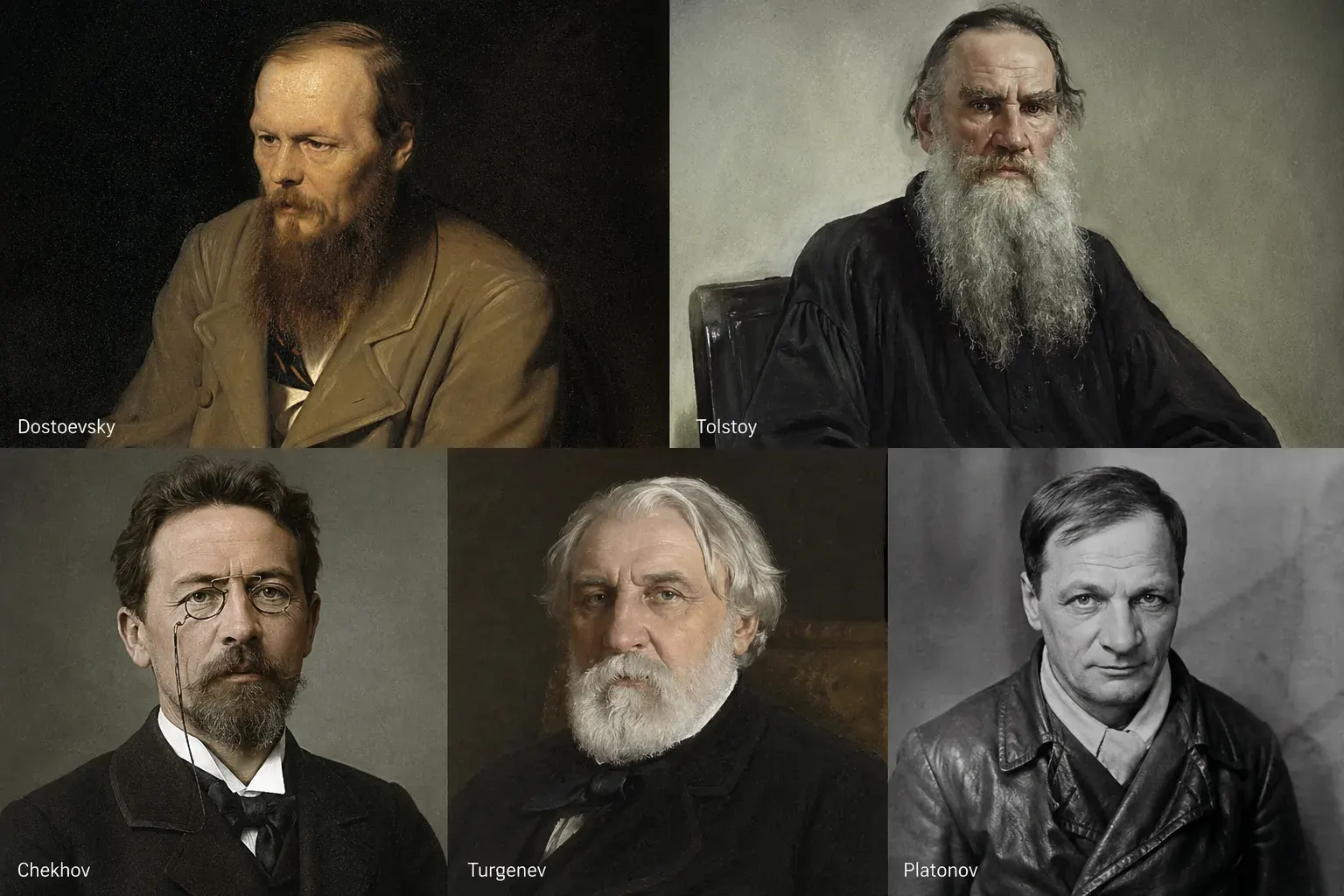
Dostoevsky, Tolstoy, Chekhov, Turgenev and Platonov
Where to start with Russian literature: essential works by Dostoevsky, Tolstoy, Chekhov, Gogol, Turgenev and Platonov, and why each is worth reading.
The Roulette of the Soul: Dostoevsky's "The Gambler"
Fyodor Dostoevsky's The Gambler is a short, intense, and remarkable novel, made all the more fascinating by the famous circumstances of its writing.
The Possessed and the Possibility of Meaning: Dostoevsky’s Warning to the Modern World
Lessons from Dostoevsky's The Possessed (Demons): ideology without morality, the crisis of meaning without faith and why true change begins within.
Comments
No comments yet. Start the conversation.