Contracts & Legal Basics for Consultants
The contract is not the thing that ends the friendship. It is the thing that keeps it.
TL;DR
For consultants, a contract is not a sign of distrust but the thing that protects the relationship, because people remember the same conversation differently. It must define scope, deliverables, payment, IP ownership and how change is handled, which turns scope creep from a personality clash into a process.
On this page
There is a moment, familiar to every consultant, that arrives somewhere around week six of a project. The client says, warmly, “I thought we agreed you’d handle the analytics piece too?” And you, equally warmly and equally certain, did not agree any such thing. Neither of you is lying. You are simply two motivated people remembering the same conversation differently, which is what human beings reliably do. The only question now is whether there is a document that remembers it for you.
For a profession built on advice, consultants are remarkably bad at taking the most basic advice of all: write it down. We treat the contract as a chore that delays the real work, a faint accusation of bad faith, a thing for big companies with legal departments. Then we spend the rest of the engagement paying for that decision in unpaid revisions, vanished invoices, and arguments we cannot win because there is nothing to point at.
The contract is a kindness
Here is the reframe that changes everything: a contract is not a weapon you aim at your client. It is a shared memory you build together while you both still agree. It is the most generous thing you can do for a relationship, because it means that when the inevitable drift happens - in scope, in timeline, in money - neither of you has to be the villain. You do not have to out-argue your client. You both just read the page.
Seen that way, a contract stops being adversarial and starts being almost romantic. It is two people, at the high point of mutual optimism, agreeing to protect each other from their own future fallibility. The client who happily signs a fair, readable agreement has just told you they are serious. The client who balks at one has just told you something equally valuable, and for free.
What it actually has to do
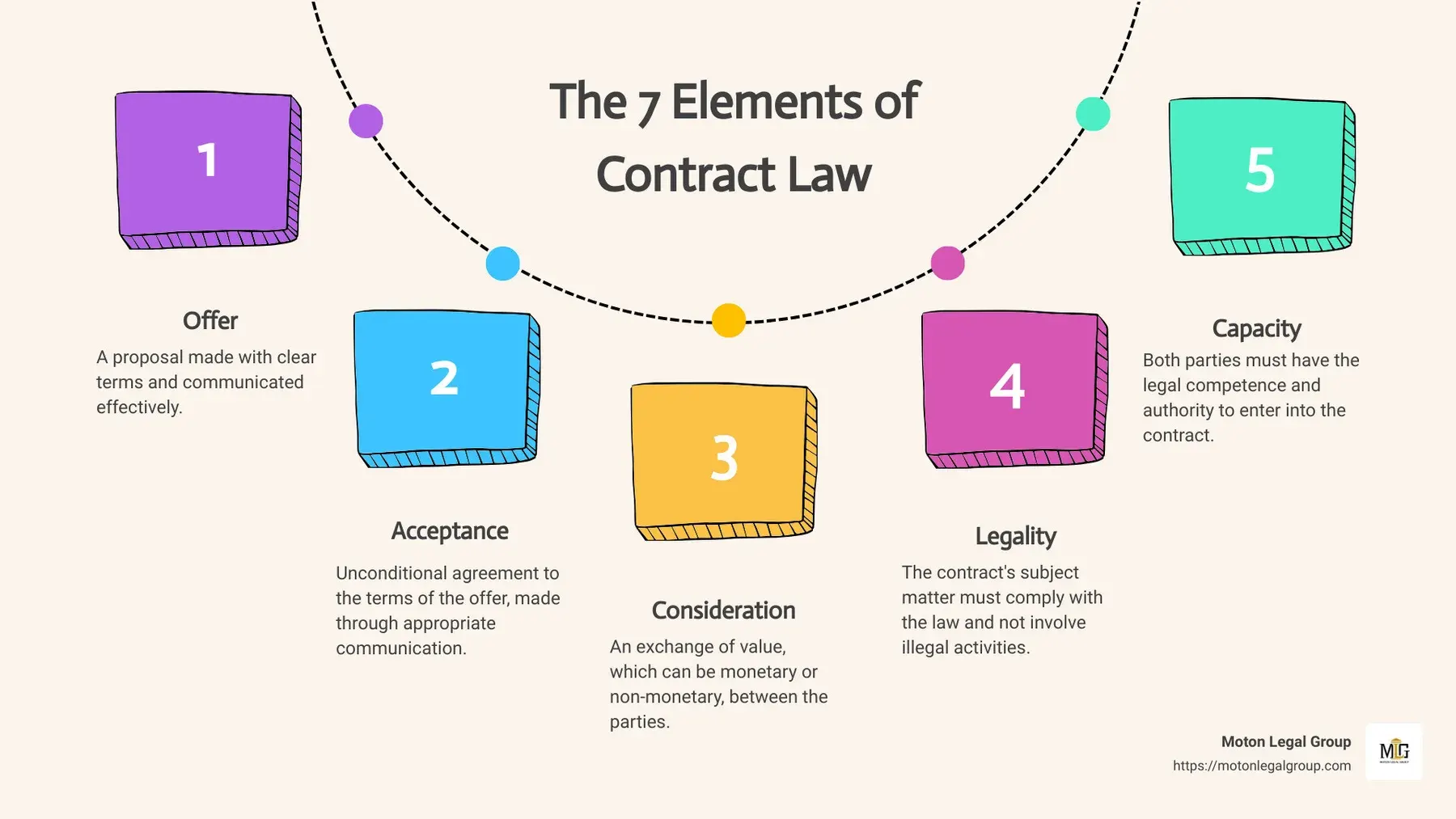
Strip away the legalese and a working consulting agreement does only four things. It says who the parties are - and “who” matters more than people think, because the friendly contact and the entity with the money are not always the same. It says what the work is, concretely enough that both sides know when it is finished. It says what you will be paid and when. And it allocates the risks that could otherwise sink the smaller party: who owns the work, who keeps secrets, who pays if something goes badly wrong, and how the whole thing ends.
That last category is where consultants get hurt, because it is the part that feels theoretical right up until it isn’t. The clause that caps your liability at the fees paid is boring to read and business-saving to have. A five-thousand-dollar project should never, ever expose you to a five-million-dollar claim, and yet consultants sign exactly that exposure all the time, because the clause was long and the client seemed nice. Nice has nothing to do with it. A truck does not care that you are nice.
Own your work until they pay for it
The single most common self-inflicted wound is intellectual property. New consultants assume that because they made the thing, they own the thing, or alternatively that because the client paid, the client owns it. The truth depends on your jurisdiction and on what your contract says - and if your contract says nothing, you may not like where ownership lands.
The principle to internalise is simple enough to tattoo on your forearm: the client owns the specific deliverable, you keep the reusable toolkit you brought to the job, and nothing transfers until you are paid in full. Tie the IP assignment to payment and you have quietly solved your biggest leverage problem before it exists. An unpaid client who walks away owns nothing.
Scope creep is a design problem, not a personality problem
We talk about scope creep as if it were a moral failing in clients, but clients are supposed to want more; their needs evolve, that is healthy. The failure is ours, when we have no mechanism for saying “yes, and here is what that costs.” That mechanism has a name - the change order - and it is nothing more intimidating than a short email: this is outside what we agreed, here is the extra time and money, reply to approve. Once it lives in your contract as an expected step, it stops being an awkward confrontation and becomes simple administration. “No” becomes “yes, here’s the price,” and the relationship stays warm.
The same logic governs getting paid. Late payment is almost never bad luck; it is bad structure. Take a deposit, so the client has skin in the game and you are not financing their project. Bill in milestones, so you never carry more than one stage of unpaid work. Set a payment window you actually chose rather than defaulted into, and write yourself the right to pause work when an invoice goes stale. The leverage you will wish you had in month three is the leverage you wrote into the agreement in week one.
A word of honesty
None of this is legal advice, and I would be doing you harm to pretend otherwise. Laws vary across countries and states in ways that matter, contractor-classification rules can bite, and the single highest-return legal expense a consultant can make is having one good reusable template reviewed, once, by a qualified lawyer in their own jurisdiction. Do that, and you stop reinventing risk on every project.
But the mindset costs nothing and protects everything. Write it down. Cap your liability. Keep your toolkit. Get the deposit. Put the contract before the work, not after. Do those five things and you will spend far less of your career in that week-six conversation - and when you do find yourself in it, you will have something better than a good memory. You will have a page you can both just read.
Key takeaways 5
- A written contract protects the relationship rather than threatening it.
- Define scope, deliverables, timelines and payment terms precisely.
- Keep ownership of your work until it is paid for.
- Handle scope creep with a change-request process, not goodwill.
- Have a lawyer review your template; this is not legal advice.
Frequently asked questions
What should a consulting contract include?
At minimum: scope of work and deliverables, timeline, fees and payment terms, intellectual property ownership, confidentiality, how changes are requested and priced, liability limits and termination terms.
How do consultants handle scope creep?
By defining scope clearly in the contract and using a change-request process: new work is written down, estimated and approved before it starts.
Who owns the work a consultant produces?
It depends on the contract. A common approach is that ownership transfers to the client only after full payment, while the consultant keeps rights to pre-existing tools and know-how.
Go deeper with the free masterclass
Workshop, PDF handbook and curated resources for “Contracts & Legal Basics for Consultants”.
Related articles

Finding Your First Clients
The first paying client feels impossible right up until it isn't. Here is the unglamorous, reliable path from zero to one, without an audience or an ad budget.
The Independent Tech Consultant's Playbook
New consultants reach for the easiest number they know - their old salary divided by the hours in a year. Here is why that math quietly bankrupts you, and what to calculate instead.

Discovery & Requirements Gathering
The most expensive code is the code that perfectly solves the wrong problem. Discovery is how you make sure that never happens.
Comments
No comments yet. Start the conversation.