A Comprehensive Guide to Hierarchical Planning in Production and Supply Chain Management
TL;DR
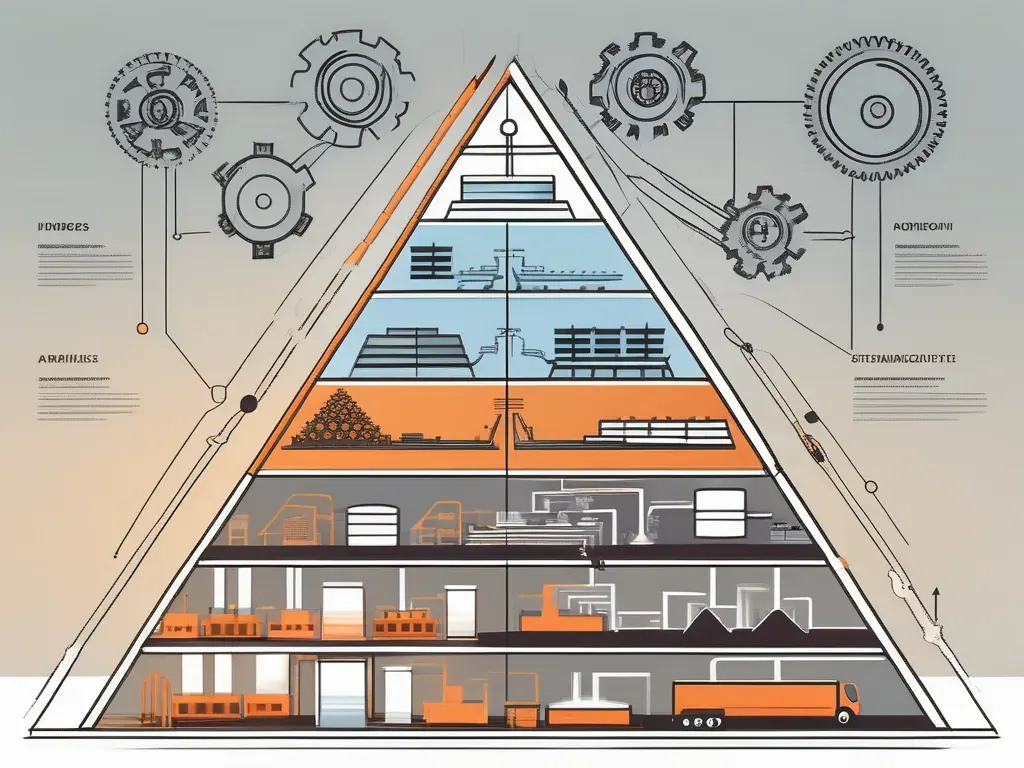
Hierarchical planning splits production and supply-chain decisions into five linked levels, from strategic planning and S&OP down to master scheduling, MRP and detailed scheduling. Each level has its own horizon and granularity, and a worked example with two products shows how plans flow from one level to the next.
On this page
Hierarchical Planning in Production and Supply Chain Management: A Structured Approach
Abstract
Production and supply chain management require a structured, multi-level approach to planning that ranges from strategic decisions to daily scheduling. This paper presents a hierarchical planning framework, encompassing Strategic Planning (SP), Sales and Operations Planning (S&OP), Master Production Scheduling (MPS), Material Requirements Planning (MRP), and Detailed Scheduling (DS). Each level includes specific planning horizons, frequencies, and granularities, enabling companies to respond effectively to market changes while optimizing resources and production processes. This paper uses a practical example of a manufacturing company producing two products, A and B, to illustrate calculations at each level.
1. Introduction
Hierarchical planning structures allow organizations to manage complexities in demand, resource constraints, and efficiency goals. By dividing planning into five levels—Strategic Planning, Sales and Operations Planning, Master Production Scheduling, Material Requirements Planning, and Detailed Scheduling—companies can establish long-term strategic alignment while maintaining short-term flexibility in operations. This integration enhances responsiveness to market changes and internal process optimization.
2. Hierarchical Planning Levels
Each level in the hierarchical planning model has distinct objectives, planning horizons, and calculation methods that contribute to a cohesive and responsive production plan.
SP (Strategic Plan)
S&OP (Sales and Operations Plan)
MPS (Master Production Schedule)
MRP (Material Requirements Planning)
DS (Detailed Scheduling) / SFS (Shop Floor Scheduling)
2.1 Strategic Planning (SP)
The highest level, Strategic Planning (SP), sets the long-term vision and objectives of the organization. This level typically covers a horizon of three to five years, allowing companies to assess market trends, anticipate future demands, and determine necessary investments in resources and capacity. The key components of SP include market analysis, capacity planning, and investment forecasting. Strategic Planning is less about immediate operational details and more about ensuring that the organization is equipped to meet future challenges through informed, data-driven decisions.
- Objective: Define long-term goals, assess market opportunities, and align resources.
- Horizon: 3-5 years.
- Frequency: Annually or biannually.
Equations Used:
- Future Demand Calculation:
Future Demand = Current Demand * (1 + Growth Rate) ^ Years - Capacity Requirement:
Capacity Requirement = Projected Demand / Capacity Utilization Rate
Example Calculation:
Suppose current demand is 200,000 units, with a projected annual growth rate of 5%.
Year 1 Demand: 200,000 units
Year 2 Demand: 200,000 * 1.05 = 210,000 units
Year 3 Demand: 210,000 * 1.05 = 220,500 units
If the current capacity is 200,000 units, SP highlights the need for a 10% increase in capacity within three years to meet projected demand.
2.2 Sales and Operations Planning (S&OP)
Sales and Operations Planning (S&OP) serves as a bridge between high-level strategy and production execution. S&OP aligns production capabilities with forecasted demand, typically covering a one- to two-year horizon. This level focuses on balancing supply with anticipated sales to meet customer demand while minimizing costs. Through demand forecasting and inventory planning, S&OP determines the production targets and resource requirements, creating a plan that can be adjusted quarterly or semi-annually based on market conditions.
- Objective: Align supply and demand, set production targets, and establish inventory policies.
- Horizon: 1-2 years.
- Frequency: Quarterly or semi-annually.
Equations Used:
- Monthly Demand:
Monthly Demand = Annual Demand / 12 - Safety Stock:
Safety Stock = Monthly Demand * Safety Stock Coverage (in months)
Example Calculation:
Forecasted Annual Demand for Product A is 120,000 units, and for Product B is 80,000 units.
Monthly Demand for Product A: 120,000 / 12 = 10,000 units
Monthly Demand for Product B: 80,000 / 12 ≈ 6,667 units
With a safety stock of one month’s demand, Safety Stock for Product A = 10,000 units, and for Product B ≈ 6,667 units.
2.3 Master Production Scheduling (MPS)
The Master Production Scheduling (MPS) stage breaks down S&OP targets into actionable, shorter-term production schedules. Covering a period of six months to one year, MPS specifies the quantity and timing of production for each product line. This level translates broad demand forecasts into a detailed plan that aligns with the available resources and capacity. MPS provides a foundation for further planning by establishing which products to manufacture and when, ensuring production efforts are synchronized with demand.
- Objective: Convert demand forecasts into specific production plans for each product line.
- Horizon: 6 months to 1 year.
- Frequency: Monthly or weekly.
Equations Used:
- Quarterly Production Target:
Quarterly Production Target = Annual Production Target / 4 - Monthly Production Target:
Monthly Production Target = Quarterly Production Target / 3 - Required Machine Hours:
Required Machine Hours = Production Volume * Machine Time per Unit
Example Calculation:
Quarterly Production Target for Product A: 120,000 / 4 = 30,000 units
Quarterly Production Target for Product B: 80,000 / 4 = 20,000 units
Monthly Production Target for Product A: 30,000 / 3 = 10,000 units
Monthly Production Target for Product B: 20,000 / 3 ≈ 6,667 units
2.4 Material Requirements Planning (MRP)
At the Material Requirements Planning (MRP) level, the organization calculates specific material requirements to support the MPS. MRP focuses on determining the net quantity of each component needed by exploding the Bill of Materials (BOM) and taking inventory levels into account. Covering a shorter-term horizon of weeks to months, MRP ensures that all necessary materials are available for production, using lead times and safety stock levels to avoid production delays.
- Objective: Calculate net material requirements to support production plans.
- Horizon: Weeks to months.
- Frequency: Weekly.
Equations Used:
- Net Requirement:
Net Requirement = Gross Requirement - On-hand Inventory + Safety Stock - Gross Requirement:
Gross Requirement = Production Target (from MPS) * Quantity of Component Required per Unit - Order Release Timing:
Order Release Timing = Material Requirement Date - Lead Time
Example Calculation:
Suppose Product A requires Component X (1 unit) and Component Y (2 units), and Product B requires Component Y (1 unit) and Component Z (1 unit).
Weekly Material Requirement Calculation:
- Component X for A:
7,500 * 1 = 7,500 units - Component Y for A:
7,500 * 2 = 15,000 units - Component Y for B:
5,000 * 1 = 5,000 units - Total Component Y:
15,000 + 5,000 = 20,000 units - Component Z for B:
5,000 * 1 = 5,000 units
2.5 Detailed Scheduling (DS)
The lowest level, Detailed Scheduling (DS), also known as Shop Floor Scheduling (SFS), involves the precise scheduling of day-to-day operations on the shop floor. DS determines the exact sequencing of tasks, machine assignments, and labor allocations, covering a very short-term horizon of days to hours. Using finite capacity scheduling, DS ensures efficient utilization of resources, minimizes idle time, and handles any last-minute adjustments due to unforeseen changes.
- Objective: Finalize task sequencing, assign resources, and execute production activities.
- Horizon: Days to hours.
- Frequency: Real-time or daily.
Equations Used:
- Daily Production Goal:
Daily Production Goal = Weekly Production Target / Number of Working Days per Week - Job Start Time:
Job Start Time = Previous Job End Time + Setup Time + Queue Time
Example Calculation:
Daily Production Requirement:
- Product A:
7,500 / 5 = 1,500 units per day - Product B:
5,000 / 5 = 1,000 units per day
Required Machine Hours for Product A (2 hours per unit): 1,500 * 2 = 3,000 hours
Required Machine Hours for Product B (1.5 hours per unit): 1,000 * 1.5 = 1,500 hours
3. The Hierarchical Integration
The hierarchical structure of planning creates a feedback loop between levels, where each stage provides the foundation for the next. Strategic Planning sets long-term goals, which inform S&OP’s demand alignment and production targets. S&OP goals then feed into MPS to specify product-specific schedules, which MRP uses to ensure material availability. Finally, DS takes the detailed schedules and assigns tasks at the operational level. This alignment ensures that each decision is interconnected, creating a coherent and responsive planning system.
4. Case Example
Consider a manufacturing company producing two products, A and B, with projected annual demands of 120,000 and 80,000 units, respectively. By employing hierarchical planning, the company can ensure that resources and materials are aligned with demand across all levels:
- SP: Project future demand growth of 5% annually, indicating a need for capacity expansion within three years.
- S&OP: Set annual targets (120,000 for A, 80,000 for B) and adjust inventory policies accordingly.
- MPS: Break down these targets into quarterly production schedules.
- MRP: Calculate weekly material requirements for components based on the BOM for each product.
- DS: Develop daily shop floor schedules, assigning machines and labor for production batches.
5. Conclusion
Hierarchical planning provides a robust framework for aligning long-term strategies with day-to-day operations. Through structured calculations at each level, organizations can optimize resource allocation, balance demand with supply, and maintain flexibility in the face of market changes. This structured approach minimizes production costs, enhances customer satisfaction, and enables efficient use of resources, making it invaluable in complex production environments.
Keywords
Hierarchical Planning, Production Planning, Supply Chain Management, Strategic Planning, Sales and Operations Planning, Master Production Scheduling, Material Requirements Planning, Detailed Scheduling.
References
- APICS. APICS Dictionary, 16th Edition. Chicago: APICS, 2020. A comprehensive guide to terminology and definitions in supply chain management and production planning.
- Vollmann, T. E., Berry, W. L., Whybark, D. C., & Jacobs, F. R. Manufacturing Planning and Control for Supply Chain Management. New York: McGraw-Hill, 2005. A foundational text on hierarchical planning in production.
- Silver, E. A., Pyke, D. F., & Thomas, R. Inventory and Production Management in Supply Chains, 4th Edition. Boca Raton: CRC Press, 2016. Covers key concepts in inventory management and MRP systems.
- Christopher, M. Logistics and Supply Chain Management, 5th Edition. London: Pearson, 2016. Provides insights on strategic and operational aspects of supply chain management.
- Jonsson, P., & Mattsson, S. A. “The implications of fit between planning environments and manufacturing planning and control methods.” International Journal of Operations & Production Management, 2003, 23(8), 872-900. A study on aligning planning methods with production environments.
- Heizer, J., Render, B., & Munson, C. Operations Management, 12th Edition. Pearson, 2017. An introductory text on operations and production planning methodologies.
Key takeaways 5
- Production planning works best as a hierarchy: strategy, S&OP, MPS, MRP and detailed scheduling.
- Each level has its own planning horizon, review frequency and level of detail.
- Higher levels set constraints and targets; lower levels turn them into executable orders.
- Integration between levels is what keeps demand, capacity and materials consistent.
- A simple two-product example makes the calculations at every level concrete.
Watch & learn

Frequently asked questions
What are the levels of hierarchical production planning?
The usual levels are Strategic Planning, Sales and Operations Planning (S&OP), Master Production Scheduling (MPS), Material Requirements Planning (MRP) and Detailed Scheduling. They move from long-term, aggregated decisions to short-term, item-level schedules.
What is the difference between MPS and MRP?
The Master Production Schedule says which finished products to make, how many and when. MRP takes that schedule and calculates the components and raw materials needed, and when to order or produce them.
Why use hierarchical planning instead of one big plan?
Splitting planning into levels keeps each decision at the right horizon and detail. It makes complex supply chains manageable and lets each level react to change without replanning everything.
Learn it hands-on at AL Academy
Free practical programs in software, automation and IT, with labs and certificates.
Related articles
Risk Management for Projects
Most project failures are not bolts from the blue - they are knowable risks that nobody wrote down, scored, or owned. Here is how mature teams turn uncertainty into a managed list.
Estimation & Planning Techniques
Estimates fail for predictable reasons. Here is how to forecast work as a range, plan with honest buffers, and update as you learn.

Project Management Fundamentals
You did not ask to become a project manager - the project just landed on your desk. Here is the small set of ideas that will carry you through your first one.
Comments
No comments yet. Start the conversation.