Risk Management for Projects
Most project failures are not bolts from the blue - they are knowable risks that nobody wrote down, scored, or owned. Here is how mature teams turn uncertainty into a managed list.
TL;DR
Most project failures aren't bolts from the blue but knowable risks that nobody wrote down, scored or owned. Risk is uncertainty that matters to objectives; problems get costlier the later they're found. Make risks visible in a register, score probability and impact, assign owners and real responses, and review it regularly.
On this page
The surprise that wasn’t
Ask any project manager about their worst week and you will hear a story about a “surprise” - the vendor who vanished, the approval that took a month, the integration that quietly never worked. Then ask a more uncomfortable question: before it happened, did anyone on the team suspect it might? Almost always, the answer is yes. Someone had a bad feeling. A few people had mentioned it in passing. The risk was, in the language of the trade, a known-unknown. It was knowable. It simply lived in people’s heads instead of on a page, and so when it arrived it arrived as a crisis rather than a contingency.
That gap - between what a team collectively senses and what it actually manages - is the entire subject of project risk management. The discipline is not about predicting the future or eliminating all danger. It is about systematically moving uncertainty out of people’s stomachs and onto a shared, ranked, owned list, while there is still time and freedom to act.
Risk is uncertainty that matters
A useful definition cuts through a lot of noise: a project risk is an uncertain event or condition that, if it occurs, has an effect on at least one objective. Two words in that sentence do heavy lifting. Uncertain separates risks from issues - an issue has already happened and is now a certainty to be managed, whereas a risk still lives in the realm of “might.” And effect reminds us that risk is two-sided. We are trained to hear “risk” as threat, but the same uncertainty that can hurt a project can also help it. A new tool might let a team finish early; a partner might offer better terms than expected. Teams that hunt only for threats leave half the value of the process on the table.
This is why experienced practitioners deliberately run an opportunity pass after every threat pass, asking the unnatural question, “what could go better than planned, and how do we make that more likely?” The strategies mirror each other neatly: where you would avoid, transfer, mitigate, or accept a threat, you exploit, share, enhance, or accept an opportunity.
The cost curve nobody escapes
The reason to do any of this early is economic, and the economics are unforgiving. The cost of dealing with a risk rises as the project progresses, while your freedom to respond falls. Early on, addressing a risk might mean swapping a supplier or adding a two-week buffer - cheap, reversible moves. Midway, the same risk demands rework and overtime. Late, it becomes crisis management, penalty clauses, and damaged relationships. Ignoring a risk does not make it disappear; it just defers the bill to the most expensive possible moment and removes your good options along the way.
Making the invisible list visible
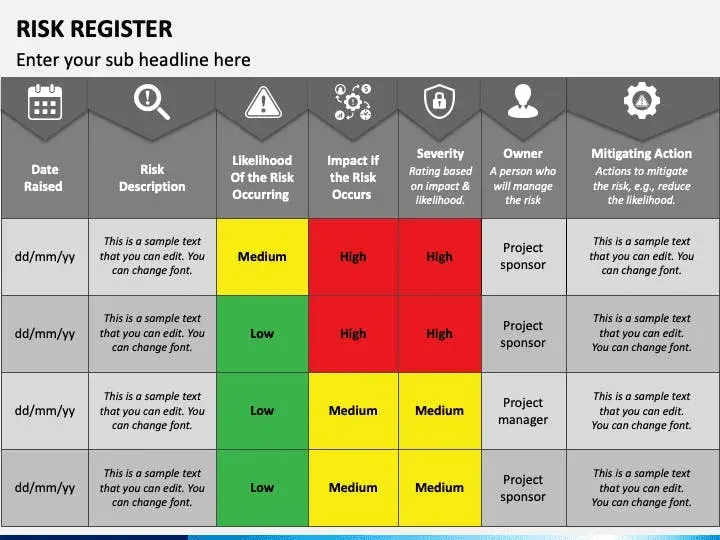
The practical heart of risk management is almost embarrassingly simple: a register. You identify risks using a layered toolkit - brainstorming, checklists drawn from past projects, SWOT, and, most powerfully, assumptions analysis (every assumption is a risk in disguise, because if it proves false, an effect follows). You write each one in a cause-event-effect form that forces clarity. Then you analyze.
Qualitative analysis rates each risk on probability and impact using defined scales, so that one person’s “high” means the same as another’s. Multiply the two and you get a score that sorts the list and a colour that tells the story on a heat map. For the vital few - the risks in the dangerous upper-right of the grid - you go quantitative. Expected Monetary Value turns a risk into a single number (a 30% chance of a $40,000 overrun is worth minus $12,000 of expected cost), and summing those numbers gives a defensible size for your contingency reserve. For high-stakes work, Monte Carlo simulation replaces false-precision single-point estimates with confidence curves, so you can finally answer the sponsor’s real question: not “when will it be done?” but “what is the chance it’s done by the thirtieth?”
Responses that actually happen
Analysis without action is just anxiety with a spreadsheet. A real response has four properties: it is specific (a concrete move, not “monitor closely”), owned (one named person, never a team), resourced (time and money allocated, often as new tasks in the schedule), and timed (linked to a trigger - the observable sign that tells the owner exactly when to act). The trigger is the unsung hero of the whole discipline. It converts a vague intention to “keep an eye on the vendor” into “when two weekly demos slip, open the backup-vendor conversation.” Rehearsed moves beat reactive scrambles every time.
Two reserves make responses real and must be kept apart: contingency, controlled by the project manager for identified risks, sized from EMV and sitting inside the baseline; and management reserve, controlled by the sponsor for the genuine unknown-unknowns, sitting outside it. Blur them and the buffer quietly gets spent on scope creep.
Keeping it alive
The most common failure is not a bad register but an abandoned one. The future keeps moving - risks expire, new ones appear, probabilities shift - so the register has to be reviewed on a rhythm: a thirty-second standing item in every status meeting, a monthly re-score and heat-map refresh, a deeper look at every stage gate. Periodically, audit the process itself, not just the risks, to catch whole categories you are systematically missing. On agile projects the same principle takes a lighter form: put high-priority risks on the backlog so they compete for real work, sequence the most uncertain work earliest when iterations are cheap, and treat the retrospective as a built-in risk audit.
None of this is exotic. It is a small, continuous habit - identify, analyze, respond, monitor, repeat - woven into how the team already works. Do it, and most of your “surprises” turn back into what they always were: knowable risks, written down in time.
Key takeaways 5
- Most project "surprises" were suspected by someone in advance.
- Risk is uncertainty that matters to project objectives.
- Problems cost more the later they are discovered.
- Record, score and assign an owner to every significant risk.
- Review the risk register regularly so it stays alive.
Watch & learn

Frequently asked questions
What is a risk register?
A risk register is a list of identified project risks with their probability, impact, owner, planned response and status, reviewed throughout the project.
What are the four risk response strategies?
For threats: avoid, transfer, mitigate or accept. Opportunities have matching strategies such as exploit, share, enhance or accept.
How do you score project risks?
Rate each risk's probability and impact, often on a 1 to 5 scale, and multiply or plot them on a matrix to prioritize the most significant ones.
Go deeper with the free masterclass
Workshop, PDF handbook and curated resources for “Risk Management for Projects”.
Related articles
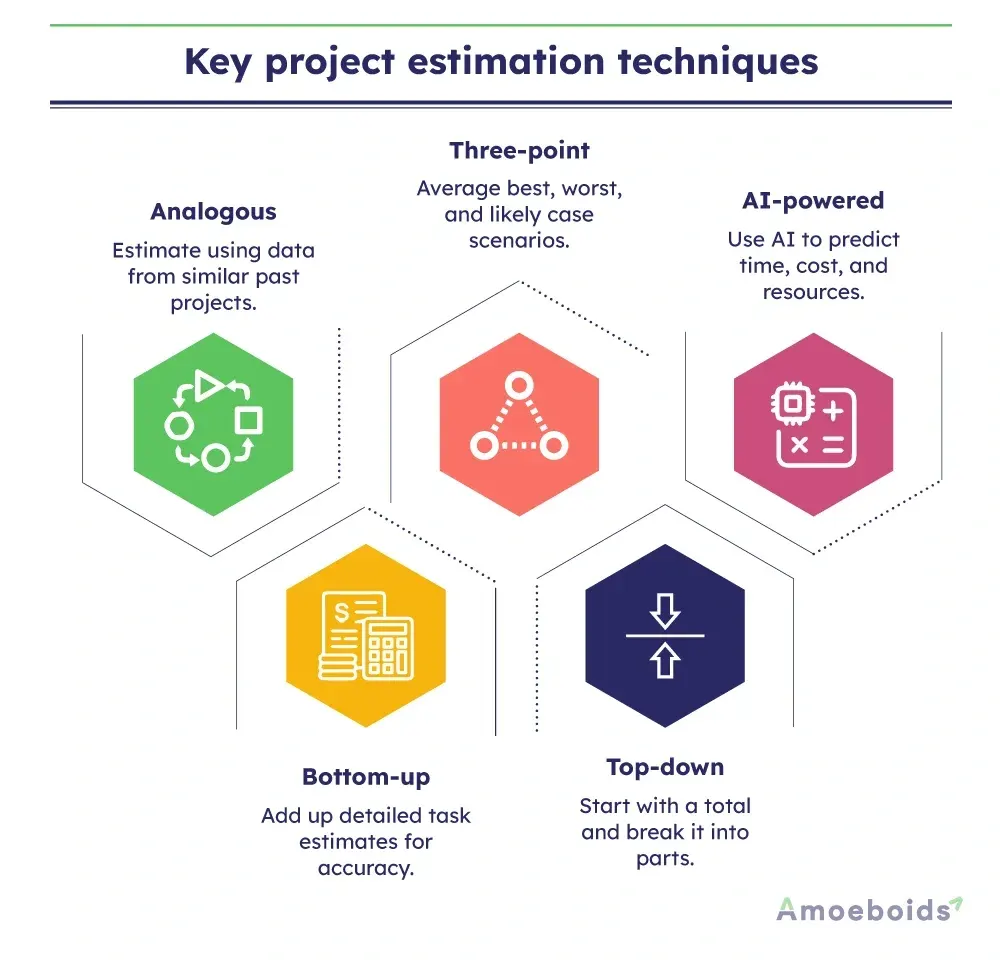
Estimation & Planning Techniques
Estimates fail for predictable reasons. Here is how to forecast work as a range, plan with honest buffers, and update as you learn.

Project Management Fundamentals
You did not ask to become a project manager - the project just landed on your desk. Here is the small set of ideas that will carry you through your first one.
AI Tools for Project Managers
I was skeptical that an AI could help me run a project. A year later it drafts half my paperwork - and I trust it less than ever, in the best possible way.
Comments
No comments yet. Start the conversation.