When Everyone Goes Blind: Saramago's Parable of Society's Fragility
In one breath
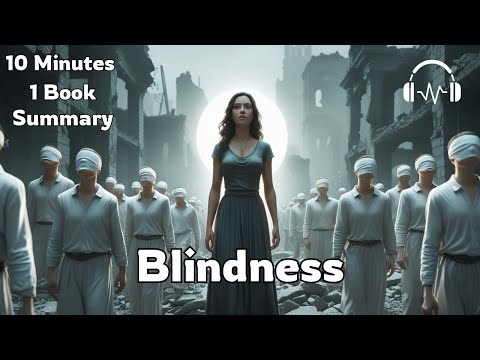
In José Saramago's Blindness, a contagious white blindness sweeps an unnamed city, and the quarantined blind descend into squalor and cruelty. The blindness is also moral, our failure to truly see one another, yet one woman who keeps her sight bears witness to both horror and surviving dignity.
On this page
José Saramago’s Blindness begins with a single, terrifying premise and follows it without flinching to its conclusion. A man, stopped at a traffic light, suddenly goes blind, not into darkness but into a milky white blankness. The blindness proves contagious, and within days it sweeps through an unnamed city, then a whole society, as person after person is struck. The newly blind are quarantined in a filthy asylum, and there, cut off and abandoned, civilisation rapidly disintegrates into squalor, cruelty, and barbarism. Saramago, a Portuguese Nobel laureate writing in a distinctive, demanding style of long, unpunctuated sentences and unnamed characters, uses this nightmare to ask a devastating question: how thin is the veneer of our civilisation, and what are we, really, when it is stripped away?
Here is what Blindness taught me about the fragility of civilisation, about the kinds of blindness we already live with, and about the dignity that can survive even the worst.
Key takeaways
- An epidemic of blindness rapidly collapses society into barbarism.
- Civilisation is a thin veneer over our capacity for cruelty.
- The “blindness” is also moral: the inability or refusal to see one another truly.
- One woman keeps her sight, bearing witness to the horror and the goodness.
- Even amid collapse, dignity and solidarity can survive in a few.
The fragility of civilisation
The most harrowing aspect of Blindness is how swiftly and completely society falls apart once the epidemic strikes. In the quarantined asylum, with no authority, no order, and no accountability, the trappings of civilisation dissolve with terrifying speed. Filth accumulates; food becomes a weapon; a gang of armed men seizes control and subjects the others to extortion, degradation, and sexual violence. Saramago shows, with unsparing realism, how thin the layer of decency and order really is, how quickly human beings, stripped of the structures that normally restrain them, can descend into cruelty and barbarism. It is the same dark lesson I encountered in Golding’s Lord of the Flies, but extended from a group of boys to an entire society of adults, and rendered even more pitilessly. The book forces the uncomfortable question: are the order and decency we take for granted truly part of us, or merely a fragile crust over something far darker?
The blindness we already live with
Saramago’s deepest stroke is that the literal epidemic is also a metaphor, and he makes this explicit in the novel’s final movement. The blindness, he suggests, is not only of the eyes but of the soul: it represents the moral blindness we already live with, our failure or refusal to truly see one another, to recognise each other’s humanity and suffering, to perceive what is really happening around us. “I don’t think we did go blind,” one character says near the end, “I think we are blind, blind but seeing, blind people who can see, but do not see.” The plague of white blindness merely makes visible, so to speak, a blindness that was already there: the indifference, the self-absorption, the wilful not-seeing that allows cruelty and injustice to flourish in our own sighted world. This is the novel’s most disturbing and most important point. The barbarism it depicts is not alien to us; it is what we are already half-blind to in ourselves.
The dignity that survives
And yet Blindness is not only a vision of horror. Amid the collapse, Saramago places one figure who does not go blind: the wife of an eye doctor, who keeps her sight but conceals it to stay with her quarantined husband, and who becomes the eyes, the conscience, and the moral centre of a small group who hold together amid the chaos. Through her, and the little band she protects and leads, the novel shows that even in the worst circumstances, dignity, compassion, love, and solidarity can survive in a few. She bears witness to the horror, but also performs acts of extraordinary courage and care. Saramago refuses both easy optimism and total despair: civilisation is terrifyingly fragile, and human beings are capable of appalling cruelty, but goodness, too, persists, in individuals who choose, against everything, to keep seeing, to keep caring, to keep their humanity intact. It is on these few that the possibility of recovery rests.
What I’m taking with me
Blindness is a difficult, harrowing, and profound novel, and it leaves a lasting mark. What I am taking from Saramago is its unflinching vision of how thin the veneer of civilisation is, and how quickly we can descend into barbarism when its structures fail; its devastating suggestion that we are already, morally, half-blind, failing to truly see one another; and its fragile but real hope, embodied in the one woman who keeps her sight, that dignity, compassion, and solidarity can survive even the worst. The novel’s haunting question stays with me: not whether I can see with my eyes, but whether I am truly seeing, the people, the suffering, the reality around me, or living, like everyone else, blind but seeing, able to see and yet not seeing.
Frequently asked questions
What is Blindness by Saramago about?
It is José Saramago’s novel about a sudden epidemic of “white blindness” that sweeps an unnamed city, causing society to collapse into squalor and barbarism, used as a parable about the fragility of civilization and our moral blindness.
What does the blindness symbolize?
Beyond the literal epidemic, it symbolizes moral blindness: our failure or refusal to truly see one another and recognize each other’s humanity, captured in the line that we are “blind people who can see, but do not see.”
Is the novel entirely bleak?
No. Amid the collapse, one woman keeps her sight and, with a small group, preserves dignity, compassion, and solidarity, showing that goodness can survive even the worst, on which the hope of recovery depends.
References & further reading
- Saramago, José. Blindness. (1995; translated by Giovanni Pontiero, Harcourt Brace, 1997.)
- Saramago, José. The Gospel According to Jesus Christ. Harcourt Brace, 1991.
- Bloom, Harold (ed.). José Saramago. Chelsea House, 2005.
Watch: others on this book

Read along with me
Book notes, philosophy and the ideas that shape how we build. New essays every month, no spam.
Related reading notes
The Beast Within: Civilization and Savagery in "Lord of the Flies"
Golding's Lord of the Flies explained: civilization as a thin veneer, the conch, the beast within and the boys' slide from order to savagery.
All Happy Families: Love, Society, and Ruin in Tolstoy's "Anna Karenina"
Tolstoy's Anna Karenina: passion, society's hypocrisy and the search for meaning, told through Anna's ruin and Levin's quiet search for a good life.

The Myth of the Blank Slate: Steven Pinker on Human Nature
Steven Pinker's The Blank Slate: the case for an evolved human nature, the fears behind denying it and why it need not threaten our values.
Comments
No comments yet. Start the conversation.