What Is and Isn't in Our Power: Lessons from Epictetus' "Enchiridion"
In one breath
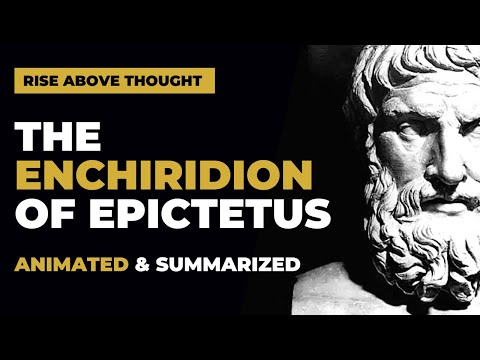
Epictetus, born a slave, taught in his Enchiridion that real freedom lies in the mind. Some things are up to us, our judgments, desires and actions, and some are not, our body, reputation and outcomes. We are disturbed not by events but by our opinions about them, and freedom means wanting what happens.
On this page
Epictetus was born a slave. He spent his early life owned by another human being, and he walked with a limp said to come from a master who broke his leg. And yet his Enchiridion, the little “handbook” of his teachings, is one of the most powerful statements of inner freedom ever written. That contrast is the whole point. A man who had no control over his own body taught that real freedom was never about external circumstances at all. It was about the one territory no master can enter: the mind.
Here is what Epictetus taught me about the single distinction that organises a Stoic life, and why it is the most useful idea I have ever tried to live by.
Key takeaways
- Some things are up to us and some are not. Confusing the two is the source of nearly all suffering.
- What is up to us: our judgments, desires, and actions. What is not: our body, reputation, and outcomes.
- We are disturbed not by events but by our opinions about events.
- Freedom is wanting what happens, not bending the world to what we want.
- Philosophy is training, a daily practice of correcting our reactions, not a set of theories.
The dividing line
The Enchiridion opens with the sentence that contains everything: some things are within our power, and some things are not. Within our power are our own opinions, intentions, desires, and aversions, in short, whatever is our own doing. Outside our power are our body, our property, our reputation, our position, in short, whatever is not our own doing. Epictetus argues that misery comes from getting this backwards, from staking our peace on things we cannot control while neglecting the one thing we can. The medicine is to draw the line clearly and to invest ourselves only on the side of it that is genuinely ours.
It is not things that disturb us
The line I quote most often comes from him: people are disturbed not by things, but by their judgments about things. The same event, a delay, a criticism, a loss, can devastate one person and barely touch another, which means the disturbance was never simply in the event. It was in the story we told ourselves about it. This is not denial. Epictetus does not say the event is unreal or painless. He says that between what happens and how we suffer there is a gap, and in that gap lives our judgment, which is ours to examine and, often, to change. Learning to find that gap has done more for my peace of mind than any amount of trying to arrange the world.
Wanting what happens
Epictetus pushes the idea to a startling conclusion. Do not seek, he says, to have events happen as you wish, but wish them to happen as they do, and you will go on well. At first this sounds like surrender. The more I sit with it, the more it looks like a strategy for never being defeated. If my happiness depends on the world cooperating, I have handed my peace to forces that do not care about me. If instead I meet what comes with acceptance and ask only how to respond well, nothing can take my equanimity without my consent. The slave understood freedom better than his masters ever did.
What I’m taking with me
The Enchiridion is short enough to read in an afternoon and deep enough to practise for a lifetime. What I am taking is the daily discipline of sorting: when something upsets me, to stop and ask whether it is actually in my power. If it is, I act. If it is not, I work on my response and let the rest go. It is simple to state and very hard to do, which is exactly why Epictetus called philosophy a training. We do not learn it once. We rehearse it every time the world refuses to obey.
Frequently asked questions
What is the Enchiridion of Epictetus?
A short handbook of Stoic ethics compiled from Epictetus’ teachings by his student Arrian. It distills Stoic practice into brief, practical maxims for daily life.
What is the central idea of Epictetus’ philosophy?
The distinction between what is in our control, our own judgments and actions, and what is not, such as outcomes and other people. Peace comes from focusing only on the former.
What did Epictetus mean by freedom?
Inner freedom, the ability to keep one’s mind unshaken regardless of external circumstances, achieved by accepting what we cannot control rather than struggling against it.
References & further reading
- Epictetus. The Enchiridion and Discourses. (Translated by W. A. Oldfather, Loeb Classical Library, 1925–1928; or Robin Hard.)
- Long, A. A. Epictetus: A Stoic and Socratic Guide to Life. Oxford University Press, 2002.
- Hadot, Pierre. The Inner Citadel. Harvard University Press, 1998.
Watch: others on this book

Read along with me
Book notes, philosophy and the ideas that shape how we build. New essays every month, no spam.
Related reading notes
On Borrowed Time: Lessons from Seneca's "Letters from a Stoic"
Lessons from Seneca's Letters from a Stoic: how we waste time, rehearsing hardship, deciding what is enough and philosophy as daily medicine.
Bad Faith and the Look of the Other: Sartre's "Being and Nothingness"
Sartre's Being and Nothingness explained: bad faith, the Look of the Other and why we are condemned to be free, and how these ideas show up every day.

Condemned to Be Free: Sartre's "Existentialism Is a Humanism"
Sartre's Existentialism Is a Humanism explained: existence precedes essence, condemned to be free, bad faith and choosing for all humanity.
Comments
No comments yet. Start the conversation.