We Are Made of Star-Stuff: Carl Sagan's "Cosmos"
In one breath
Carl Sagan's Cosmos journeys from the origins of the universe to the brain and the search for life elsewhere. The atoms in us were forged in ancient stars, the cosmic perspective both humbles and connects us, science deepens wonder and knowledge, as Alexandria's lost library shows, is precious and fragile.
On this page
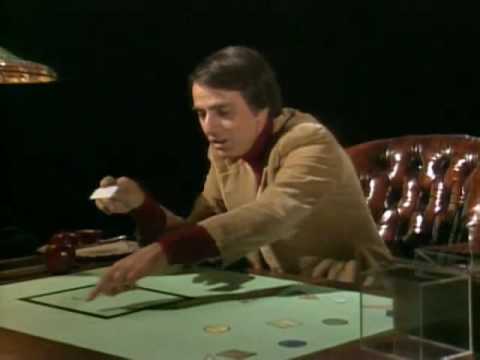
Carl Sagan’s Cosmos, the book that accompanied his landmark television series, is one of the most beloved works of popular science ever written, and it is far more than a science book. It is a sweeping, lyrical journey through the universe and the history of science, written with Sagan’s characteristic blend of rigorous knowledge and profound, almost spiritual wonder. Across its chapters, Sagan ranges from the origins of the universe to the workings of the brain, from the library of ancient Alexandria to the search for extraterrestrial life, always returning to his great themes: the grandeur of the cosmos, the power and beauty of the scientific method, and the deep connection between human beings and the universe that made us. It is science as poetry, and an invitation to wonder.
Here is what Cosmos taught me about our place in the universe, about the cosmic perspective, and about the union of science and wonder.
Key takeaways
- “We are made of star-stuff”: the atoms in us were forged in ancient stars.
- The cosmic perspective humbles us and connects us to everything.
- Science is a tool for wonder, not its enemy.
- Knowledge is precious and fragile, as the loss of ancient Alexandria warns.
- Our existence is both tiny and precious in the vastness of space and time.
Star-stuff
One of Sagan’s most famous and beautiful ideas is captured in his phrase “we are made of star-stuff.” The atoms that make up our bodies, the carbon in our cells, the iron in our blood, the calcium in our bones, were forged in the nuclear furnaces of ancient stars, scattered across space when those stars died, and eventually gathered into the Earth and into us. We are, quite literally, made of the ashes of dead stars; the cosmos is not something separate from us, out there, but the very substance of which we are made. This is not mysticism but established science, and yet Sagan conveys its profound poetry: we are a way, he says, for the cosmos to know itself. The matter of the universe, in us, has become conscious, able to look back at the stars and understand its own origins. I find this one of the most genuinely awe-inspiring facts there is, and Sagan makes it sing.
The cosmic perspective
Running through Cosmos is what Sagan calls the cosmic perspective, the view of ourselves and our world against the immense backdrop of space and time. Seen from this perspective, the Earth is a tiny speck, a “pale blue dot,” and all of human history occupies the briefest instant of cosmic time. This could be diminishing, but in Sagan’s hands it is the opposite: humbling and clarifying. The cosmic perspective reveals the pettiness of so many of our divisions and conflicts, the borders, the rivalries, the hatreds, against the backdrop of the one small planet we all share, alone in the vast dark. It teaches both humility, our smallness in the cosmos, and a strange preciousness, the rarity and fragility of life and consciousness in an immense and mostly empty universe. Sagan uses the cosmic perspective again and again to call us to wisdom, to care for our small world and one another, precisely because we are so small and so alone in such a vastness.
Science and wonder
Above all, Cosmos embodies Sagan’s deepest conviction, which I have met across his work: that science and wonder are not enemies but allies, that understanding the universe deepens rather than diminishes our awe. Sagan never presents science as cold or reductive; on the contrary, the real universe revealed by science, billions of galaxies, the deep time of evolution, the strange physics of the very large and the very small, is, he insists, far more wondrous than any myth. He writes with palpable love and excitement, conveying the thrill of discovery and the beauty of the cosmos with a warmth that has inspired generations toward science. And he reminds us, through the haunting example of the destruction of the great Library of Alexandria, how precious and fragile human knowledge is, how much can be lost, and how important it is to cherish and protect the hard-won understanding our species has achieved. Cosmos is, finally, a love letter to both the universe and the human endeavour to understand it.
What I’m taking with me
Cosmos is a book that expands the soul as much as the mind, and Sagan’s blend of knowledge and wonder is unmatched. What I am taking from it is the awe-inspiring truth that we are made of star-stuff, the very cosmos become conscious; the humbling and clarifying cosmic perspective, which reveals both our smallness and our preciousness; and Sagan’s enduring conviction that science is a path to wonder, not away from it. Cosmos leaves me looking up at the night sky with deeper awe and looking around at our small, shared world with deeper care, holding together, as Sagan did so beautifully, the rigour of science and the wonder of being alive and aware in such a vast and ancient universe.
Frequently asked questions
What is Cosmos by Carl Sagan about?
It is Carl Sagan’s sweeping, lyrical tour of the universe and the history of science, exploring our place in the cosmos, the power of the scientific method, and the deep connection between humanity and the universe that made us.
What does “we are made of star-stuff” mean?
That the atoms in our bodies were forged inside ancient stars and scattered when those stars died, so we are literally made of stellar material, the cosmos, in us, become conscious and able to understand itself.
What is the “cosmic perspective”?
Sagan’s view of ourselves against the vast backdrop of space and time, which reveals both our smallness and the preciousness and fragility of life, and which he uses to call us to humility, wisdom, and care for our shared world.
References & further reading
- Sagan, Carl. Cosmos. Random House, 1980.
- Sagan, Carl. The Dragons of Eden. Random House, 1977.
- Sagan, Carl. Pale Blue Dot. Random House, 1994.
Watch: others on this book

Read along with me
Book notes, philosophy and the ideas that shape how we build. New essays every month, no spam.
Related reading notes
Science as a Candle in the Dark: Carl Sagan's "The Demon-Haunted World"
Carl Sagan's The Demon-Haunted World: science as a way of thinking, the baloney detection kit and why skepticism and wonder belong together.
Order in Disorder: James Gleick's "Chaos"
James Gleick's Chaos: the butterfly effect, fractals, strange attractors and the maverick scientists who found hidden order in disorder.
Everything, Briefly: Bill Bryson's Curious Tour of Science
Bill Bryson's A Short History of Nearly Everything: an amateur's funny, curious tour from the Big Bang to us, and why science deepens wonder.
Comments
No comments yet. Start the conversation.