Understanding the Roles: Software Engineer vs. Data Engineer vs. Cloud Engineer vs. AI Engineer
TL;DR
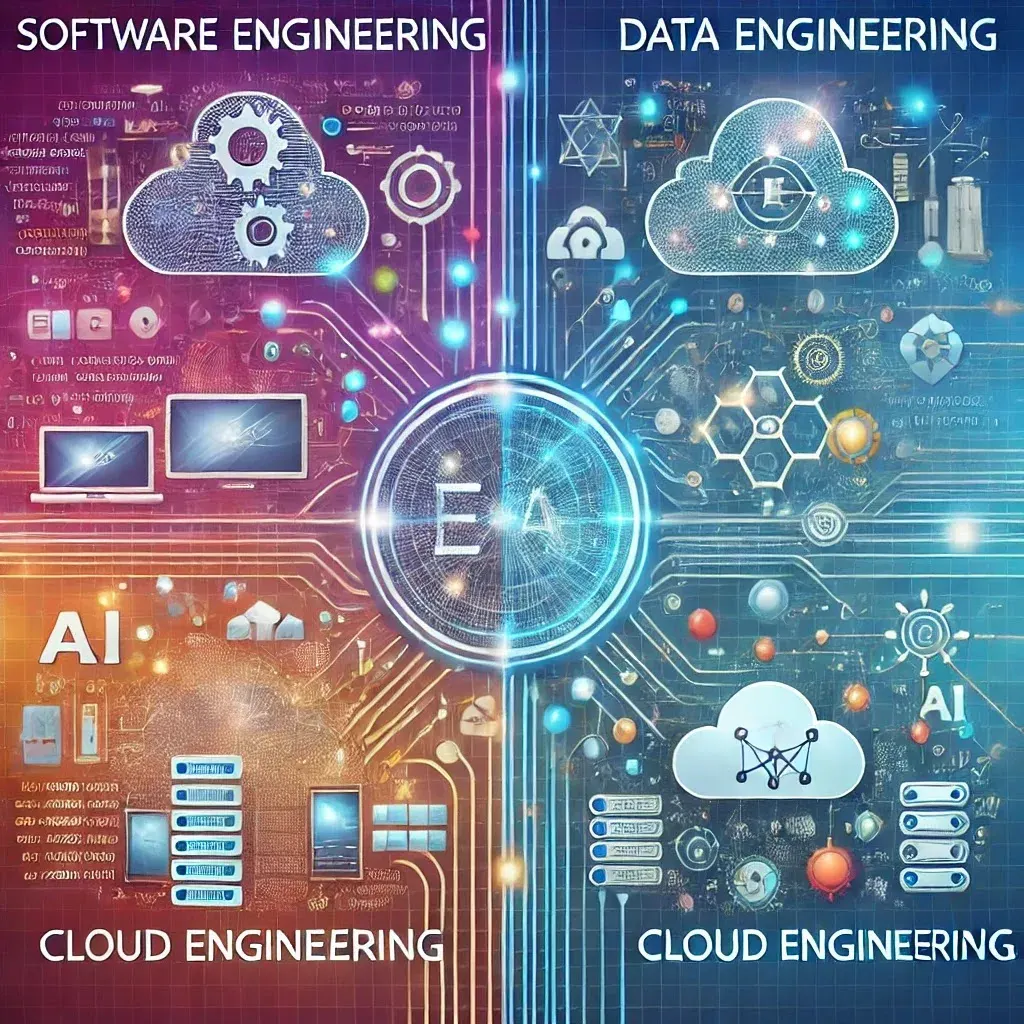
Software, data, cloud and AI engineers work closely but specialize differently. Software engineers build applications and systems, data engineers build pipelines that move and prepare data, cloud engineers design and run cloud infrastructure, and AI engineers build and deploy machine learning and AI systems.
On this page
Understanding the Roles:
Software Engineer vs. Data Engineer vs. Cloud Engineer vs. AI Engineer
The fields of software engineering, data engineering, cloud engineering, and AI engineering each play unique roles in technology development and deployment. Although they may work closely together, they are specialized in different areas of expertise. Here’s a breakdown of each role, the skills they typically require, and how they differ in focus and responsibility.
1. Software Engineer
Role Overview:
Software engineers design, develop, and maintain software applications, frameworks, and systems. They are generalists in building software solutions, and their work often forms the foundation upon which other engineering specialties build.
Core Responsibilities:
- Writing, testing, and debugging code for software applications.
- Designing scalable, efficient, and maintainable software systems.
- Collaborating with cross-functional teams, including product managers, UX/UI designers, and QA testers.
- Ensuring software adheres to best practices and complies with security and performance standards.
Key Skills:
Programming Languages: Commonly Python, Java, C++, JavaScript, and Ruby. Software Development: Knowledge of algorithms, data structures, and design patterns. Version Control: Proficient in Git or other version control systems. Familiarity with Software Development Life Cycle (SDLC) models like Agile and DevOps.
Focus Areas:
Primarily focuses on the creation, deployment, and maintenance of applications. Emphasizes writing clean, functional code and optimizing applications for user experience and performance.
2. Data Engineer
Role Overview:
Data engineers are responsible for designing, building, and managing data infrastructure. They ensure data is accessible, reliable, and organized for analysis, often by data scientists and analysts.
Core Responsibilities:
- Creating and managing data pipelines to move and transform data efficiently.
- Setting up databases, data warehouses, and data lakes.
- Ensuring data integrity, quality, and security across storage systems.
- Collaborating with data scientists and analysts to provide well-organized datasets.
Key Skills:
ETL (Extract, Transform, Load) Tools: Proficiency in tools like Apache Airflow, Talend, or Informatica. Big Data Technologies: Experience with frameworks like Hadoop, Spark, and Kafka. Database Management: Knowledge of SQL, NoSQL databases, and data warehousing solutions (e.g., Snowflake, Redshift). Programming Languages: Often Python, Scala, or SQL.
Focus Areas:
Focuses on ensuring data is accessible, reliable, and available for processing. Key contributor in the field of data analytics and machine learning, as they provide the backbone of data pipelines and infrastructure.
3. Cloud Engineer
Role Overview:
Cloud engineers design, implement, and manage cloud-based infrastructure to support applications, data, and other systems. They focus on building scalable, secure, and resilient cloud solutions that often support applications developed by software engineers and data systems created by data engineers.
Core Responsibilities:
- Managing cloud-based services and infrastructure.
- Ensuring secure, scalable, and cost-effective cloud solutions.
- Automating infrastructure deployment and managing resources efficiently.
- Monitoring and optimizing cloud performance.
Key Skills:
Cloud Platforms: Proficiency in services from AWS, Microsoft Azure, or Google Cloud Platform (GCP). Infrastructure as Code (IaC): Experience with tools like Terraform, CloudFormation, and Ansible. Networking: Understanding of VPC, load balancing, and networking fundamentals. Security and Compliance: Knowledge of cloud security best practices, including identity management, encryption, and compliance frameworks.
Focus Areas:
Focuses on cloud architecture and infrastructure management. Plays a critical role in helping organizations transition to or operate within cloud environments, often working with software and data engineering teams to deploy and manage applications in the cloud.
4. AI Engineer
Role Overview:
AI engineers focus on building and deploying artificial intelligence models that can learn from data and make intelligent decisions. They leverage machine learning, deep learning, and neural networks to create predictive and autonomous systems.
Core Responsibilities:
- Developing machine learning models to address specific business problems.
- Fine-tuning algorithms to improve prediction accuracy and performance.
- Working with data engineers to acquire, preprocess, and prepare data for machine learning.
- Deploying AI models into production, monitoring, and updating as necessary.
Key Skills:
Machine Learning and Deep Learning: Experience with algorithms, neural networks, and frameworks like TensorFlow, PyTorch, and scikit-learn. Data Science: Knowledge of statistics, probability, and data preprocessing techniques. Programming Languages: Primarily Python, with familiarity in R or Java also beneficial. Deployment: Experience with MLOps practices and deployment tools like Docker, Kubernetes, and cloud-based AI services.
Focus Areas:
AI engineers emphasize creating models that can predict outcomes, classify information, or make decisions autonomously. Their work is highly analytical and relies on both statistical knowledge and programming expertise.
Key Differences at a Glance:
| Aspect | Software Engineer | Data Engineer | Cloud Engineer | AI Engineer |
|---|---|---|---|---|
| Primary Focus | Application Development | Data Pipeline and Infrastructure | Cloud Infrastructure | AI Model Development |
| Skills Needed | Coding, Algorithms, System Design | Data Pipelines, Big Data, Databases | Cloud Services, Networking, IaC | Machine Learning, Data Science, Deployment |
| Core Tools | Programming Languages, Git | SQL, ETL Tools, Big Data Platforms | Cloud Platforms (AWS, Azure, GCP), IaC | ML Frameworks (TensorFlow, PyTorch), MLOps |
| End Goals | Functional Software | Organized, Accessible Data | Scalable, Secure Infrastructure | Predictive, Autonomous Systems |
| Collaboration | Works with all roles | Works closely with AI engineers | Supports software, data, and AI engineers | Heavily reliant on data engineers |
Conclusion
Each role contributes uniquely to modern technology stacks, but they often work together to achieve a common goal. Software engineers create applications, data engineers prepare and manage data infrastructure, cloud engineers manage the infrastructure needed to deploy these applications and data solutions, and AI engineers develop models to bring intelligent solutions to businesses. Understanding these roles helps clarify the broad spectrum of technology careers available today, each with distinct skills and specializations that drive innovation forward.
Key takeaways 5
- Software engineers design, build and maintain applications.
- Data engineers build pipelines and data platforms.
- Cloud engineers design, automate and run cloud infrastructure.
- AI engineers build and deploy machine learning and AI systems.
- The roles overlap and collaborate on most products.
Watch & learn

Frequently asked questions
What is the difference between a software engineer and a data engineer?
Software engineers build applications and systems for users. Data engineers build the pipelines, storage and processing systems that collect, clean and deliver data for analysis and AI.
What does a cloud engineer do?
A cloud engineer designs, deploys and manages infrastructure on cloud platforms such as AWS, Azure or Google Cloud, focusing on automation, reliability, security and cost.
What skills does an AI engineer need?
Programming (usually Python), machine learning fundamentals, data handling, model deployment and MLOps and, increasingly, experience integrating large language models.
Learn it hands-on at AL Academy
Free practical programs in software, automation and IT, with labs and certificates.
Related articles
AI-Assisted Software Development
AI can draft code faster than you can read it. That is exactly the problem - and the skill that now separates good engineers from dangerous ones.
IIoT: Sensor-to-Cloud Data Pipelines
Everyone wants the dashboard and the digital twin. Almost nobody wants to talk about the pipes that feed them - which is exactly why so many Industry 4.0 projects stall.
Data Warehousing & Analytics Engineering
The warehouse stopped being a place to store data and became a place to write code - and that single shift created a whole new craft.
Comments
No comments yet. Start the conversation.