To Be Is to Be Perceived: The Strange Idealism of Berkeley
In one breath
In A Treatise Concerning the Principles of Human Knowledge, George Berkeley argues that to be is to be perceived: only minds and their ideas exist, and we never experience matter directly, only perceived qualities. God's constant perception keeps unobserved things in existence, and the argument is harder to refute than it seems.
On this page
George Berkeley, an Irish philosopher and bishop, defended one of the most counterintuitive ideas in the history of thought, and his Principles of Human Knowledge argues for it with a rigour that is maddeningly hard to refute. His claim, in a phrase, is esse est percipi: to be is to be perceived. There is no material world existing independently of minds, Berkeley says; the only things that exist are minds and their ideas. The chair is real, but its reality consists entirely in being perceived. I confess I spent much of this book trying to find the flaw, and I came away with a new respect for just how slippery the concept of “matter” really is.
Here is what Berkeley taught me about idealism, about the famous puzzle of the unobserved tree, and about why his strange argument is so difficult to dismiss.
Key takeaways
- “To be is to be perceived”: things exist only insofar as they are perceived by a mind.
- There is no mind-independent matter, only minds and their ideas.
- We never experience “matter” directly, only our perceptions of qualities.
- God’s constant perception keeps the world existing when no human observes it.
- The argument is far harder to refute than its strangeness suggests.
The argument for idealism
Berkeley’s reasoning starts from a point the empiricists had already conceded: all we ever directly experience are our own perceptions, the colours, sounds, textures, tastes that make up our sensory world. We never perceive “matter” itself, the supposed inert stuff lying behind these qualities; we only ever have the qualities. So what reason do we have to believe in matter at all? Berkeley’s bold move is to say: none. The idea of a material substance existing unperceived behind our perceptions is, he argues, incoherent and unnecessary. All that exists are perceiving minds and the ideas they perceive. The world is real, but it is mental through and through. Strip away the assumption of matter, he insists, and nothing in our actual experience is lost.
The tree in the empty quad
The obvious objection leaps out immediately, and Berkeley meets it head on. If things exist only when perceived, does the tree in the empty courtyard cease to exist the moment everyone looks away? Common sense rebels. Berkeley’s answer is that the world does not flicker in and out of existence, because there is always a perceiver: God. God perceives all things constantly, and so the world maintains its steady existence whether or not any human is looking. (A famous pair of limericks later captured this exactly, with God assuring us the tree continues “since observed by yours faithfully, God.”) Whatever one makes of this theological solution, it shows that Berkeley’s idealism is not the chaotic, reality-dissolving view it first appears. The world is stable and orderly; it is just that its existence is mental rather than material.
Why it is so hard to refute
The story goes that Samuel Johnson, hearing Berkeley’s theory, kicked a stone and declared, “I refute it thus.” But of course this refutes nothing; the sensation of the kick, the pain in the foot, the sight of the stone, are all exactly the perceptions Berkeley says are real. He never denied that the world is solid, predictable, and shared; he only analysed what its reality consists in. And that is why the argument is so unnervingly durable. Berkeley simply takes the empiricist premise, that we know only our perceptions, and follows it more consistently than anyone else dared. To refute him, you have to justify your belief in a material substance you can never actually perceive, which turns out to be far harder than it sounds. He forces us to notice how much we assume and how little of it we can prove.
What I’m taking with me
I do not think I am an idealist, but Berkeley changed how I hold the question. What I am taking from the Principles is a lasting humility about the word “matter,” which I had always treated as the most obvious thing in the world and now see is a philosophical assumption I cannot easily defend. Berkeley taught me to take counterintuitive arguments seriously, to follow premises honestly even toward strange conclusions, and to notice the difference between what I directly experience and what I merely infer. His tree in the quad still rustles in my mind, and I am no longer quite so sure what is holding it up.
Frequently asked questions
What does “to be is to be perceived” mean?
It is Berkeley’s principle (esse est percipi) that things exist only insofar as they are perceived by a mind. For Berkeley, there is no mind-independent matter, only minds and their ideas.
What is Berkeley’s idealism?
The view that reality is fundamentally mental: the only things that exist are perceiving minds and the ideas they perceive, with no material substance existing behind or independent of perception.
What happens to objects when no one perceives them?
Berkeley answers that God perceives all things constantly, so the world continues to exist in a stable, orderly way even when no human being is observing it.
References & further reading
- Berkeley, George. A Treatise Concerning the Principles of Human Knowledge. 1710.
- Warnock, G. J. Berkeley. Penguin, 1953.
- Pitcher, George. Berkeley. Routledge, 1977.
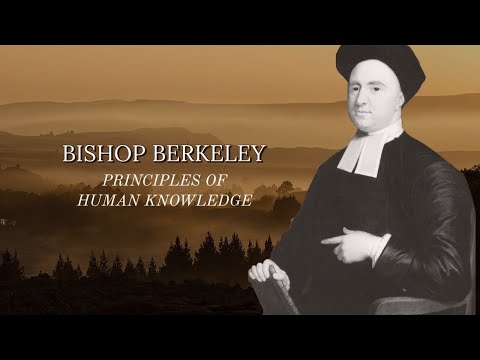
Watch: others on this book

Read along with me
Book notes, philosophy and the ideas that shape how we build. New essays every month, no spam.
Related reading notes
Navigating Life's Maze: Wisdom from William James' Pragmatism
Lessons from William James' Pragmatism: truth as a process, the value of experience, radical empiricism, pluralism and an action-oriented philosophy.
The Best of All Possible Worlds: Leibniz's "Monadology"
Leibniz's Monadology explained: monads, pre-established harmony and why the best of all possible worlds is serious philosophy, not naive optimism.
The Long Road of the Spirit: Wrestling with Hegel
Wrestling with Hegel's Phenomenology of Spirit: the dialectic, the master-slave dialectic, truth as the whole and how to read a book this hard.
Comments
No comments yet. Start the conversation.