The Self-Taught Philosopher: Ibn Tufayl's "Hayy ibn Yaqzan"
In one breath
Ibn Tufayl's 12th-century philosophical novel Hayy ibn Yaqzan tells of a child raised by a gazelle alone on an island who, through observation and reason alone, discovers the natural order, the soul and God. Reason and faith reach the same truth by different roads, though the deepest truths are hard to share.
On this page
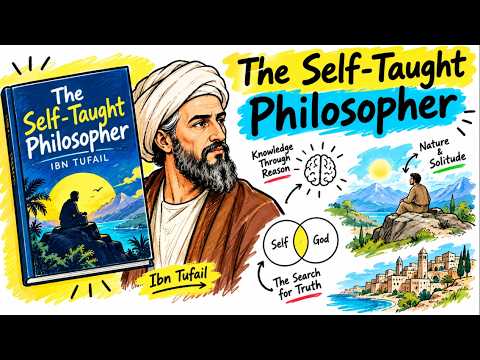
Hayy ibn Yaqzan, written by the twelfth-century Andalusian philosopher Ibn Tufayl, may be the most remarkable book most people have never heard of. It is a philosophical novel, written centuries before the form supposedly existed, about a child who grows up entirely alone on a desert island, raised by a gazelle, with no language, no teachers, and no society. Through observation and reason alone, Hayy gradually works out the structure of the natural world, the existence of the soul, and finally the reality of God. It is a thought experiment with a thrilling question at its heart: how much truth could a single mind reach with no help at all?
Here is what Hayy ibn Yaqzan taught me about the power of unaided reason, about the harmony of reason and faith, and about the lonely gap between the truth and the crowd.
Key takeaways
- Reason alone can reach profound truths, even without society or revelation.
- Reason and authentic faith point to the same reality, arrived at by different roads.
- Nature is a book that the attentive mind can learn to read.
- The deepest truths are hard to share; most people are not ready to hear them.
- It anticipates the philosophical novel and even later “desert island” stories by centuries.
A mind building the world from scratch
The genius of the book is its patience. We watch Hayy progress, step by careful step, from a helpless infant imitating the animals to a mature philosopher. He learns to make fire, to dissect and understand bodies, to distinguish the living from the dead, and then to reason upward from the changing physical world to the unchanging cause behind it. Ibn Tufayl is making a bold claim: that the essential truths about reality and the divine are written into the world itself, accessible to any mind that observes carefully and reasons honestly. Reading it, I felt the quiet thrill of watching a human being think their way, alone, toward the largest questions there are.
Reason and faith, two roads to one summit
The deeper purpose of the story emerges near the end, when Hayy finally encounters another human being, a devout man from a nearby island named Absal. To their mutual astonishment, they discover that the truths Hayy reached through pure reason and the truths Absal received through religious revelation are the same. This is Ibn Tufayl’s great theme, the harmony of reason and faith. They are not enemies but two routes to a single reality, one through the careful use of the mind, the other through revelation. In an age when reason and religion are so often set against each other, this medieval Muslim philosopher’s confidence that they ultimately agree feels both generous and bracing.
The truth and the crowd
The ending is the part that has stayed with me, because it is so unromantic. Hayy, full of the truths he has discovered, travels with Absal to the inhabited island to teach the people. It does not go well. The ordinary people cannot follow his subtle reasoning; they need the simpler images and rules of conventional religion to live decently, and Hayy’s pure philosophy only confuses and disturbs them. He concludes, sadly, that the unveiled truth is not for everyone, and withdraws again to his solitude. There is a hard wisdom here about the gap between contemplative insight and social life, and about the limits of trying to hand people a truth they are not ready to receive.
What I’m taking with me
Hayy ibn Yaqzan is a small marvel, a medieval book that anticipates the novel, the desert-island tale, and some of the great debates of the Enlightenment. What I am taking from it is its central faith, that an honest mind, attending closely to the world, can reach real truth, and its central caution, that such truth is often lonely and hard to share. Ibn Tufayl leaves me admiring the power of reason and humbled by its solitude, and quietly hopeful that reason and faith, pursued honestly, are climbing the same mountain from different sides.
Frequently asked questions
What is Hayy ibn Yaqzan about?
It is a twelfth-century philosophical novel by Ibn Tufayl about a boy who grows up alone on a desert island and, through observation and reason alone, discovers the truths of nature, the soul, and God.
What is the main idea of Hayy ibn Yaqzan?
That human reason, unaided by society or revelation, can reach profound truths, and that the conclusions of reason and the truths of authentic faith ultimately agree.
Why is Hayy ibn Yaqzan historically important?
It is one of the earliest philosophical novels, influenced later European thought and the “desert island” genre, and offers a powerful medieval argument for the harmony of reason and faith.
References & further reading
- Ibn Tufayl. Hayy ibn Yaqzan. (Translated by Lenn Evan Goodman, Twayne, 1972.)
- Conrad, Lawrence I. (ed.). The World of Ibn Tufayl. Brill, 1996.
- Fakhry, Majid. A History of Islamic Philosophy. Columbia University Press, 1970.
Watch: others on this book

Read along with me
Book notes, philosophy and the ideas that shape how we build. New essays every month, no spam.
Related reading notes
Exploring the Depths of "The Incoherence of the Incoherence"
In the vast ocean of philosophical discourse, certain works emerge as guiding stars, illuminating the path to deeper understanding and critical inquiry.
Unveiling the Wisdom of "The Incoherence of the Philosophers"
In the realm of philosophical discourse, few works stand as towering monuments of intellectual inquiry like "The Incoherence of the Philosophers".
The Floating Man: Avicenna and the Mystery of the Self
Avicenna's Floating Man thought experiment: why self-awareness needs no senses, and how it anticipated Descartes' cogito by six centuries.
Comments
No comments yet. Start the conversation.