The Realization of Life: Rabindranath Tagore's "Sadhana"
In one breath
In Sadhana, Nobel laureate Rabindranath Tagore distills the wisdom of the Upanishads into poetic essays on realizing life's fullness. We are one with nature and all life, the infinite is found within the finite and the self is realized through union, love and joy, seeking harmony with the world rather than conquest.
On this page
Rabindranath Tagore’s Sadhana: The Realisation of Life is a series of meditative essays by the great Bengali poet, the first non-European to win the Nobel Prize in Literature, in which he distils the spiritual wisdom of the ancient Indian tradition, especially the Upanishads, into a vision of life as a journey toward harmony, wholeness, and the realisation of our deepest self. The word “sadhana” means spiritual practice or realisation, and the book is Tagore’s reflection on how we might realise the fullness of life: our unity with nature, with one another, and with the infinite. Written with the beauty and warmth of a poet rather than the dryness of a theologian, it offers a serene, hopeful, and deeply attractive vision of human existence, one that gently challenges the divisions and alienations of modern life.
Here is what Sadhana taught me about our unity with the whole, about finding the infinite in the finite, and about realising life through love and joy.
Key takeaways
- We are one with nature and all life, not separate from the world.
- The infinite is found within the finite, the eternal within the everyday.
- The self is realised not by isolation but by union with the larger whole.
- Love and joy are the means of realising life’s fullness.
- Harmony, not conquest, is the right relationship with the world.
Our unity with the whole
At the heart of Tagore’s vision is the conviction, drawn from the Upanishads, that we are not isolated, separate selves cut off from the world, but are deeply, essentially one with all of nature and all of life. Tagore contrasts what he sees as the Western tendency to set humanity against nature, to treat the natural world as something separate, to be conquered and exploited, with the ancient Indian sensibility, nurtured in the forest hermitages where the sages dwelt, of profound unity and kinship with nature. On this view, we are not strangers in a hostile or indifferent universe but participants in a living whole, bound to the trees, the rivers, the animals, the stars, and to one another, by a deep underlying unity. To realise life, for Tagore, begins with awakening to this unity, with overcoming the illusion of our separateness and feeling our true kinship with the whole of existence. This is a healing vision, and one that speaks powerfully to a modern world that has too often set itself apart from and against nature, with consequences we are only now reckoning with.
The infinite in the finite
One of Tagore’s most beautiful and characteristic themes is that the infinite, the divine, the eternal, is not to be sought by fleeing the world but is found within it, present in the finite things of everyday life. Tagore’s is not a spirituality of renunciation and withdrawal, of rejecting the world as illusion or distraction in order to reach some far-off heaven. Rather, he finds the infinite shining through the finite: in the beauty of nature, in human love, in the ordinary activities and relationships of daily life, in joy and creativity and work. The eternal is woven into the everyday, the boundless revealed in the bounded, and the spiritual life consists not in escaping the finite world but in perceiving and realising the infinite that dwells within it. This is a profoundly affirming view of life and the world, one that sanctifies the ordinary and finds the sacred not elsewhere but here, in the very texture of our embodied, relational, everyday existence. To live spiritually, for Tagore, is not to turn away from life but to enter into it more deeply, with eyes open to the infinite present in every finite thing.
Realising life through love and joy
How, then, do we realise the fullness of life and our unity with the whole? Tagore’s answer is not through ascetic discipline or intellectual doctrine but through love and joy. It is love, he argues, that overcomes the barrier of separateness, that unites us with others and with the world, that realises in feeling the unity that is our deepest truth. And it is joy that he places at the very heart of existence: the universe itself, in his vision, springs from and expresses a divine joy, an overflowing creative delight, and to realise life is to participate in that joy, to find delight in beauty, in love, in creation, in the simple fact of being alive in a living world. The self, for Tagore, is realised and fulfilled not by clinging to its own isolation but by giving itself in love, by losing its narrow separateness in union with the larger life. This is the “realisation of life” of his subtitle: a movement from the small, walled-off, anxious self toward harmony, love, joy, and unity with the infinite whole. It is a serene and hopeful vision, free of fear and grasping, and I find it genuinely beautiful.
What I’m taking with me
Sadhana is a luminous, gentle, and profound book, and Tagore’s poetic spirituality has a serene beauty all its own. What I am taking from it is his healing vision of our unity with nature and all life, against the modern illusion of our separateness; his affirming insight that the infinite is found within the finite, the sacred within the everyday; and his teaching that we realise the fullness of life not through withdrawal but through love and joy, through giving ourselves in union with the larger whole. In a fragmented, anxious, and often alienated age, Tagore offers a vision of wholeness, harmony, and joyful belonging that feels like a deep breath, a reminder that to truly live is to awaken to our unity with the world and to enter it, in love and delight, more fully.
Frequently asked questions
What is Sadhana by Tagore about?
It is a series of meditative essays by Rabindranath Tagore distilling the wisdom of the Upanishads into a vision of life as the realisation of our unity with nature, with one another, and with the infinite, achieved through love and joy.
What does “sadhana” mean?
“Sadhana” is a Sanskrit term meaning spiritual practice, discipline, or realisation. Tagore uses it for the journey toward realising the fullness of life and our unity with the larger whole, hence the subtitle “The Realisation of Life.”
How does Tagore say we should relate to nature?
In harmony and unity rather than conquest. Tagore contrasts the modern tendency to set humanity against nature with the ancient Indian sense of deep kinship with the natural world, urging us to awaken to our oneness with all of life.
References & further reading
- Tagore, Rabindranath. Sadhana: The Realisation of Life. Macmillan, 1913.
- Tagore, Rabindranath. Gitanjali. 1912.
- The Upanishads. (Translated by Max Müller, Sacred Books of the East, 1879–1884.)
Watch: others on this book
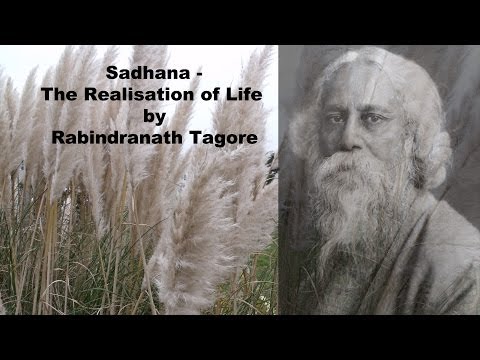

Read along with me
Book notes, philosophy and the ideas that shape how we build. New essays every month, no spam.
Related reading notes
Reconnecting with Nature: Rediscovering Our Natural Rhythms
Reconnecting with nature: how modern city life pulls us away from our natural rhythms, and how to recover the balance our ancestors lived by.

Knowing the Self, Knowing the Divine: Al-Ghazali's "The Alchemy of Happiness"
Al-Ghazali is one of the towering figures of Islamic thought, a jurist and theologian so influential he was called the Proof of Islam.
Duty Without Attachment: Lessons from the "Bhagavad Gita"
Lessons from the Bhagavad Gita: act without attachment to results, why inaction is not an escape, and the many paths to the divine.
Comments
No comments yet. Start the conversation.