The Journey to the Self: Attar's "The Conference of the Birds"
In one breath
In Attar's 12th-century Sufi masterpiece, the world's birds set out with a hoopoe to find the Simurgh, their true king. Each bird's excuse mirrors a human attachment; the seven valleys map the spiritual path; and at the end, the thirty surviving birds (si murgh) discover that the Simurgh they sought is themselves.
On this page
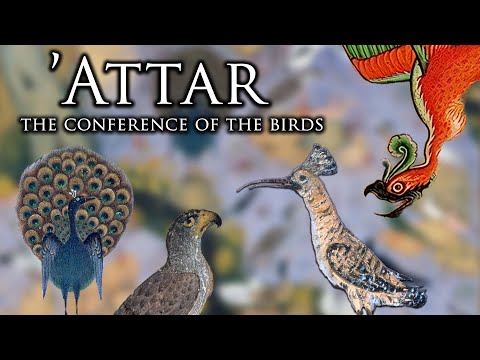
Farid ud-Din Attar’s The Conference of the Birds, written in twelfth-century Persia, is one of the masterpieces of Sufi literature, and it disguises its profundity inside a charming fable. All the birds of the world gather to seek a king, and a wise hoopoe tells them of the Simurgh, the great mythical bird who is the true sovereign, dwelling beyond a series of perilous valleys. The poem is the story of their journey toward him. It sounds like a fairy tale, and on one level it is. On another, it is a precise and demanding map of the spiritual path, with an ending so perfect it took my breath away.
Here is what The Conference of the Birds taught me about the excuses that keep us from the journey, about the valleys we must cross, and about the secret hidden in the Simurgh’s name.
Key takeaways
- The birds are us; each represents a human type with its own attachments and excuses.
- The seven valleys map the stages of the spiritual journey, from longing to annihilation.
- Most seekers fall away; the path demands everything, and few will pay the price.
- The final revelation is a pun: the Simurgh they sought turns out to be themselves.
- The divine is not elsewhere but discovered within, once the self is purified.
The birds and their excuses
Before the journey begins, the birds make excuses, and these are the most human part of the poem. The nightingale is too in love with the rose to leave; the parrot wants only its freedom; the peacock longs to return to paradise rather than seek its Lord; others plead weakness, fear, or attachment to gold. The hoopoe answers each in turn, exposing how their excuses are really attachments dressed up as reasons. I saw myself in this gallery uncomfortably often. We are all experts at producing dignified reasons not to begin the journey we know we should make, and Attar names them with gentle, devastating accuracy.
The seven valleys
Those birds who do set out must cross seven valleys, and these form the spiritual core of the poem: the valleys of Quest, Love, Knowledge, Detachment, Unity, Bewilderment, and finally Poverty and Annihilation. Each stage strips away more of the self, more attachment, more illusion, more of the ego’s certainty. The journey grows harder, not easier, the further it goes, and the final valley is the dissolving of the self entirely. This is the Sufi path of fana, the annihilation of the ego in the divine. Attar does not pretend it is gentle. The road to the Simurgh costs the seeker everything they thought they were.
The pun at the end of the world
After unimaginable hardship, only thirty birds survive to reach the court of the Simurgh, and here Attar delivers one of the most beautiful endings in all of literature, built on a pun. In Persian, si murgh means “thirty birds.” The thirty exhausted survivors arrive seeking the Simurgh, and discover that the Simurgh is themselves, their own purified collective being reflected back. The king they crossed the world to find was within them all along, hidden beneath everything they had to shed to get there. I find this ending almost unbearably moving. The divine was never somewhere else. The whole impossible journey was a journey into the self.
What I’m taking with me
The Conference of the Birds is a fable, a poem, and a spiritual handbook at once, and it rewards every level of reading. What I am taking from it is the recognition of my own excuses, the sobering honesty about how much the inner journey costs, and above all that luminous final pun, the discovery that what we seek most desperately outside ourselves may be waiting within, recognisable only once we have shed everything that hid it. The Simurgh, Attar reminds me, is closer than I think, and farther than I want.
Frequently asked questions
What is The Conference of the Birds about?
It is a Sufi allegorical poem in which the birds of the world journey across seven valleys in search of their king, the Simurgh, as a symbol of the soul’s difficult journey toward the divine.
What do the seven valleys represent?
The stages of the spiritual path, including Quest, Love, Knowledge, Detachment, Unity, Bewilderment, and Annihilation, each stripping away more of the ego on the way to union with the divine.
What is the meaning of the ending?
The thirty surviving birds discover that the Simurgh they sought is themselves, a pun on the Persian “si murgh” (thirty birds), revealing that the divine they searched for is found within.
References & further reading
- Attar, Farid ud-Din. The Conference of the Birds. (Translated by Afkham Darbandi and Dick Davis, Penguin Classics, 1984.)
- Schimmel, Annemarie. Mystical Dimensions of Islam. University of North Carolina Press, 1975.
- Nott, C. S. (trans.). The Conference of the Birds. 1954.
Watch: others on this book

Read along with me
Book notes, philosophy and the ideas that shape how we build. New essays every month, no spam.
Related reading notes
The Lover's Religion: Reflections on the Poetry of Rumi
There is a reason Rumi, a thirteenth-century Persian mystic and jurist, is one of the best-selling poets in the modern world.
Knowing the Self, Knowing the Divine: Al-Ghazali's "The Alchemy of Happiness"
Al-Ghazali is one of the towering figures of Islamic thought, a jurist and theologian so influential he was called the Proof of Islam.
Embarking on a Spiritual Odyssey: Reflections on "The Varieties of Religious Experience" by William James
Hey there, fellow seekers of enlightenment! Today, I'm thrilled to invite you on a transformative journey through the realms of human spirituality.
Comments
No comments yet. Start the conversation.