The Hedgehog and the Fox: Isaiah Berlin on Two Ways of Knowing
In one breath
Isaiah Berlin builds his essay on a fragment by Archilochus: the fox knows many things, the hedgehog one big thing. Hedgehogs relate everything to a single vision; foxes pursue many, even contradictory, ideas. His diagnosis of Tolstoy as a fox who longed to be a hedgehog became a lasting lens for thinkers and ourselves.
On this page
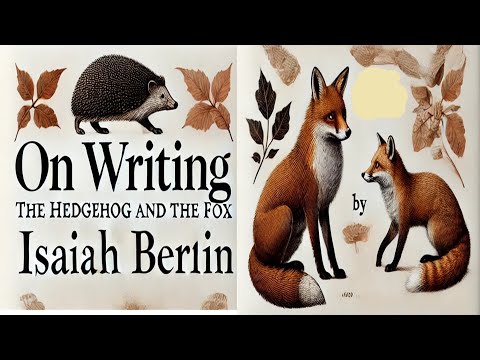
Isaiah Berlin’s The Hedgehog and the Fox is a short, dazzling essay built around a single fragment from the ancient Greek poet Archilochus: “the fox knows many things, but the hedgehog knows one big thing.” Berlin takes this enigmatic line and turns it into one of the most useful distinctions in all of intellectual life, a way of dividing thinkers, writers, and indeed people, into two great temperaments. The hedgehogs relate everything to a single central vision; the foxes pursue many ideas at once, distrustful of grand unifying systems. Ostensibly an essay about Tolstoy’s philosophy of history, it became famous as a meditation on these two fundamental ways of seeing the world.
Here is what The Hedgehog and the Fox taught me about the two great types of mind, about Tolstoy’s inner conflict, and about which kind of thinker I am.
Key takeaways
- The hedgehog knows one big thing, relating all to a single unifying idea.
- The fox knows many things, pursuing varied, even contradictory, ideas.
- Tolstoy was a fox who longed to be a hedgehog, and this is the tragedy Berlin diagnoses.
- Neither type is superior; each is a way of grasping reality.
- The distinction illuminates thinkers, art, and ourselves.
Two kinds of mind
Berlin develops the ancient fragment into a rich typology. The hedgehogs are those who relate everything to a single, central, unifying vision, one organising principle or system in terms of which they understand all of reality; their thought has a deep unity and coherence. Plato, Dante, Hegel, Nietzsche, Berlin suggests, are hedgehogs. The foxes, by contrast, pursue many different ends and ideas, often unrelated or even contradictory; they are skeptical of grand systems, drawn to the variety and particularity of experience, comfortable with multiplicity and inconsistency. Shakespeare, Aristotle, Montaigne, Goethe are foxes. Berlin is careful to say this is at first a playful distinction, not to be pressed too hard. But it captures something real and illuminating about how different minds work, and once you have it, you find yourself sorting everyone you read, and yourself, into hedgehogs and foxes.
Tolstoy’s tragedy
The heart of the essay is Berlin’s brilliant application of the distinction to Tolstoy, and his diagnosis is subtle and moving. Tolstoy, Berlin argues, was by nature a fox, possessed of an unrivalled gift for perceiving the immense variety, particularity, and irreducible multiplicity of life, the very quality that makes War and Peace and Anna Karenina so overwhelmingly real. No writer saw the manifold texture of human existence more clearly. And yet Tolstoy longed, with his whole soul, to be a hedgehog, to find and proclaim a single, unifying truth that would make sense of everything, a grand theory of history, a simple moral and religious vision. This is the tragic conflict Berlin sees at the centre of Tolstoy: a fox’s incomparable vision warring with a hedgehog’s desperate need for unity, a man whose genius lay in seeing the many while he craved the one. It is one of the most penetrating pieces of literary and psychological insight I have read, illuminating both Tolstoy and the deep human tension between the love of variety and the longing for unity.
Which are you?
What makes the essay so enjoyable, and so lasting, is that the distinction does not stay confined to famous thinkers; it immediately turns into a mirror. Reading it, I could not help asking which I am, hedgehog or fox? Do I seek one grand unifying idea to make sense of everything, or do I delight in the many, distrustful of systems, drawn to variety and the particular case? Most of us, I suspect, are mixtures, with a dominant tendency. Berlin is wise enough not to declare one type superior; both the hedgehog’s depth and unity and the fox’s range and realism are genuine ways of grasping the world, each with its strengths and its blind spots. The hedgehog risks forcing reality into a single mould; the fox risks never arriving at any settled conviction. The value of the distinction is the self-knowledge it offers, the recognition of one’s own cast of mind, and perhaps the encouragement to borrow a little from the opposite type.
What I’m taking with me
The Hedgehog and the Fox is a small masterpiece that gave me a lens I now use constantly. What I am taking from Berlin is the rich distinction between the hedgehog, who knows one big thing, and the fox, who knows many; his beautiful diagnosis of Tolstoy as a fox tormented by the longing to be a hedgehog; and the gentle self-examination the essay invites, asking which kind of mind is mine. Berlin reminds me that there is more than one way to grasp reality, that depth and breadth are different gifts, and that knowing one’s own intellectual temperament, and respecting the opposite, is a kind of wisdom in itself.
Frequently asked questions
What is The Hedgehog and the Fox about?
It is Isaiah Berlin’s essay using the line “the fox knows many things, but the hedgehog knows one big thing” to distinguish two types of thinkers, and to analyze Tolstoy’s philosophy of history.
What is the difference between a hedgehog and a fox?
A hedgehog relates everything to a single central vision or system, while a fox pursues many varied, even contradictory ideas and distrusts grand unifying theories. Neither is presented as superior.
Why does Berlin call Tolstoy a fox who wanted to be a hedgehog?
Because Tolstoy’s genius lay in perceiving the immense variety of life (a fox’s gift), yet he longed to find a single unifying truth (a hedgehog’s aim). Berlin sees this conflict as the tragedy at the heart of Tolstoy.
References & further reading
- Berlin, Isaiah. The Hedgehog and the Fox: An Essay on Tolstoy’s View of History. Weidenfeld & Nicolson, 1953.
- Berlin, Isaiah. Russian Thinkers. Hogarth Press, 1978.
- Berlin, Isaiah. The Proper Study of Mankind (anthology). Chatto & Windus, 1997.
Watch: others on this book

Read along with me
Book notes, philosophy and the ideas that shape how we build. New essays every month, no spam.
Related reading notes
History, Fate, and the Individual: Tolstoy's "War and Peace"
To read Tolstoy's War and Peace is to live, for a few hundred hours, inside an entire world.
Unraveling America's Intellectual Tapestry: Insights from "The Metaphysical Club" by Louis Menand
Picture this: a bustling intellectual crossroads where minds collide and ideas intertwine.
A Map of the Mind's Long Journey: Russell's "A History of Western Philosophy"
Bertrand Russell's A History of Western Philosophy: a witty, opinionated tour from the Greeks to the 20th century, and why it is still worth reading.
Comments
No comments yet. Start the conversation.