History, Fate, and the Individual: Tolstoy's "War and Peace"
In one breath
War and Peace follows Pierre, Andrei, Natasha and dozens more through Napoleon's invasion of Russia. Woven through the story is Tolstoy's argument that history is moved by countless ordinary actions rather than great men, and that life's meaning lives in family, love and simple presence.
On this page
To read Tolstoy’s War and Peace is to live, for a few hundred hours, inside an entire world. Set against Napoleon’s invasion of Russia, it follows dozens of characters, the searching Pierre, the noble Andrei, the radiant Natasha, through war, peace, love, death, and the slow turning of history. It is so vast that people joke about ever finishing it, but its size is the point: Tolstoy is trying to capture nothing less than the whole texture of human life and to answer the largest question of all, what actually moves history. The story carries you, but woven through it is a profound and stubborn argument about fate, freedom, and the limits of the great man.
Here is what War and Peace taught me about the forces that drive history, about the illusion of the great man, and about where Tolstoy locates the meaning of a life.
Key takeaways
- History is not made by great men but by countless small actions of ordinary people.
- Leaders like Napoleon are carried by events more than they command them.
- Meaning is found in ordinary life, in family, love, and simple presence.
- Pierre’s search for how to live is the moral center of the novel.
- Acceptance and love, not grand theories, are Tolstoy’s answer to existence.
What really moves history
Tolstoy is obsessed, throughout the novel and especially in its famous essayistic passages, with a single question: what causes the great events of history? The conventional answer credits great men, kings, generals, Napoleons, who supposedly bend the world to their will. Tolstoy rejects this with passion. History, he argues, is the sum of an incalculable number of individual human wills and actions, the soldier who runs or stands, the peasant who plants or flees, the thousand tiny decisions that no leader controls. Napoleon imagines he is directing the battle, but he is really being swept along by forces far larger than himself, no more in command than a child holding ribbons inside a moving carriage and believing he is driving it. It is a humbling, almost democratic vision of history, made not from above but from below.
The illusion of the great man
This conviction gives the novel some of its most memorable scenes. We see Napoleon, the supposed master of Europe, reduced to a vain, deluded man issuing orders that no longer matter once the chaos of battle takes over. And we see, by contrast, the old Russian general Kutuzov, who succeeds precisely because he understands that he cannot control events, and so he waits, yields, and lets the deeper forces, exhaustion, winter, the spirit of a people, do their work. Tolstoy is attacking the cult of the heroic individual at the very moment Europe was busy building it. Real power, he suggests, is not in the loud man who thinks he commands but in the vast, patient, collective life of ordinary people. I found this a bracing antidote to our own endless worship of leaders and “great men.”
Where life’s meaning lives
But War and Peace is not finally a book about history; it is a book about how to live, and that question belongs above all to Pierre. Awkward, wealthy, endlessly searching, Pierre tries everything, dissipation, idealism, secret societies, grand schemes to remake the world, looking for the meaning of life in theories and causes. He finds it, eventually, in the simplest place: in ordinary human life, in love, family, presence, and the humble acceptance of things as they are. It is the same conclusion Levin reaches in Anna Karenina, the same one Tolstoy spent his own life circling. The meaning we chase in grand abstractions is waiting, all along, in the unremarkable fabric of daily love and connection.
What I’m taking with me
Finishing War and Peace feels less like completing a book than like emerging from a second life. What I am taking from it is its great double lesson: a profound skepticism toward the cult of the great man, and a deep faith in the ordinary. History, Tolstoy insists, is made by all of us together, not by a heroic few, and the meaning of a life is found not in grand schemes but in love, family, and the humble acceptance of what is. For all its philosophical ambition, the novel’s final wisdom is almost tender, and I will carry it for a long time.
Frequently asked questions
What is War and Peace about?
Set during Napoleon’s invasion of Russia, it follows several aristocratic families through war and peace, weaving an enormous human story together with Tolstoy’s reflections on history, fate, and the meaning of life.
What is Tolstoy’s theory of history in War and Peace?
That history is not driven by great men but by the countless actions of ordinary people. Leaders like Napoleon are carried along by vast forces they imagine they control but do not.
Where does Tolstoy say meaning is found?
In ordinary life, in love, family, and simple presence, rather than in grand theories or causes. This is the realization the searching Pierre finally reaches.
References & further reading
- Tolstoy, Leo. War and Peace. (Translated by Louise and Aylmer Maude; or Constance Garnett.)
- Berlin, Isaiah. The Hedgehog and the Fox. Weidenfeld & Nicolson, 1953.
- Bayley, John. Tolstoy and the Novel. Chatto & Windus, 1966.
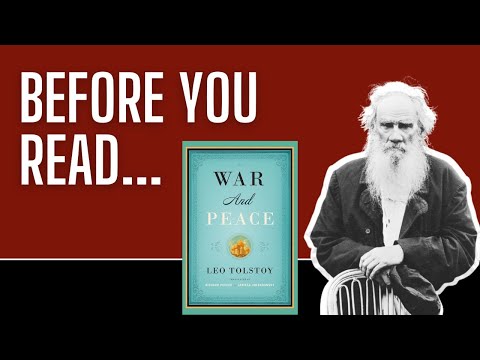
Watch: others on this book

Read along with me
Book notes, philosophy and the ideas that shape how we build. New essays every month, no spam.
Related reading notes
All Happy Families: Love, Society, and Ruin in Tolstoy's "Anna Karenina"
Tolstoy's Anna Karenina: passion, society's hypocrisy and the search for meaning, told through Anna's ruin and Levin's quiet search for a good life.
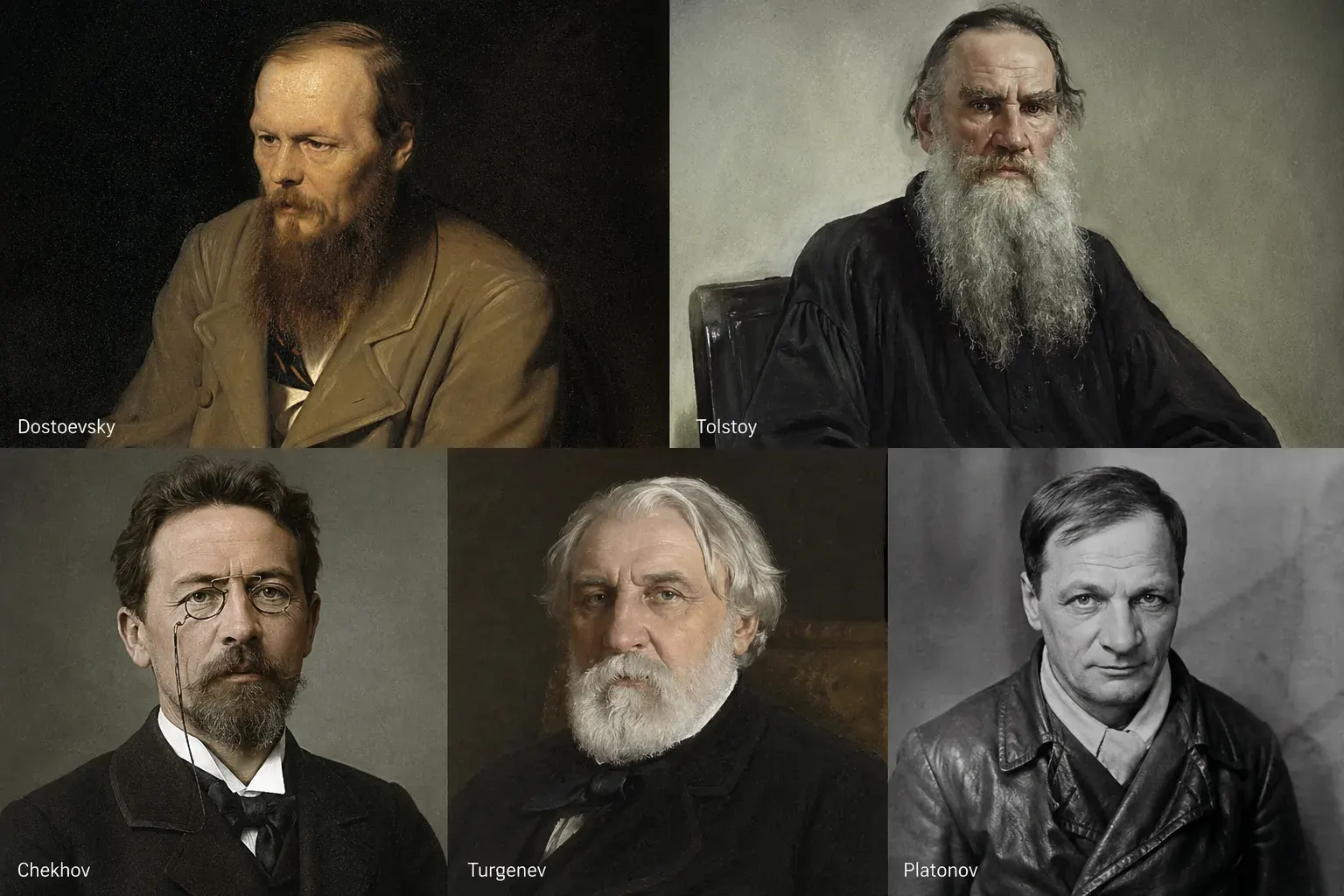
Dostoevsky, Tolstoy, Chekhov, Turgenev and Platonov
Where to start with Russian literature: essential works by Dostoevsky, Tolstoy, Chekhov, Gogol, Turgenev and Platonov, and why each is worth reading.
Facing the End: Tolstoy's "The Death of Ivan Ilyich" and a Life Well Lived
Tolstoy's The Death of Ivan Ilyich: a respectable life revealed as hollow, the lie of denying death, and the question of whether we lived rightly.
Comments
No comments yet. Start the conversation.