The Dunning-Kruger Effect: When Ignorance Breeds Confidence
TL;DR
The Dunning-Kruger effect, named after psychologists David Dunning and Justin Kruger, describes how people with low ability in a skill tend to overestimate it because they lack the knowledge to judge themselves, while experts often underestimate theirs. Understanding it encourages humility, feedback and continuous learning.
On this page
Ever met someone who seems cluelessly overconfident in their abilities? Perhaps a driver weaving dangerously while claiming to be a “defensive pro,” or a cook serving burnt offerings insisting they’re a “master chef.” This intriguing phenomenon, where people with low ability overestimate their skills, is known as the Dunning-Kruger effect.
Named after psychologists David Dunning and Justin Kruger, this cognitive bias highlights a fascinating twist in human self-perception. Those lacking the knowledge or expertise to accurately assess their own performance tend to inflate their abilities, mistaking their limited understanding for mastery.
Why Does This Happen?
Imagine a pyramid of knowledge for a specific skill, like driving. Beginners occupy the base, gradually accumulating knowledge as they climb. However, at the base, they lack the perspective to recognize the vastness of knowledge above them. This limited view leads to an **overestimation of their actual position on the pyramid,** creating an inflated sense of skill.

The Double-Edged Sword
The Dunning-Kruger effect has two fascinating sides:
Overestimation of low ability:
- Poor decision-making: Think of the “know-it-all” who stubbornly clings to wrong information, leading to potentially harmful outcomes.
- Risky behavior: The overconfident driver weaving through traffic, putting themselves and others at risk.
- Resistance to learning: Believing they already know everything, they miss opportunities to improve.
Underestimation of high ability:
- Self-doubt: Questioning their skills despite being objectively talented.
- Reluctance to share knowledge: Undervaluing their expertise, they may hold back from teaching or mentoring others.
Beyond the Buzzword
It’s important to remember that the Dunning-Kruger effect is a complex phenomenon with ongoing research and debate. It’s not a universal rule, and individual variations exist. Moreover, attributing someone’s behavior solely to this effect can be oversimplifying and potentially offensive.
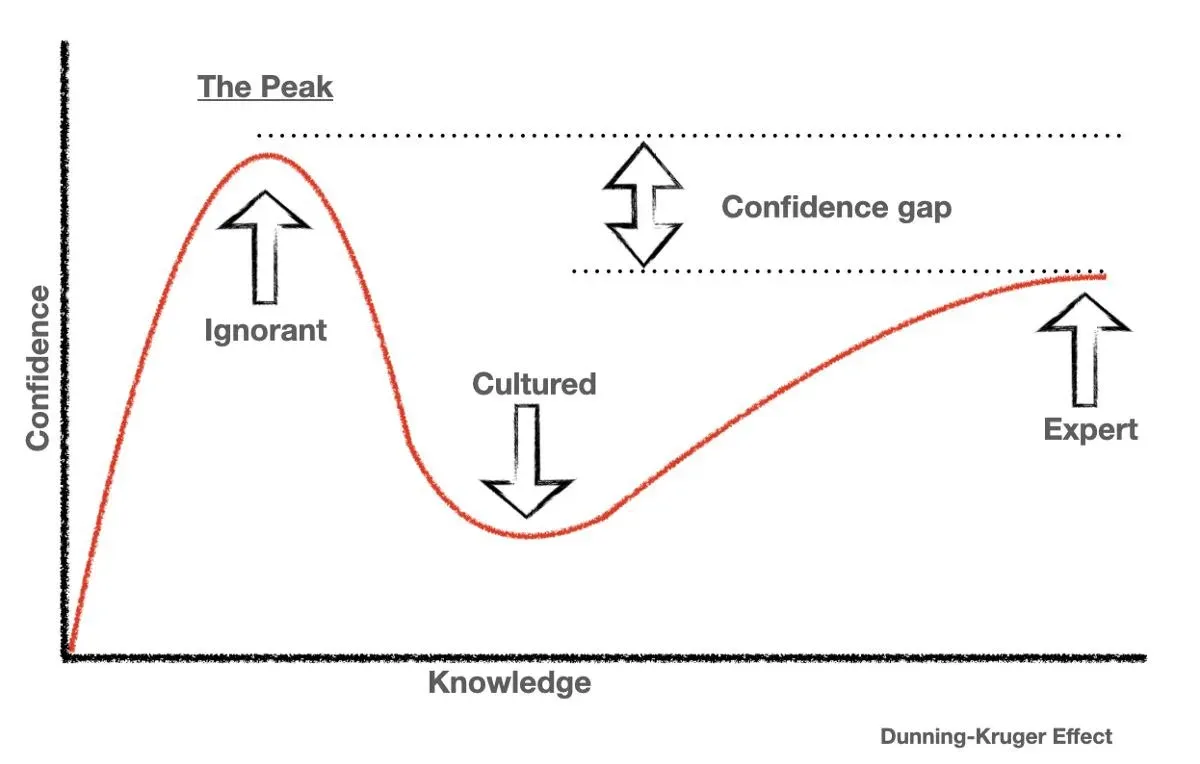
However, understanding the Dunning-Kruger effect can offer valuable insights:
For individuals:
- Recognizing our own susceptibility to cognitive biases can encourage self-reflection and foster a growth mindset.
- Seeking feedback from trusted sources can help us calibrate our self-assessment.
For educators and leaders:
- Creating learning environments that promote metacognition and self-evaluation can empower individuals to improve their skills and close the gap between perceived and actual competence.
For society:
- Recognizing the limitations of overconfidence can lead to more informed decision-making in various spheres, from politics to healthcare.
Remember, the Dunning-Kruger effect is not about shaming individuals but understanding the complexities of self-perception and the importance of seeking diverse perspectives to bridge the gap between our perceived and actual abilities.
Stay curious, stay humble, and keep learning!
References:
Key takeaways 5
- People with low skill often overestimate their ability.
- Lacking skill also means lacking the ability to judge it.
- Experts may underestimate themselves, assuming tasks are easy for everyone.
- Feedback and diverse perspectives correct self-perception.
- Stay curious and humble; it is not about shaming people.
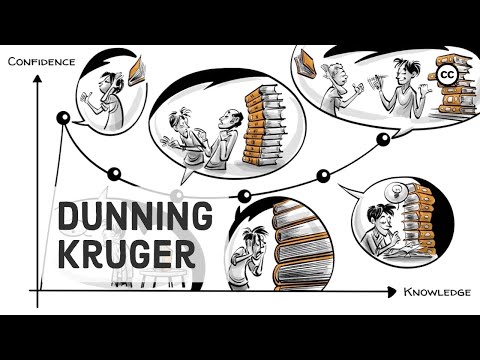
Watch & learn
Frequently asked questions
What is the Dunning-Kruger effect?
It is a cognitive bias in which people with limited competence in an area overestimate their ability, because the skills needed to perform well are also needed to recognize good performance.
Who discovered the Dunning-Kruger effect?
Psychologists David Dunning and Justin Kruger described it in a 1999 study at Cornell University.
How can I avoid the Dunning-Kruger effect?
Seek honest feedback, compare your work with experts, keep learning, test your knowledge and stay open to the possibility that you are wrong.
Learn it hands-on at AL Academy
Free practical programs in software, automation and IT, with labs and certificates.
Related articles

AI Tutors & Personalized Learning
For forty years we have known one-to-one tutoring works almost magically well, and we could never afford it. Large language models change the math - but only if we remember that the model was never the teacher.
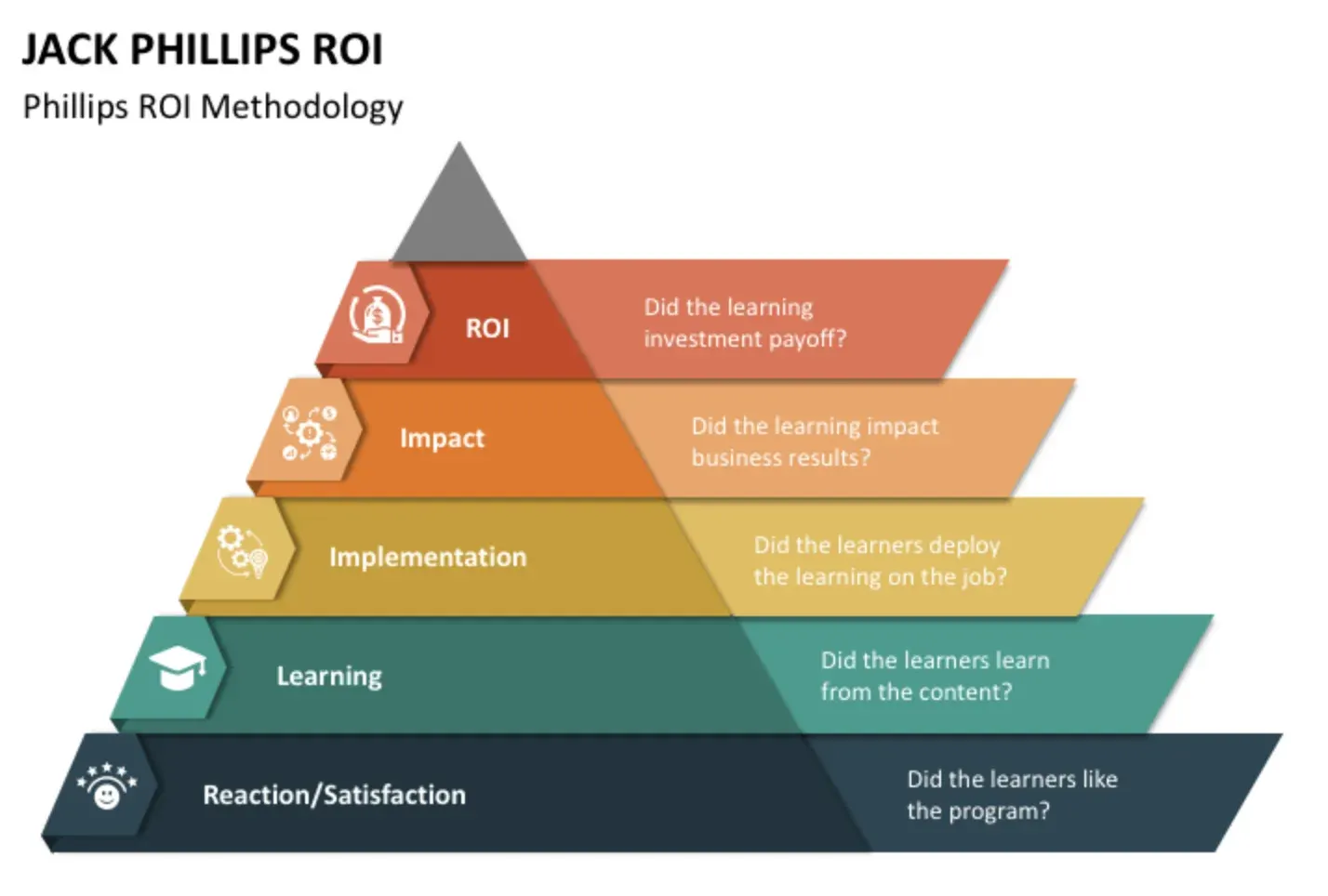
Measuring Training Effectiveness (ROI)
Most training is measured by accident - attendance, smile sheets, hours delivered. Here is how to prove what learning is actually worth, and why the conservative number wins.
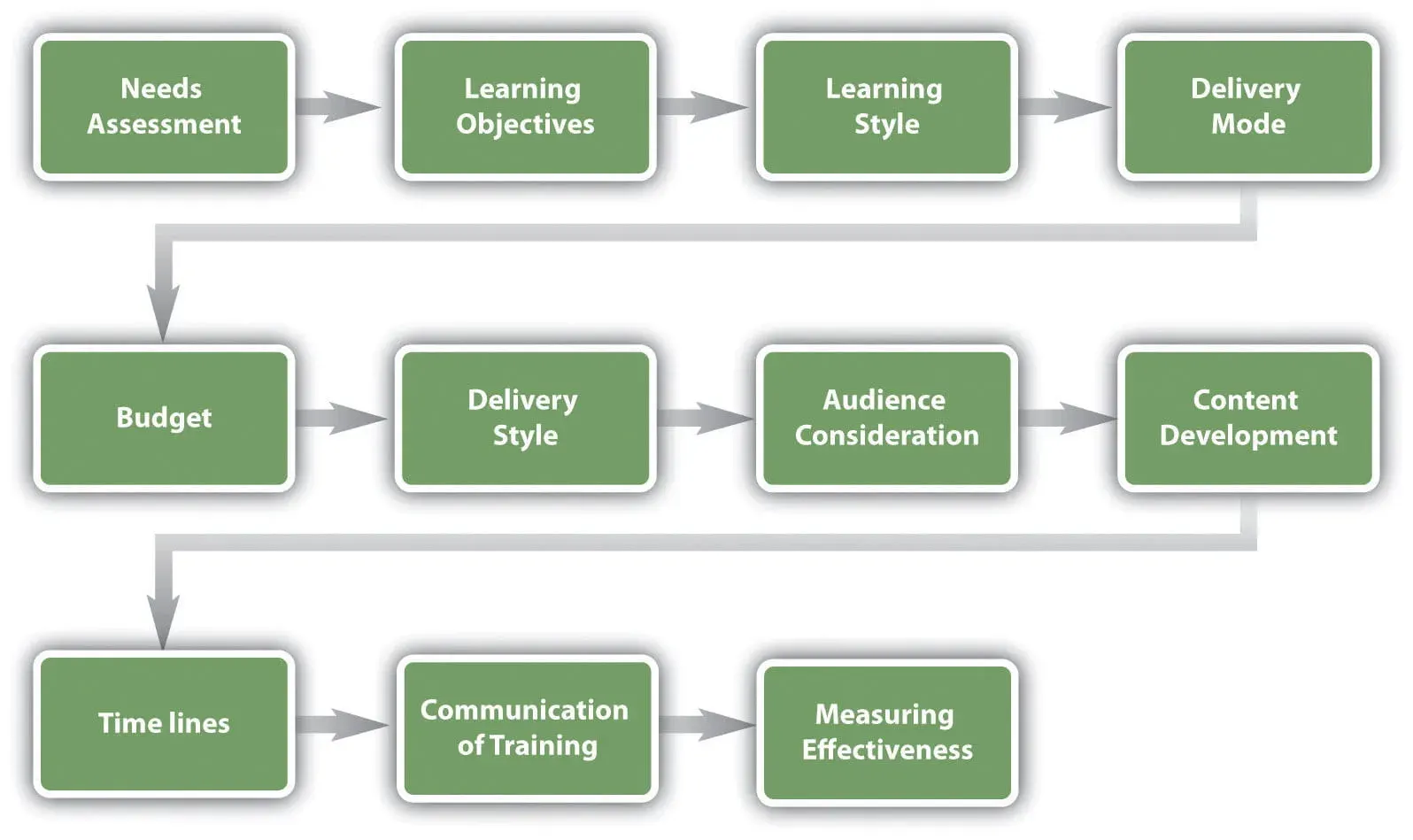
Designing Effective Technical Training
Your best engineer giving a workshop that flops is not a paradox. Expertise and the ability to teach are two different skills - and the gap between them is predictable, well-studied, and fixable.
Comments
No comments yet. Start the conversation.