The Butterfly Dream: Freedom and Flow in Zhuangzi
In one breath
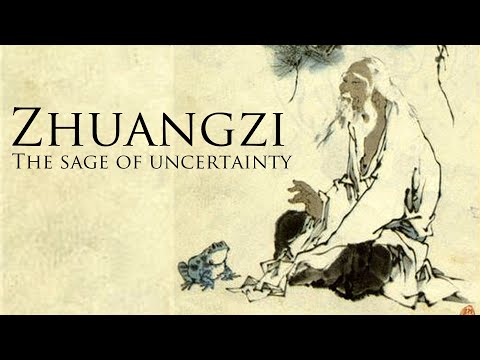
Zhuangzi is the laughing face of Taoism. Through jokes and strange tales, including the famous butterfly dream, he loosens our certainties: right and wrong depend on viewpoint, the useless escapes being used up, skill becomes effortless when we stop forcing, and freedom means wandering with the transformation of things.
On this page
If the Tao Te Ching is the calm, aphoristic face of Taoism, Zhuangzi is its laughing, mischievous one. The Inner Chapters attributed to him are full of jokes, tall tales, talking trees, useless cripples who outlive everyone, and skilled butchers whose blades never dull. Beneath the humour is one of the most liberating philosophies I have encountered, an invitation to stop taking our own certainties so seriously and to flow with the great transformation of things. Zhuangzi does not lecture. He tells a strange story, grins, and lets it loosen something in your mind.
Here is what Zhuangzi taught me about the limits of our certainties, about the freedom of “useless” things, and about the famous dream that dissolves the line between waking and sleeping.
Key takeaways
- The butterfly dream questions how we can be sure of what is real and who we truly are.
- Our judgments of right and wrong are relative, tied to our limited point of view.
- The “useless” is often the most free; what serves no purpose escapes being used up.
- Skill becomes effortless when we stop forcing and move with the grain of things.
- Freedom is wandering, riding the natural transformations rather than clinging to a fixed self.
The dream of the butterfly
The most famous passage in Chinese philosophy is barely a paragraph. Zhuangzi dreamed he was a butterfly, fluttering happily, knowing nothing of being Zhuangzi. Then he woke and was Zhuangzi again. But now he did not know: was he a man who had dreamed he was a butterfly, or was he a butterfly now dreaming he was a man? The little story is bottomless. It unsettles our confidence that we know what is real and who we are. Zhuangzi is not trying to make me doubt everything into paralysis; he is trying to loosen my grip on the certainty that my particular point of view is the final truth. That loosening, it turns out, is the beginning of his freedom.
The relativity of right and wrong
Zhuangzi delights in showing how our judgments depend on where we stand. What is beautiful to one creature is hideous to another; what is useful from one angle is useless from another; what one age calls wisdom, the next calls folly. We argue endlessly about who is right, he observes, each of us trapped inside our own perspective, like a frog at the bottom of a well that thinks the small circle of sky overhead is the whole heavens. He is not saying nothing is true. He is saying that our confident little certainties are far smaller than we imagine, and that wisdom begins when we stop mistaking our well for the sky.
The freedom of being useless
One of Zhuangzi’s favourite themes is the value of uselessness, and it is a deliberate provocation. He tells of a great gnarled tree so twisted and knotty that no carpenter would touch it, and precisely because it was useless, it was never cut down and grew to a vast old age, giving shade to all. The “useful” trees are felled young. There is a quiet rebellion in this against a world that values everything only for what it can produce. To be useless, in Zhuangzi’s sense, is to escape being used up, to belong to oneself. In a culture, his and mine, that measures worth by output, this is a strangely refreshing heresy.
What I’m taking with me
Zhuangzi is the most playful philosopher I know, and his lightness is itself the teaching. What I am taking from the Inner Chapters is a loosened grip: a willingness to hold my own certainties more humbly, to suspect that my point of view is one well among many, and to flow with the transformations of life rather than forcing them. He would not want me to take even his philosophy too seriously. He would want me to laugh, to wander, and to let the butterfly dream remind me how little I really know.
Frequently asked questions
What is the meaning of Zhuangzi’s butterfly dream?
It questions the certainty of reality and identity. If Zhuangzi cannot tell whether he is a man dreaming of a butterfly or a butterfly dreaming of a man, then our confidence about what is real and who we are may be far less secure than we think.
What is the main teaching of Zhuangzi?
That we should free ourselves from rigid judgments and fixed perspectives, flow with the natural transformations of life, and find freedom by not clinging to a single view of the world or the self.
Why does Zhuangzi praise uselessness?
Because what is “useless” is left alone and not exploited or destroyed. The useless tree survives while useful ones are cut down, illustrating a freedom that comes from not being valued only for one’s productivity.
References & further reading
- Zhuangzi. The Complete Works of Chuang Tzu. (Translated by Burton Watson, Columbia University Press, 1968.)
- Graham, A. C. Chuang-tzu: The Inner Chapters. Allen & Unwin, 1981.
- Fung Yu-lan. A Short History of Chinese Philosophy. Macmillan, 1948.
Watch: others on this book

Read along with me
Book notes, philosophy and the ideas that shape how we build. New essays every month, no spam.
Related reading notes
The Way That Cannot Be Named: Exploring Lao Tzu's "Tao Te Ching"
The very first line of the Tao Te Ching tells you that the book is about to fail on purpose: the Tao that can be spoken is not the eternal Tao.
How Freedom Dies: Arendt's "The Origins of Totalitarianism"
Hannah Arendt's The Origins of Totalitarianism: why totalitarianism was new, how loneliness, ideology and terror destroy freedom, and why it matters.
Freedom and Responsibility: Simone de Beauvoir's "The Ethics of Ambiguity"
Simone de Beauvoir's The Ethics of Ambiguity: how existentialist freedom grounds an ethics of responsibility and willing the freedom of others.
Comments
No comments yet. Start the conversation.