Predictive Maintenance with Sensor Data
A machine never fails silently. It hums, it heats, it spikes for weeks before it dies. Predictive maintenance is just the discipline of learning to listen.
TL;DR
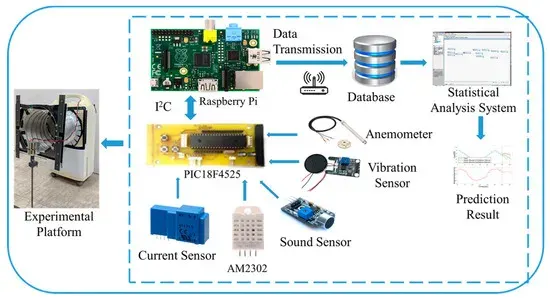
Machines rarely fail silently: vibration, heat and current drift for weeks before a breakdown. Predictive maintenance moves from calendar-based to condition-based maintenance by listening to sensor data. Sensors are the easy part; data plumbing, baselines and, above all, the people who must act on alerts decide success.
On this page
The machine was talking the whole time
The first time I watched a 200-kilowatt pump destroy itself, the post-mortem was almost insulting in its clarity. We pulled the trend data after the fact and there it was: a clean, almost textbook ramp in high-frequency vibration energy, climbing steadily for nine days before the bearing seized and took the shaft with it. The machine had been talking the entire time. We just had not been in the room.
That is the quiet truth at the heart of predictive maintenance. Machines do not fail out of nowhere. Bearings spall, gears wear, rotor bars crack, lubricant breaks down, and every one of those processes leaks energy into the world as vibration, heat, sound, and changes in the current the motor draws. A functional failure is the last event in a long story, not the first. The whole game is to read the earlier chapters.
From the calendar to the condition
For most of the twentieth century, maintenance was governed by the calendar. You changed the oil every so many hours, replaced the bearing every so many months, and hoped the schedule was conservative enough to stay ahead of trouble. It is a comforting model, and it is mostly wrong.
The uncomfortable finding, established decades ago in the reliability studies that gave us Reliability-Centered Maintenance, is that most failures are not age-related. They do not wait politely for the scheduled interval. If a component is roughly as likely to fail in its third month as in its thirtieth, a fixed replacement schedule does the worst of both worlds: it throws away healthy parts while still getting surprised by early failures. You pay for the maintenance and you pay for the downtime.
Predictive maintenance replaces the question “How old is this part?” with a better one: “How is this part actually doing, right now?” Instead of trusting a schedule, you trust the asset to tell you when it needs attention. The schedule does not disappear; it gets demoted from dictator to advisor.
What the sensors actually see
The reason this works is that different physical defects produce different, predictable signatures. A vibration spectrum is close to a fingerprint. Imbalance shouts at the running speed; misalignment rings at twice it; a bearing defect screams in high-frequency bands tied to the exact geometry of the bearing. A trained eye, or a well-built feature, can look at the spectrum and name the fault before anyone has touched the machine.
Vibration is the workhorse, but it is not alone. Temperature is cheap and honest, though it tends to speak late, by the time a bearing runs hot it is often already in trouble. Motor current signature analysis lets you diagnose a motor without touching it, reading mechanical faults in the sidebands of the supply current. Ultrasound hears the earliest whisper of friction and lubrication starvation, long before a human could. Oil analysis reads the wear metals suspended in a gearbox like a blood test reads health. Each modality sees some failures early, others not at all. A serious program layers them, choosing per asset based on which failure modes actually matter and how much warning each technique buys.
The unglamorous middle
Here is where the romance of machine learning meets the reality of the plant floor. Between the raw signal and the useful prediction sits a great deal of unglamorous engineering, and it is where programs are won or lost.
You have to sample fast enough to capture the frequencies that carry the diagnosis; undersample and you turn signal into aliased noise. You have to compress millions of raw points into a handful of features that preserve the symptoms: RMS for overall severity, kurtosis for the impulsiveness of an incipient impact, the FFT to expose which frequencies are ringing. Then, and only then, does a model earn its place, and even there the honest answer is usually modest. Most machines spend almost their entire lives healthy, which means you rarely have examples of failure to learn from. So you do not train a classifier to recognize failure; you teach a model the shape of normal and let it flag the strange. An Isolation Forest watching a few good features will catch more real problems than a neural network fed raw noise.
The hardest part is human
I have seen technically excellent PdM systems die on the floor, and the cause is almost never the model. It is trust. A system that cries wolf three times teaches everyone to ignore the fourth alert, which is the real one. An alert that says “anomaly score 0.87” tells a technician nothing; an alert that says “Pump P-204, bearing-band energy up forty percent over six days, likely outer-race defect, inspect this week” tells them everything. The difference between those two messages is the difference between a program people use and one they route to a folder nobody opens.
So the discipline is as much organizational as technical. Suppress false alarms with persistence logic. Tier your alerts so not every wobble is a midnight phone call. Route them into the work-order system people already live in. Close every alert with a verdict, true or false, and feed that verdict back into the model. Report the savings in the plant’s own money, every quarter, so the program keeps its budget.
Learning to be in the room
Predictive maintenance is not really about sensors or algorithms. Those are means. It is about choosing to be in the room when the machine talks, and committing to act on what you hear. The pump that destroyed itself on my watch was not a failure of technology. The data existed. The signal was clean. We simply had not yet built the habit of listening. Building that habit, sensor by sensor, alert by trusted alert, is the whole job.
Key takeaways 5
- Failures announce themselves through vibration, heat and current.
- Condition-based maintenance replaces fixed calendars.
- Vibration analysis is powerful for rotating equipment.
- Data plumbing and baselines are the unglamorous middle.
- Technicians must trust and act on the alerts.
Watch & learn

Frequently asked questions
What is predictive maintenance?
Predictive maintenance uses sensor data and analytics to estimate when equipment is likely to fail, so maintenance is done just before failure instead of on a fixed schedule or after breakdown.
What sensors are used for predictive maintenance?
Common sensors measure vibration, temperature, current, pressure, oil quality and acoustic emissions, chosen according to how the equipment typically fails.
What is the difference between preventive and predictive maintenance?
Preventive maintenance follows a fixed schedule regardless of condition. Predictive maintenance acts based on the measured condition of the equipment.
Go deeper with the free masterclass
Workshop, PDF handbook and curated resources for “Predictive Maintenance with Sensor Data”.
Related articles
AI-Driven Anomaly Detection on the Line
Why catching abnormal behavior in real time is less about the algorithm and more about trust, data discipline, and the cost of being wrong.

Machine Learning for Analysts
You do not need a PhD to build a useful model. You need to frame the problem, respect the test set, and know when to stop.
AI & MLOps for Industrial Engineers
Most industrial machine-learning models work beautifully in a notebook and die on the laptop they were born on. Here is why that happens, and what MLOps actually fixes.
Comments
No comments yet. Start the conversation.