Nasty, Brutish, and Short: Hobbes' "Leviathan" and the Birth of the State
In one breath
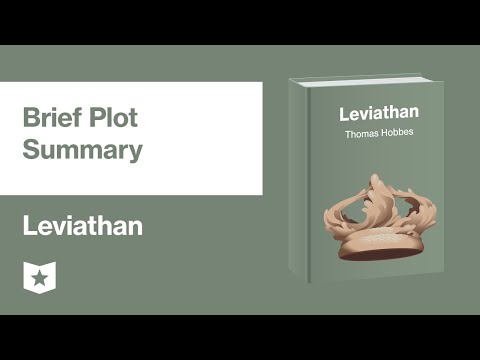
Written in the shadow of the English Civil War, Hobbes' Leviathan pictures the state of nature as a war of all against all where life is nasty, brutish and short. Fear drives people into a social contract, giving a near-absolute sovereign power in exchange for security, a tension with liberty we still live with.
On this page
Thomas Hobbes wrote Leviathan in the shadow of the English Civil War, and you can feel the trauma of that chaos on every page. Hobbes had watched a society tear itself apart, and his great book is an attempt to answer one urgent question: why do we need government at all, and how much authority must we grant it to keep us from destroying one another? His answer is bleak, brilliant, and uncomfortable, built up step by step from a stark picture of human nature toward a sweeping justification of the all-powerful state. Even where I resist his conclusions, I find his reasoning impossible to dismiss.
Here is what Leviathan taught me about the state of nature, about the bargain we make to escape it, and about the permanent tension between security and freedom.
Key takeaways
- The state of nature is a “war of all against all,” where life is “nasty, brutish, and short.”
- Fear of violent death drives us to seek peace through a common power.
- The social contract: we surrender freedom to a sovereign in exchange for security.
- The sovereign’s power must be near-absolute to keep order, in Hobbes’ view.
- Security and liberty pull against each other, a tension we still live with.
The war of all against all
Hobbes begins with a thought experiment: imagine human beings with no government, no laws, no common power over them, in what he calls the state of nature. Because people are roughly equal in strength and cunning, because resources are scarce, and because we compete for gain, safety, and reputation, this condition would be a perpetual war of every man against every man. There would be no industry, no agriculture, no arts, no society, only continual fear and danger of violent death. In his unforgettable phrase, the life of man would be solitary, poor, nasty, brutish, and short. It is a grim picture, and Hobbes means it to be. He wants us to feel the terror of life without order, so that we will value what order costs.
The bargain
From this fear comes Hobbes’ solution: the social contract. Rational people, desperate to escape the war of all against all, agree to give up their natural freedom to do whatever they like and to transfer that power to a sovereign, an individual or assembly, who will enforce peace. We trade liberty for security. The sovereign, which Hobbes names the Leviathan after the biblical sea monster, is the great artificial person created by this agreement, embodying the will of all in one overwhelming authority. The famous frontispiece of the book shows exactly this: a giant king whose body is composed of the tiny figures of all his subjects. We are the Leviathan; we make it, out of our own fear, to protect us from ourselves.
The uncomfortable conclusion
Here is where Hobbes becomes hard to swallow. To keep us from sliding back into chaos, he argues, the sovereign’s power must be nearly absolute and undivided. A divided or limited authority, he thinks, is no real authority at all and invites the return of civil war. So he is willing to grant the state enormous power over its subjects, far more than most of us would accept. This is where I part ways with him; the history since Hobbes is full of the horrors that absolute power produces. And yet his underlying problem will not go away. Every society must balance security against freedom, and Hobbes states the dilemma with a clarity no one has surpassed. Too little authority and we risk chaos; too much and we risk tyranny. We are still negotiating that line today.
What I’m taking with me
Leviathan is a book I argue with rather than simply admire, which is itself a sign of its power. What I am taking from Hobbes is his unsparing honesty about why we need government at all, his insight that political order is something we construct out of fear rather than something natural and free, and above all his framing of the permanent tension between security and liberty. I reject his near-absolute sovereign. But I cannot unsee the problem he posed, and I think any honest political thinking has to begin by reckoning with the grim possibility he described.
Frequently asked questions
What is Hobbes’ Leviathan about?
It argues that without government, human life would be a violent “war of all against all,” and that to escape this we form a social contract, surrendering freedom to a powerful sovereign in exchange for peace and security.
What does “nasty, brutish, and short” mean?
It is Hobbes’ description of human life in the state of nature, without government, a condition of constant fear, danger, and violence in which life would be miserable and brief.
Why did Hobbes want an all-powerful sovereign?
Because he believed that only a strong, undivided authority could prevent society from collapsing back into civil war. A weak or divided government, he feared, would invite renewed chaos.
References & further reading
- Hobbes, Thomas. Leviathan. (1651; edited by C. B. Macpherson, Penguin Classics, 1968.)
- Tuck, Richard. Hobbes. Oxford University Press, 1989.
- Martinich, A. P. Hobbes: A Biography. Cambridge University Press, 1999.
Watch: others on this book

Read along with me
Book notes, philosophy and the ideas that shape how we build. New essays every month, no spam.
Related reading notes
Born Free, Everywhere in Chains: Rousseau's "The Social Contract"
Jean-Jacques Rousseau's The Social Contract opens with a thunderclap of a sentence: man is born free, and everywhere he is in chains.
The Minimal State: Robert Nozick's Libertarian Challenge
Robert Nozick's Anarchy, State, and Utopia: rights as side constraints, the entitlement theory of justice, the Wilt Chamberlain argument and the minimal state.
How Freedom Dies: Arendt's "The Origins of Totalitarianism"
Hannah Arendt's The Origins of Totalitarianism: why totalitarianism was new, how loneliness, ideology and terror destroy freedom, and why it matters.
Comments
No comments yet. Start the conversation.