Microlearning & Bite-Sized Content
Microlearning gets dismissed as the fast food of training, but the problem was never the small portions, it was the empty calories.
TL;DR
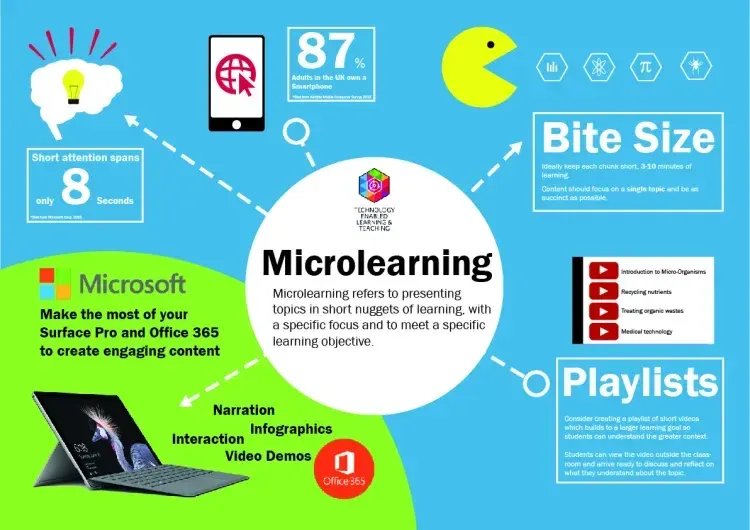
Microlearning is often dismissed as training fast food, but the problem was never the small portions, it was the empty calories. Short units work when each targets one specific skill or decision, includes practice and retrieval, is spaced over time and connects to real work. That design work is what few want to fund.
On this page
Say the word “microlearning” in a room of seasoned trainers and you can usually predict the reaction. Half the room lights up about engagement and mobile-first delivery. The other half rolls its eyes and mutters something about attention spans, TikTok-brained employees, and the slow death of serious education. Both reactions miss what is actually going on, and the gap between them is worth closing, because the eye-rollers are reacting to something real even if they have aimed their complaint at the wrong target.
The real complaint is not that learning units are small. It is that a lot of “microlearning” is small and empty. A library of two-minute clips with no objective, no practice, and no plan for reinforcement is genuinely useless. But notice that the same content, stretched into a sixty-minute webinar, would be just as useless. We do not blame the hour-long course for being an hour. We should not blame the two-minute unit for being two minutes. Length is not the variable that determines whether someone learns. Design is.
The portion size was never the problem
There is a tired metaphor that microlearning is the fast food of corporate training: quick, cheap, satisfying in the moment, and bad for you over time. It is a good line and a wrong idea. The thing that makes fast food unhealthy is not that the portions are small. Plenty of nourishing food comes in small portions. It is what is in the portion, and how often you eat nothing else.
Apply that honestly to learning and the diagnosis changes. The problem with bad microlearning is not the grain size. It is that each grain contains no real substance, that the grains never add up to a meal, and that nobody ever checks whether the learner can actually do anything afterward. Fix those three things and small portions become a feature, because they fit into the cracks of a working day where a sixty-minute course never could.
Why “make it shorter” became a trap
I think the discipline got into trouble the moment “microlearning” started being used as a synonym for “shorter.” A leader hears that attention is scarce, concludes that the answer is brevity, and asks the team to chop the existing four-hour onboarding into bite-sized pieces. The team obliges. Now there are forty-eight five-minute videos that must be watched in order, each one depending on the last, none of them useful on its own.
That is not microlearning. It is the same course in smaller boxes, and it inherits every weakness of the original while adding a new one: the learner has lost the thread that held the long version together. The defining quality of a genuine micro-unit is that it stands on its own. It answers one question a learner actually has. You should be able to drop it into someone’s day at the moment they need it and have it help, without requiring them to have watched the previous forty-seven things.
This is why “how long should a unit be?” is the wrong opening question. The right one is “what is the single thing this unit teaches, and how will the learner prove they got it?” Answer that, and the length takes care of itself. Most well-scoped units turn out to be short, but they are short as a consequence of tight scope, not as a goal in itself.
The unglamorous part nobody wants to fund
Here is the uncomfortable truth that separates microlearning that works from microlearning that merely exists. The hard part is not making the content small. It is everything around the content: deciding what one thing each unit teaches, ending each unit with a moment where the learner has to recall rather than just nod along, and then arranging the units across days and weeks so they resurface before they fade.
That last piece is where most programs quietly give up. Building a clip is fun and visible. Spacing its review three days later, then again two weeks after that, is invisible plumbing that no one applauds. Yet it is precisely the spacing and the recall that turn a pleasant viewing experience into something a person still knows next month. Skip it, and you have produced content, not learning. The metric that flatters you, completion rate, will look great. The metric that matters, whether anyone can do the job differently, will not move at all.
What I would tell a skeptic
If you are one of the eye-rollers, I am mostly on your side. You are right that a great deal of microlearning is shallow, that “we’ll just make some short videos” is often a way to dodge the hard work of defining objectives, and that completion dashboards are a comforting lie. Hold onto all of that skepticism. Just point it at the right thing.
The format is not the failure. A flashcard on a spaced schedule, a single well-built scenario that forces a real decision, a one-page job aid that quietly replaces a memorization task no one should have to do, these are not concessions to short attention spans. They are honest responses to how memory and busy schedules actually work. People reach for a two-minute refresher right before they do the task, not in a conference room three weeks earlier. Meeting them there is not dumbing things down. It is showing up where the work happens.
So keep your standards high and your portions small. Demand one clear objective per unit, a moment of genuine recall, and a plan for spacing that you actually follow. Microlearning done that way is not junk food. It is the difference between handing someone a stack of clips and handing them something they will still be using long after they have forgotten where they learned it.
Key takeaways 5
- Small learning units aren't the problem; empty content is.
- "Make it shorter" alone produces shallow learning.
- Each unit should target one skill, decision or behavior.
- Retrieval practice and spacing make short lessons stick.
- Design and maintenance are the unglamorous costs.
Watch & learn

Frequently asked questions
What is microlearning?
Microlearning delivers learning in short, focused units, usually a few minutes long, each covering one objective, often on mobile devices and close to the moment of need.
Does microlearning work?
Yes, for focused skills, reinforcement and performance support, especially with practice and spaced repetition. It is less suited to complex topics that need deep, connected understanding.
How long should a microlearning lesson be?
Long enough to achieve one clear objective, often 2 to 7 minutes. The focus matters more than a strict time limit.
Go deeper with the free masterclass
Workshop, PDF handbook and curated resources for “Microlearning & Bite-Sized Content”.
Related articles

Building Hands-On Labs & Exercises
Most technical training fails not because the content is wrong, but because learners never get their hands dirty. Here is how to design labs that turn watching into doing.
AI Tutors & Personalized Learning
For forty years we have known one-to-one tutoring works almost magically well, and we could never afford it. Large language models change the math - but only if we remember that the model was never the teacher.

Building an Online Course
Most online courses fail not because the teaching is bad, but because they were never designed to be finished. Here is how to build one that is.
Comments
No comments yet. Start the conversation.