ITSM & the Service Desk (ITIL)
The service desk is the most underrated team in IT. Run it as a service, not a switchboard, and it quietly makes the whole organisation better.
TL;DR
The service desk is IT's most underrated team: the only one that sees every user's experience every day. Run it as a service, not a switchboard. ITIL's ideas, a single point of contact, services instead of equipment, and clear incident, request, problem and change practices, plus balanced metrics, make the whole organization better.
On this page
The team everyone underestimates
Ask an executive to name IT’s most strategic function and you will hear “architecture,” “security,” maybe “the cloud team.” Almost nobody says “the service desk.” Yet the service desk is the only IT team that sees what every single user actually experiences, every day. It is the front door, the early-warning system, and the place where the business’s trust in technology is won or lost one ticket at a time.
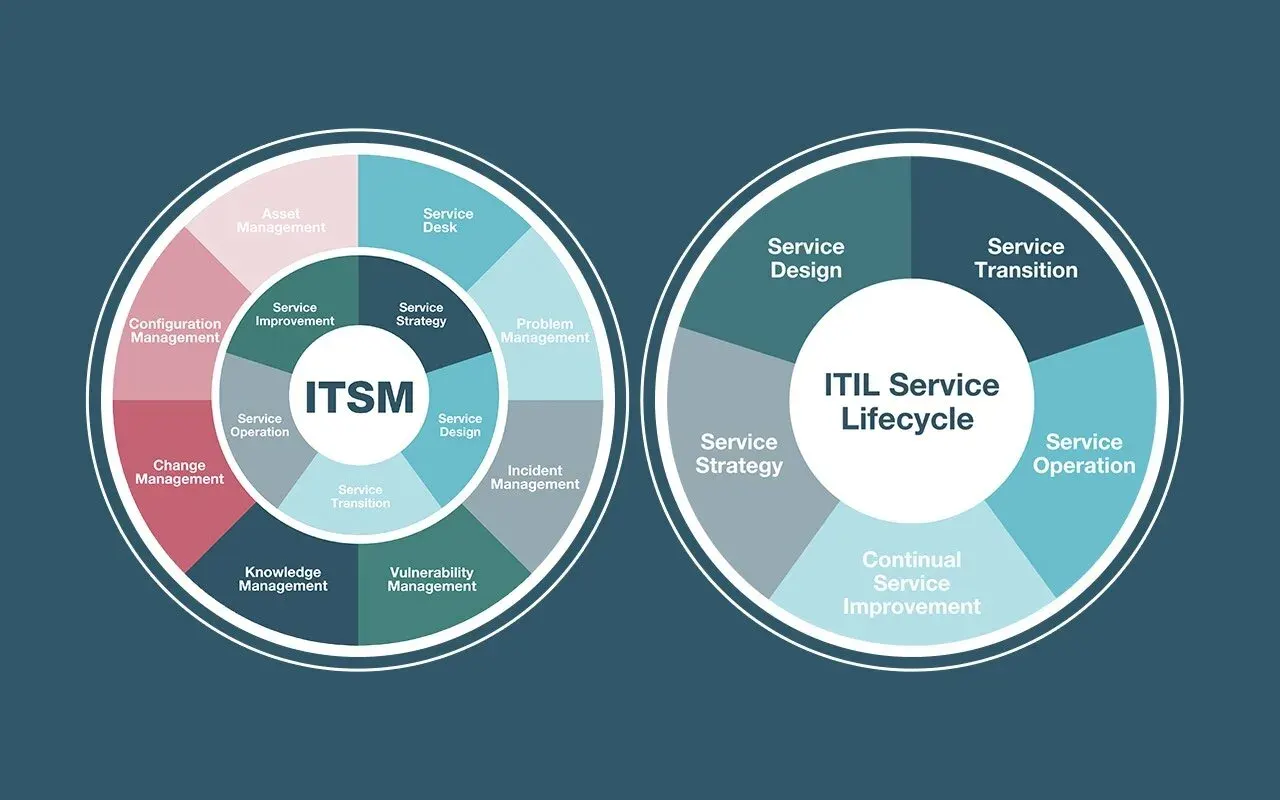
The reason the desk gets underestimated is that we describe it wrongly. We call it a “help desk” and picture a switchboard - people answering phones and resetting passwords. That framing guarantees it will be treated as a cost to minimise. The better framing comes from IT Service Management: the desk is the operational face of a service, and a service exists to create value. Reframe it that way and everything about how you staff, measure and improve it changes.
Services, not kit
The central insight of ITSM, and of ITIL 4 in particular, is that technology is not the point. Value is. Nobody in finance cares which mail server you run; they care that the invoice goes out before the deadline. “Email,” “a working laptop on day one,” “the ability to reset my own password” - these are services, and the hardware and software beneath them are just moving parts.
This sounds obvious until you watch how most IT decisions actually get made. Teams optimise the kit - faster servers, newer tools - while the service the user experiences stays mediocre because tickets vanish into inboxes and nobody owns the outcome. ITIL 4’s four dimensions exist precisely to stop this: look at people and culture, at technology, at suppliers, and at how work actually flows - all four, or you fix one and break another.
The single front door
The first thing a real service desk gives you is a single point of contact. One front door sounds bureaucratic; it is the opposite. When every request is logged in one place, nothing falls through the cracks, work can be prioritised across the whole queue instead of by who shouts loudest, and - critically - you start generating data. What breaks, how often, how long it takes to fix. Without that data you are guessing. With it, you can manage.
A single front door also lets you do the most valuable thing a desk can do: shift work left. The cheapest ticket is the one a user resolves themselves through a good knowledge article or a self-service portal. The next cheapest is one a first-line agent closes using a documented fix from a specialist. Every time you write a knowledge article or automate a routine request, you push work toward the user and free your skilled engineers for the problems that genuinely need them. Shift-left is not cost-cutting; it is respect for everyone’s time.
Four words that prevent chaos
If I could give a new desk just one gift, it would be the discipline to keep four words distinct: incident, problem, change, request. An incident is something broken, and the goal is to restore service fast - a workaround counts. A problem is the underlying cause, and the goal is to diagnose and remove it. A change is a modification, and the goal is to do it safely. A request is a standard, pre-approved ask, and the goal is to fulfil it efficiently.
Desks that blur these distinctions burn out. They “fix” the same incident every week because nobody ever runs problem management to find the root cause. Or they let urgent changes skip assessment and cause the very outages they were meant to prevent. The vocabulary is not pedantry; it is the difference between a desk that learns and one that runs on a treadmill.
Measure outcomes, balance the metrics
You cannot improve what you do not measure, but the wrong measures are worse than none. Priority should follow a simple, defensible rule - impact multiplied by urgency, plotted on a matrix that turns arguments into codes. A single user’s slow printer is a P4 no matter how loudly they complain; a company-wide outage at month-end is a P1, full stop.
For performance, the trap is measuring speed alone. Reward first-contact resolution and agents close tickets prematurely; reward raw speed and quality collapses. The fix is to always pair an efficiency metric (mean time to resolve, first-contact resolution) with a quality metric (customer satisfaction, reopen rate). Metrics drive behaviour, including bad behaviour - so design them as a balanced set, and tie your service-level agreements to the operational agreements and vendor contracts that actually make them achievable.
The quiet payoff
Run a desk this way - as a service, with a single front door, a clear vocabulary, balanced metrics and a steady habit of continual improvement - and something counterintuitive happens. It becomes nearly invisible. Services just work. Requests are fast. When something breaks, it is handled calmly and learned from, so it breaks less next time.
That quiet competence is easy to overlook, which is exactly why the desk gets underestimated. But it is the whole promise of ITSM delivered in practice: technology reliably creating value, every single day. The team at the front door is not the bottom of the org chart. It is the nervous system of the entire operation.
Key takeaways 5
- The service desk is IT's front door and early-warning system.
- Describe IT as services users understand, not equipment.
- A single point of contact keeps requests visible and consistent.
- Separate incidents, requests, problems and changes.
- Balance speed metrics with quality and user satisfaction.
Watch & learn

Frequently asked questions
What is ITSM?
IT Service Management (ITSM) is the set of practices for designing, delivering, managing and improving the IT services an organization provides to its users.
What is the difference between an incident and a problem in ITIL?
An incident is an unplanned interruption or degradation of a service. A problem is the underlying cause of one or more incidents, investigated to prevent them from recurring.
Which service desk metrics matter?
Useful metrics include first contact resolution, time to resolve, backlog, customer satisfaction and repeat incidents, balanced so speed doesn't come at the expense of quality.
Go deeper with the free masterclass
Workshop, PDF handbook and curated resources for “ITSM & the Service Desk (ITIL)”.
Related articles

AI-Assisted IT Support & Automation
AI will not replace your service desk. It will quietly hand the keys to whoever forgets to keep a human in the room.

Supporting Hybrid & Remote Workforces
The office help desk assumed it could walk over and fix things. When the users scattered, the service desk had to be rebuilt around a single uncomfortable truth - you can never touch the device.
Remote Support Tools & Techniques
Remote support runs on the same software scammers use. What makes you trustworthy is not the tool, but consent, restraint, and a record of what you did.
Comments
No comments yet. Start the conversation.