Industrial IoT Architecture
Most failed Industrial IoT projects were not killed by bad code. They were killed at the whiteboard, by an architecture that ignored where the work actually happens.
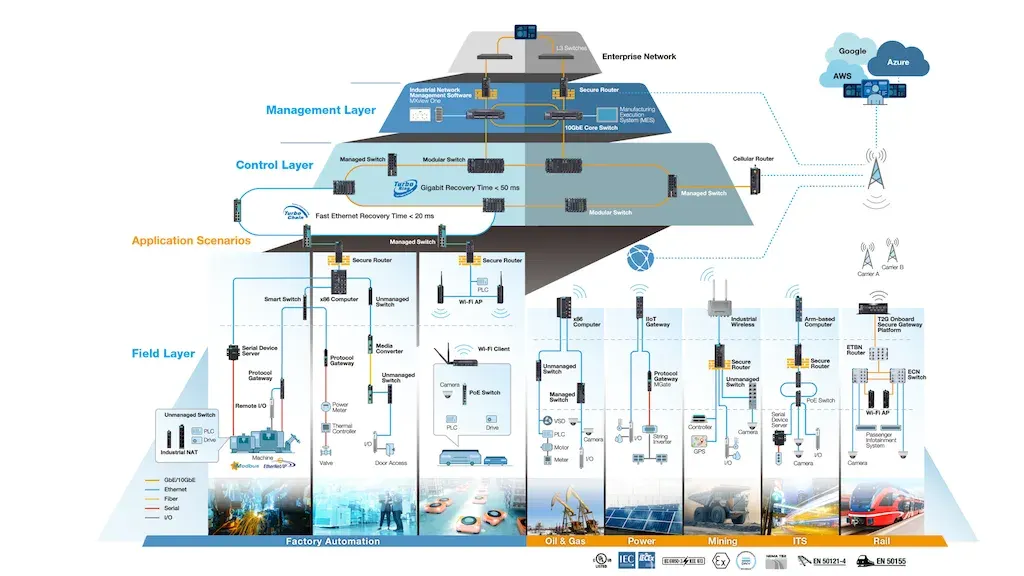
TL;DR
Industrial IoT projects usually fail at the whiteboard, not in the code. Good architecture decides early what runs at the edge versus the cloud, draws a clear boundary between OT and IT, gives data context so it isn't just noise, treats security as a posture, and is designed for the second hundred devices.
On this page
There is a comfortable myth in Industrial IoT that the hard part is the technology you can buy. Pick a cloud, pick a platform, pick a protocol, wire the demo, and the architecture takes care of itself. The demo always works. It is a sensor on a desk, a clean network, and one device. Then the system meets a real plant, and the cracks that were invisible in the demo become the reasons the project stalls.
The cracks are almost never in the components. They are in the boundaries between them - the decisions about where things run, what data means, and what happens when the network fails. Those are architecture decisions, and they are made early, on paper, long before anyone writes ingestion code. Get them wrong and no amount of engineering downstream will save you.
The decision that decides everything
If I could make an IIoT team get exactly one decision right, it would not be the cloud vendor or the protocol. It would be the split between edge and cloud.
This is the choice that quietly sets the cost, the responsiveness, and the resilience of the entire system, and it is the one most often made by accident. The default failure mode is to treat the cloud as the system and the edge as a dumb pipe. Everything streams up; everything is decided centrally. It looks clean on a slide and it is ruinous in practice.
Consider a vibration sensor sampling at twenty kilohertz. Stream that raw to the cloud across two hundred machines and you have built a system whose connectivity bill grows without bound and whose insight arrives a second too late to matter. The fix is not a better cloud. It is recognizing that the feature extraction belongs at the edge, near the signal, and only the distilled result should travel.
The principle, once you see it, is hard to unsee: filter and react at the edge, learn and coordinate in the cloud. The edge owns what must be fast, local, or able to survive a dropped link. The cloud owns what benefits from scale and a long memory - training models, comparing assets, spotting fleet-wide patterns. Everything else can go either way, and there you should let simplicity win, because every capability you push to the edge is something you must deploy, secure, and update across devices you may never physically touch again.
The line nobody draws until it is too late
Here is the single most under-designed property in industrial systems: what happens when the network drops.
In a software product, you assume connectivity. In a plant, a mine, a ship, or a remote pumping station, connectivity is a temporary state of grace. It will go away. The question is whether your architecture treats that as an exception or as the normal weather.
A serious IIoT design buffers at the edge through every outage and forwards without losing or duplicating a single reading when the link returns. The asset keeps running; the system loses visibility, not function. A design that assumes a constant connection is not robust software with a flaw - it is the wrong category of system for an industrial setting. If you take one habit from this, make it this: for every component, ask out loud what it does during a multi-hour outage, and refuse to accept “it would not happen” as an answer.
Data without context is just noise
The second quiet killer is meaning. A reading of “72.3” is worthless. It only becomes useful when the architecture has decided where it acquires identity, units, an accurate timestamp, and a quality flag - where “72.3” becomes “bearing temperature, Pump 7, degrees Celsius, good, at this instant.”
Teams obsess over moving data fast and forget to decide where it becomes information. Timestamps are the classic trap: let device clocks drift and your entire history is subtly wrong, and every analysis built on it inherits the error invisibly. Context is not a feature you add later. It is a decision about which layer owns meaning, and it has to be made up front.
Security is a posture, not a product
Industrial IoT widens the attack surface in uncomfortable ways: many devices, long lifespans, physical exposure, and a bridge across the old air gap between operational and information technology. The defensive mindset is to assume the network is hostile and to limit how far any single compromise can spread. Give every device a unique, revocable identity. Encrypt in transit and at rest. Grant least privilege, so a compromised sensor cannot command an actuator. Segment control networks from general IT. Sign your updates. And keep the IoT system entirely out of safety loops - safety belongs in certified control systems that fail safe, not in a telemetry stack. These are guardrails that shrink the blast radius when something goes wrong, which it eventually will.
Build for the second hundred devices
The last architectural blind spot is scale, and the tell is simple. Your demo onboards one device by hand. Can your design onboard the two hundred and first without a human? If provisioning, configuration, updates, and monitoring are manual, the system works beautifully right up to the point where it doesn’t, and that point arrives sooner than anyone plans for.
None of this is glamorous. It is layers, boundaries, and unglamorous questions about failure and cost. But that is precisely the point. The exciting parts of IIoT - the dashboards, the predictions - are built on a structure that is decided early and changed expensively. Spend your attention at the whiteboard, on the edge-cloud split, the offline behavior, the meaning of the data, and the path to scale. That is where the project is won, long before it ships.
Key takeaways 5
- Architecture decisions, not components, decide IIoT success.
- Decide what runs at the edge and what runs in the cloud.
- Draw the OT/IT boundary explicitly and early.
- Data needs context such as asset, unit and location to be useful.
- Design for scale, offline operation and security from the start.
Watch & learn

Frequently asked questions
What are the layers of an IIoT architecture?
Typical layers are devices and sensors, edge gateways and computing, connectivity and messaging, a data platform for storage and processing, and applications such as dashboards, analytics and integrations.
Why do IIoT pilots fail to scale?
Because the pilot ignores real-plant problems: network failures, device management, inconsistent data models, security across OT and IT and the operational cost of many devices.
How should IIoT handle network outages?
Edge devices should buffer data locally (store-and-forward) and keep local functions running, then synchronize when the connection returns.
Go deeper with the free masterclass
Workshop, PDF handbook and curated resources for “Industrial IoT Architecture”.
Related articles
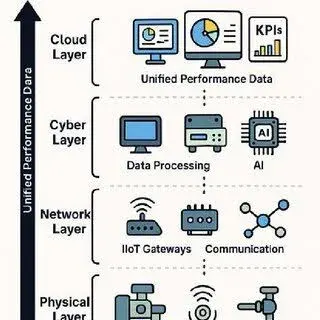
IIoT: Sensor-to-Cloud Data Pipelines
Everyone wants the dashboard and the digital twin. Almost nobody wants to talk about the pipes that feed them - which is exactly why so many Industry 4.0 projects stall.
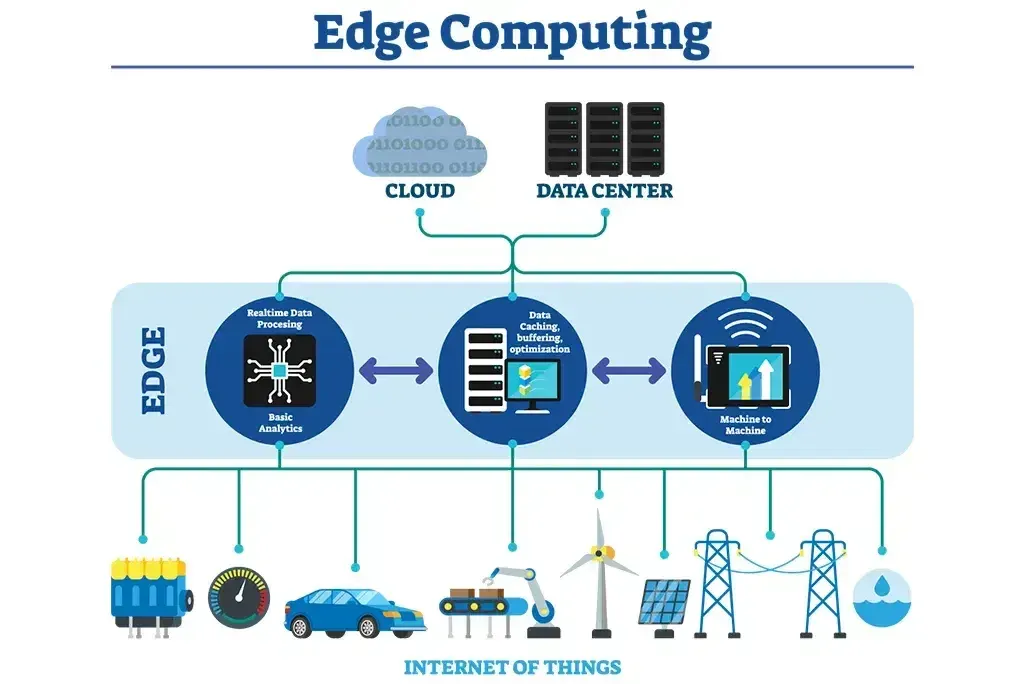
Edge Computing for Smart Manufacturing
The factory cloud dream hit a wall of latency, bandwidth and broken WAN links. The answer was to move the compute back to the machines.
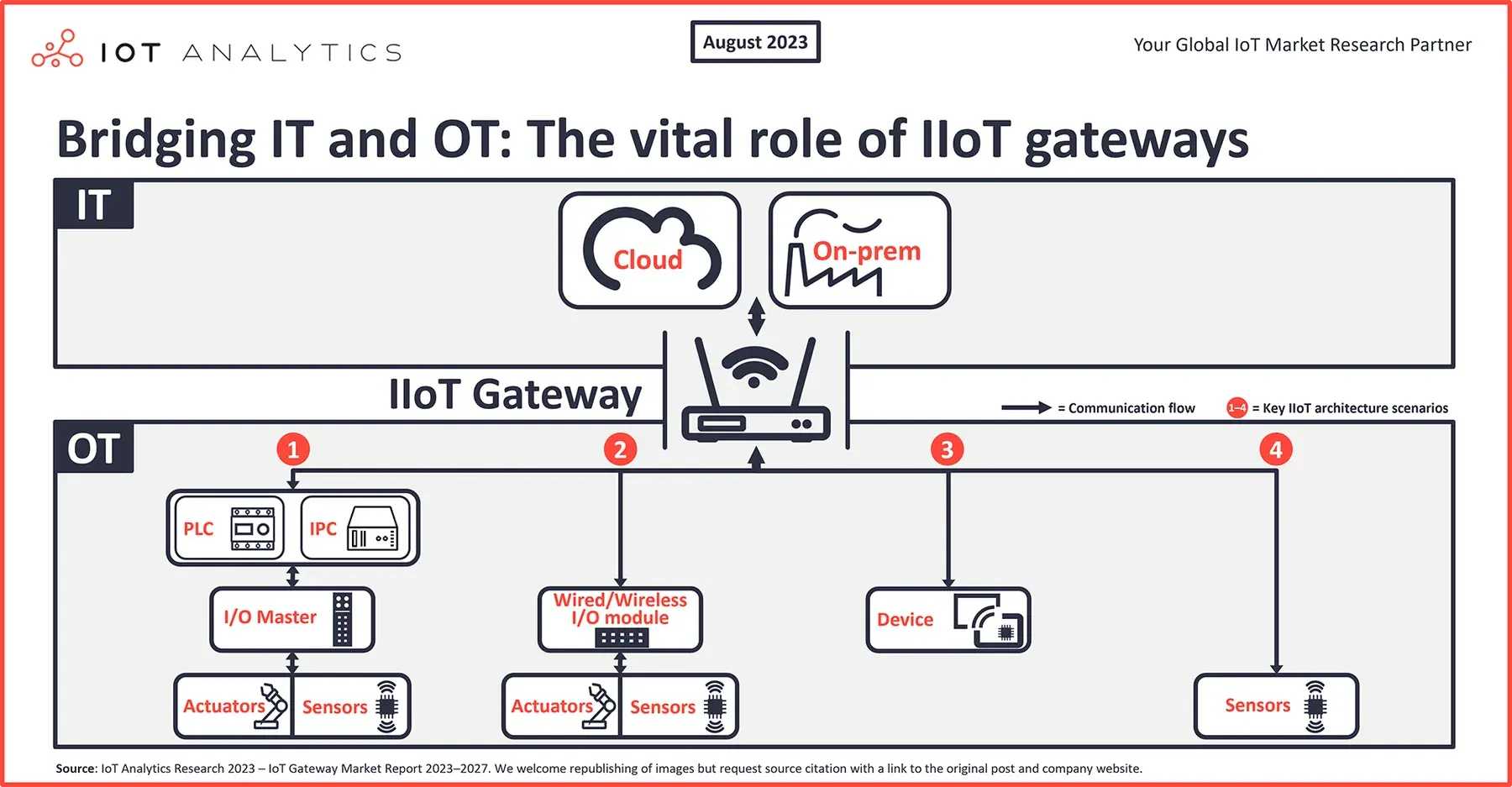
From PLC to IIoT: Bridging OT Data
The most valuable data in a factory is generated every second and almost none of it ever leaves the room. Bridging OT to IIoT is the unglamorous engineering that finally lets it out - safely.
Comments
No comments yet. Start the conversation.