Big Brother and the Death of Truth: Orwell's "1984"
In one breath
1984 follows Winston Smith's doomed attempt to keep his own mind in a totalitarian state where the Party watches everyone, rewrites the past and controls thought through Newspeak and doublethink. Orwell's warning is that power sought for its own sake ultimately demands the surrender of truth itself.
On this page
George Orwell’s 1984 is the great dystopian novel of the twentieth century, and it has given our language a whole vocabulary of warning: Big Brother, doublethink, thoughtcrime, the memory hole, “Orwellian” itself. Set in a totalitarian superstate where the Party, led by the never-seen Big Brother, controls everything, including the past, the present, and the very thoughts of its citizens, it follows Winston Smith’s doomed attempt to hold onto his own mind and a scrap of truth. Orwell wrote it in 1948, looking at the totalitarian regimes of his time and projecting their logic to its terrifying conclusion. It is bleak, brilliant, and disturbingly relevant, a warning that has never stopped being timely.
Here is what 1984 taught me about total surveillance, about the manipulation of truth and language, and about the Party’s ultimate goal of power for its own sake.
Key takeaways
- “Big Brother is watching”: total surveillance destroys all private freedom.
- The Party controls the past by constantly rewriting history.
- “Newspeak” and “doublethink” show how controlling language controls thought.
- “2 + 2 = 5”: the regime demands the surrender of objective truth itself.
- Power is sought for its own sake, not as a means to any other end.
The eye that never closes
The most famous feature of Orwell’s world is total surveillance. The telescreens in every room watch and listen at all times; the Thought Police may be anywhere; even a flicker of the wrong expression can be fatal. “Big Brother is watching you,” the posters declare. The genius and horror of this is psychological: when you can never be sure you are not being observed, you internalise the watcher, policing your own thoughts and feelings until genuine privacy, and with it genuine freedom, becomes impossible. There is nowhere to be simply yourself. In an age of cameras, data, and digital surveillance far beyond anything Orwell imagined, this vision feels less like fantasy than prophecy. The deepest tyranny, Orwell saw, is the one that reaches inside your own head.
The war on truth and language
What makes 1984 more than a thriller about surveillance is its profound analysis of how truth itself is destroyed. The Party controls the past, literally rewriting historical records so that history always confirms whatever the Party now says; what is inconvenient is dropped down the “memory hole” and ceases ever to have existed. It controls the present through “doublethink,” the capacity to hold two contradictory beliefs at once and accept both, and through “Newspeak,” a shrinking, impoverished language deliberately engineered so that dissenting thoughts become literally unthinkable for lack of words to think them. Orwell understood that whoever controls language and the record of the past controls the very possibility of thought. The climactic demand that Winston believe that two plus two equals five is the regime’s claim to command not just behaviour but reality itself. When a power can make you deny what you can see with your own eyes, it owns you completely.
Power for its own sake
The most chilling revelation comes near the end, in Winston’s interrogation by the Party official O’Brien. Why does the Party do all this? Not, it turns out, for any noble goal, not for the good of the people, not even for wealth or security. The Party seeks power purely for its own sake. O’Brien’s image is unforgettable: if you want a picture of the future, imagine a boot stamping on a human face, forever. The Party wants power, and the pure exercise of power, the ability to inflict suffering and to break the human spirit, is its own reward. This is the darkest insight of the book, and the most terrifying. It strips away every comforting illusion that tyranny must have some rational purpose that might be reasoned with. Sometimes, Orwell warns, the cruelty is the point.
What I’m taking with me
1984 is a permanent warning, and rereading it I am struck by how much of its vocabulary we now use to describe our own world. What I am taking from Orwell is his terrifying portrait of total surveillance and the death of privacy; his profound insight that controlling language and the past is the deepest form of control, the war on objective truth itself; and his darkest lesson, that power can be sought purely for its own sake, that the boot may stamp on the face simply because it can. Orwell does not offer comfort. He offers vigilance, the reminder that freedom of thought, the integrity of truth, and the right to say that two plus two makes four are precious, fragile, and never to be taken for granted.
Frequently asked questions
What is 1984 by George Orwell about?
It is a dystopian novel set in a totalitarian state where the Party, led by Big Brother, controls all of life through total surveillance, the rewriting of history, and the manipulation of language, following one man’s doomed resistance.
What is “doublethink”?
The capacity, demanded by the Party, to hold two contradictory beliefs simultaneously and accept both, allowing people to deny obvious truths whenever the regime requires it.
Why does the Party seek power, according to 1984?
Purely for its own sake. As O’Brien explains, the Party does not seek power as a means to any other goal; the exercise of power and the ability to inflict suffering are themselves its aim.
References & further reading
- Orwell, George. Nineteen Eighty-Four. Secker & Warburg, 1949.
- Crick, Bernard. George Orwell: A Life. Secker & Warburg, 1980.
- Williams, Raymond. Orwell. Fontana, 1971.
Watch: others on this book
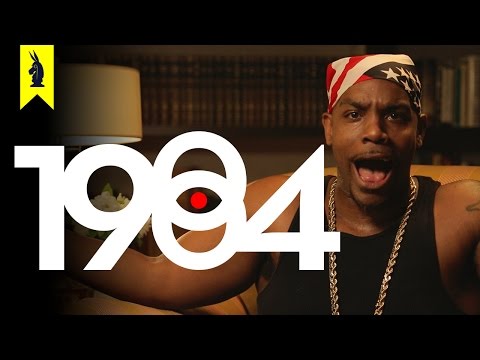
Read along with me
Book notes, philosophy and the ideas that shape how we build. New essays every month, no spam.
Related reading notes
All Animals Are Equal, But...: Power and Betrayal in Orwell's "Animal Farm"
Orwell's Animal Farm: how a revolution for equality is betrayed by the pigs, and what the fable teaches about power, propaganda and language.
Amusing Ourselves to Servitude: Huxley's "Brave New World"
Huxley's Brave New World warns of control through pleasure, not pain. What the novel says about soma, stability and loving our servitude.
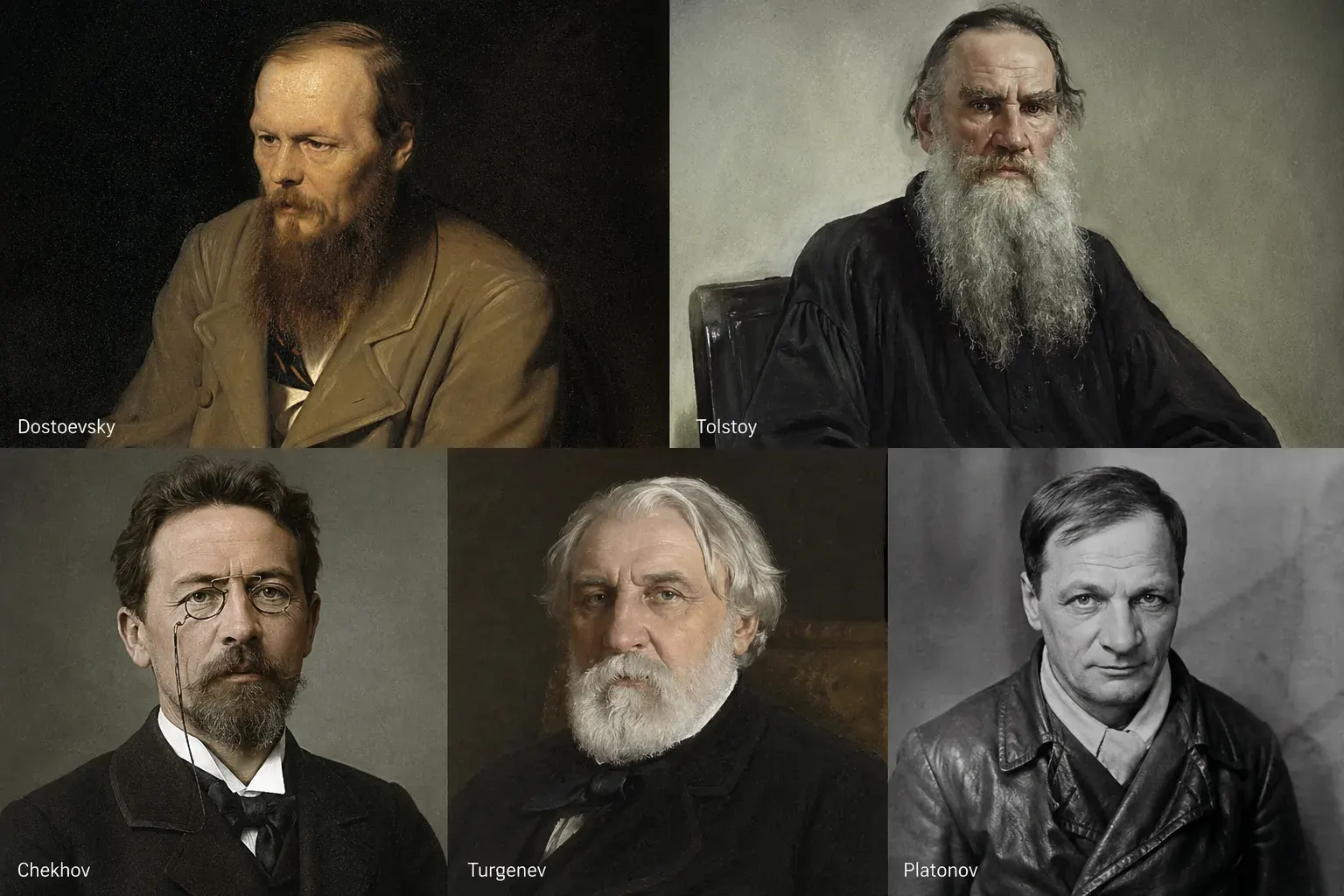
Dostoevsky, Tolstoy, Chekhov, Turgenev and Platonov
Where to start with Russian literature: essential works by Dostoevsky, Tolstoy, Chekhov, Gogol, Turgenev and Platonov, and why each is worth reading.
Comments
No comments yet. Start the conversation.