Beyond Survival: Maslow and the Heights of Human Need
In one breath
In Toward a Psychology of Being, Abraham Maslow asks what makes people thrive rather than what makes them ill. His hierarchy of needs runs from survival to self-actualization, and his studies of healthy people and peak experiences helped found humanistic psychology.
On this page
Abraham Maslow helped found a movement he called humanistic psychology, and his Toward a Psychology of Being is one of its founding texts. Maslow was frustrated with a psychology that studied mostly the sick, the broken, and the rat in the maze. He wanted to ask a different and more hopeful question: not what makes people ill, but what makes them thrive? What does a human being at their healthiest, fullest, and most alive actually look like? Out of that question came his famous hierarchy of needs and his rich idea of self-actualization, and reading him felt like a psychology that finally took human possibility seriously.
Here is what Maslow taught me about the hierarchy of needs, about the people he called self-actualizing, and about the peak experiences that show us what we can be.
Key takeaways
- Needs form a hierarchy, from basic survival up to self-actualization.
- Lower needs must be reasonably met before higher ones become pressing.
- Self-actualization is becoming everything one is capable of becoming.
- “Peak experiences” are moments of joy, wholeness, and transcendence.
- Psychology should study health, not only sickness.
The hierarchy of needs
Maslow’s most famous contribution is the hierarchy of needs, often drawn as a pyramid. At the base are physiological needs, food, water, sleep; above them, safety; then love and belonging; then esteem, the need for respect and achievement; and at the summit, self-actualization, the need to fulfil one’s deepest potential. The key idea is that these needs are ordered: when the lower ones are unmet, they dominate us completely, but as each is reasonably satisfied, the next emerges and begins to pull at us. A starving person thinks only of food; once fed and safe and loved, a person begins to hunger for meaning and growth. I find this a humane and clarifying map. It explains why prosperity does not automatically bring contentment: meeting our lower needs does not satisfy us, it simply uncovers the higher ones beneath.
The self-actualizing person
Maslow’s deepest interest was the top of the pyramid, and rather than theorising about it he went and studied actual people he considered unusually healthy and fulfilled, both living acquaintances and historical figures. What were they like? They tended, he found, to perceive reality clearly, to accept themselves and others without crippling guilt, to be spontaneous and creative, to have a few deep relationships rather than many shallow ones, to enjoy solitude, to retain a freshness of appreciation for ordinary things, and to be devoted to some work or cause beyond themselves. Self-actualization, in his account, is not selfish self-absorption but the opposite: becoming so fully oneself that one is freed to give attention to the world. This portrait of psychological health gave me something to aim at, a picture of what flourishing actually looks like.
Peak experiences
Among the marks of self-actualizing people, Maslow noticed, were what he called peak experiences: moments of intense joy, wonder, and a sense of unity with the world, in which the self seems to expand and ordinary concerns fall away. These might come through love, art, nature, creative work, or sudden insight. They are not mystical privileges reserved for saints, he argued, but natural experiences available to everyone, glimpses of our highest possibilities. What moved me is how Maslow treats these moments not as escapist or trivial but as deeply important data, fleeting revelations of what fuller human being feels like. They show us, however briefly, the heights we are built to reach.
What I’m taking with me
Toward a Psychology of Being reoriented how I think about my own life by reorienting the basic question, from “what is wrong with me?” to “what would it mean to flourish?” What I am taking from Maslow is the liberating map of the hierarchy of needs, which explains why satisfaction keeps receding; the inspiring portrait of self-actualizing people, which gives flourishing a recognisable face; and the encouragement to treasure peak experiences as signposts toward what I can become. He insisted that human beings are built not merely to survive but to grow, and that is a conviction worth carrying.
Frequently asked questions
What is Maslow’s hierarchy of needs?
A model ranking human needs from basic survival (food, safety) through love and esteem up to self-actualization. Lower needs generally must be reasonably met before higher ones become motivating.
What is self-actualization?
The drive to fulfil one’s deepest potential, to become everything one is capable of being. Maslow described self-actualizing people as realistic, accepting, creative, and devoted to something beyond themselves.
What is a “peak experience”?
A moment of intense joy, wonder, and unity in which the self expands and ordinary worries fall away. Maslow saw these as natural glimpses of our highest human possibilities, available to everyone.
References & further reading
- Maslow, Abraham H. Toward a Psychology of Being. Van Nostrand, 1962.
- Maslow, Abraham H. Motivation and Personality. Harper, 1954.
- Hoffman, Edward. The Right to Be Human: A Biography of Abraham Maslow. Tarcher, 1988.
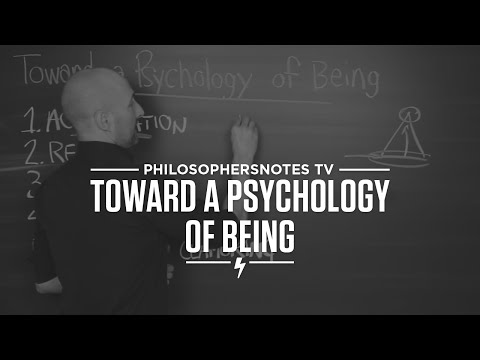
Watch: others on this book

Read along with me
Book notes, philosophy and the ideas that shape how we build. New essays every month, no spam.
Related reading notes
Becoming Who You Are: Carl Rogers and the Therapeutic Self
Carl Rogers' On Becoming a Person: unconditional positive regard, empathy and the curious paradox that we change once we accept ourselves.

Passion and Perseverance: Angela Duckworth on Grit
Angela Duckworth on grit: why passion and perseverance predict success better than talent, why effort counts twice and how grit can grow.
Fixed vs. Growth: Carol Dweck's "Mindset" and the Power of Yet
Carol Dweck's Mindset is built around a deceptively simple idea that turns out to have enormous consequences.
Comments
No comments yet. Start the conversation.