Selling the Soul for Experience: Goethe's "Faust"
In one breath
Goethe's Faust turns the legend of the scholar who sells his soul into a drama of modern restlessness. Faust's wager with Mephistopheles turns on whether he will ever be satisfied; his striving harms the innocent Gretchen, yet Goethe redeems him because whoever strives may be redeemed.
On this page
Goethe worked on Faust for most of his long life, finishing the second part only shortly before his death, and it is widely regarded as the supreme work of German literature. It takes the old folk legend of the scholar who sells his soul to the devil and transforms it into a vast poetic drama about the deepest restlessness of the modern human spirit. Goethe’s Faust is not damned for lust or greed in the simple medieval way; his sin, if it is one, is a boundless craving for experience, knowledge, and life itself, a refusal ever to be satisfied. In him, Goethe captured something essential and dangerous about the striving modern soul.
Here is what Faust taught me about the hunger that drives us, about the terms of the famous bargain, and about why Goethe lets Faust be redeemed in the end.
Key takeaways
- Faust’s sin is restless striving, an endless craving for more experience.
- The wager with Mephistopheles turns on whether Faust will ever be satisfied.
- Striving itself is both the danger and the salvation.
- Faust’s pursuit causes real harm, most tragically to the innocent Gretchen.
- Goethe redeems Faust, because “whoever strives may be redeemed.”
The hunger that cannot be filled
When we meet Faust, he is an aging scholar who has mastered every field of learning and despairs that it has brought him no real life, no genuine experience, no satisfaction. His agony is not ignorance but the emptiness of all his knowledge. This is what makes Goethe’s Faust so modern. His defining trait is an insatiable restlessness, a craving to feel, to know, to experience everything the world can offer, that nothing can finally quench. He represents the striving spirit of the modern age itself, forever reaching, forever dissatisfied, forever pushing past every limit. I recognised something of this restlessness in myself and in the culture around me, the conviction that there is always more to have, to do, to experience, and the quiet despair when none of it suffices.
The terms of the bargain
The wager Faust strikes with the devil Mephistopheles is brilliantly designed around exactly this restlessness. Faust does not simply sell his soul for a fixed term of pleasure. He bets that Mephistopheles can never give him a single moment so satisfying that he would want it to last, that he would say to the passing moment, “stay, you are so beautiful.” If Faust ever becomes content, ever stops striving, the devil wins his soul. It is a profound reframing of the legend. The danger is no longer damnation for forbidden pleasure but the spiritual question of whether endless striving can ever be at peace. Faust gambles his soul on his own inability to be satisfied, which is, Goethe suggests, the characteristic gamble of the modern self.
The cost and the redemption
Goethe does not romanticise this striving uncritically. Faust’s restless pursuit causes terrible real harm, above all in the tragedy of Gretchen, the innocent young woman he loves, seduces, and destroys, leaving a trail of death and grief. The striving spirit is not free; it tramples the vulnerable in its path, and Goethe makes us feel the cost. And yet, at the end of the second part, Faust is redeemed and his soul carried to heaven. Why? Because, the angels sing, whoever strives and keeps on striving, him we can redeem. For Goethe, the very restlessness that endangers Faust is also, finally, what saves him, the refusal to sink into complacency, the ceaseless reaching toward something higher. It is a remarkable, almost paradoxical verdict: that striving, for all its dangers, is closer to salvation than the comfortable death of the satisfied soul.
What I’m taking with me
Faust is a lifetime’s work about the deepest drive of the modern spirit, and it refuses easy moralising. What I am taking from it is its searching portrait of restless striving as both our glory and our danger; its sober reckoning with the harm that boundless ambition can do to others; and Goethe’s surprising, generous conclusion that the striving itself, when it reaches toward the good, can be redeemed. Faust leaves me asking the hard questions about my own restlessness, whether it tramples or builds, whether it reaches upward or merely consumes, and whether I could ever, like Faust, learn to bless a passing moment without selling my soul to keep it.
Frequently asked questions
What is Goethe’s Faust about?
It retells the legend of the scholar who makes a pact with the devil, transforming it into a drama about restless human striving, the craving for limitless experience and knowledge, and the question of redemption.
What is Faust’s bargain with Mephistopheles?
Faust wagers that the devil can never satisfy him so completely that he would wish a single moment to last forever. If he ever becomes truly content and stops striving, the devil wins his soul.
Why is Faust redeemed at the end?
Because, in Goethe’s vision, the one who never stops striving toward something higher can be saved. The restless striving that endangers Faust is also what ultimately redeems him.
References & further reading
- Goethe, Johann Wolfgang von. Faust, Parts One and Two. (Translated by Walter Kaufmann, 1961; or Philip Wayne, Penguin.)
- Boyle, Nicholas. Goethe: The Poet and the Age. Oxford University Press, 1991–2000.
- Reed, T. J. Goethe. Oxford University Press, 1984.
Watch: others on this book


Read along with me
Book notes, philosophy and the ideas that shape how we build. New essays every month, no spam.
Related reading notes
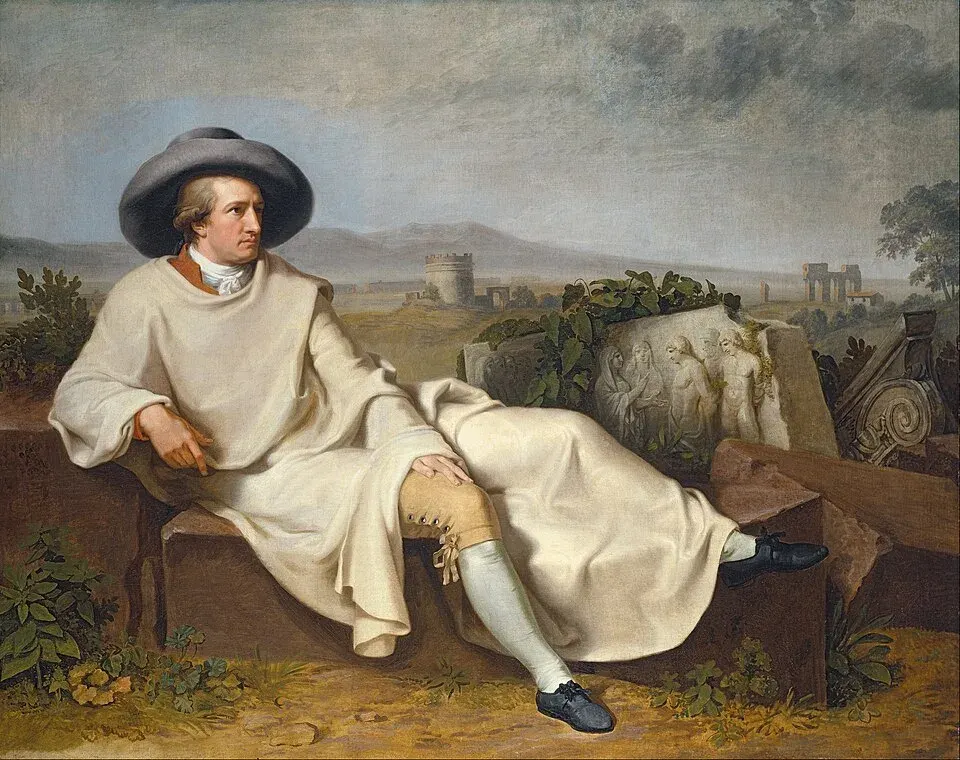
The Fever of Romantic Longing: Goethe's "The Sorrows of Young Werther"
Goethe's The Sorrows of Young Werther: Romantic sensibility, hopeless longing for Lotte, Werther Fever and the gift and peril of intense feeling.
The Game of Life and Knowledge: Hesse's "The Glass Bead Game"
The Glass Bead Game was Hermann Hesse's last and most ambitious novel, the work for which he was awarded the Nobel Prize.
The Wolf and the Man Within: Reflections on Hesse's "Steppenwolf"
If Siddhartha is Hesse at his most serene, Steppenwolf is Hesse at his most tormented.
Comments
No comments yet. Start the conversation.