NAPE: The Pyramid of Meaning and Its Two Descents
One pyramid, four philosophies, and two ways down: into a meaning of your own, or into the gray.
In one breath
NAPE stacks four philosophies into one pyramid: Nihilism, Absurdism, Pragmatism, Existentialism. Read from Nihilism down, it is a descent into meaning that ends in gold. Read from Existentialism down, it is a descent into meaninglessness that ends in gray. Most lives travel both ways, and the direction is the part you choose.
On this page
Most of us, at some point, ask the question that has no polite answer: what if none of this means anything? It tends to arrive at night, or after a loss, or when a goal we chased for years turns out to be smaller than we thought. I have asked it more than once. Over time I noticed that my answers kept passing through the same four stations, and I started drawing them as a pyramid. I call it NAPE: Nihilism, Absurdism, Pragmatism, Existentialism.
This is not a new school of philosophy. Each of the four has its own thinkers, history and quarrels, and none of them saw their work as one step on someone else’s staircase. NAPE is a way of reading them together. What took me longest to see is that the pyramid can be read in two directions, and that they end in very different places.
One pyramid, two descents
My first drawing had nihilism at the bottom and existentialism at the top, a climb from nothing to meaning. Then I turned it over, and it told a different story.
Stand the pyramid on its point, with nihilism on top, and read it downward. You start in a doubt as wide as the sky, where every value is open to question. Each level narrows the question and makes it more personal, until it comes down to a single point of gold: you, choosing what your life will mean. That is the descent into meaning.
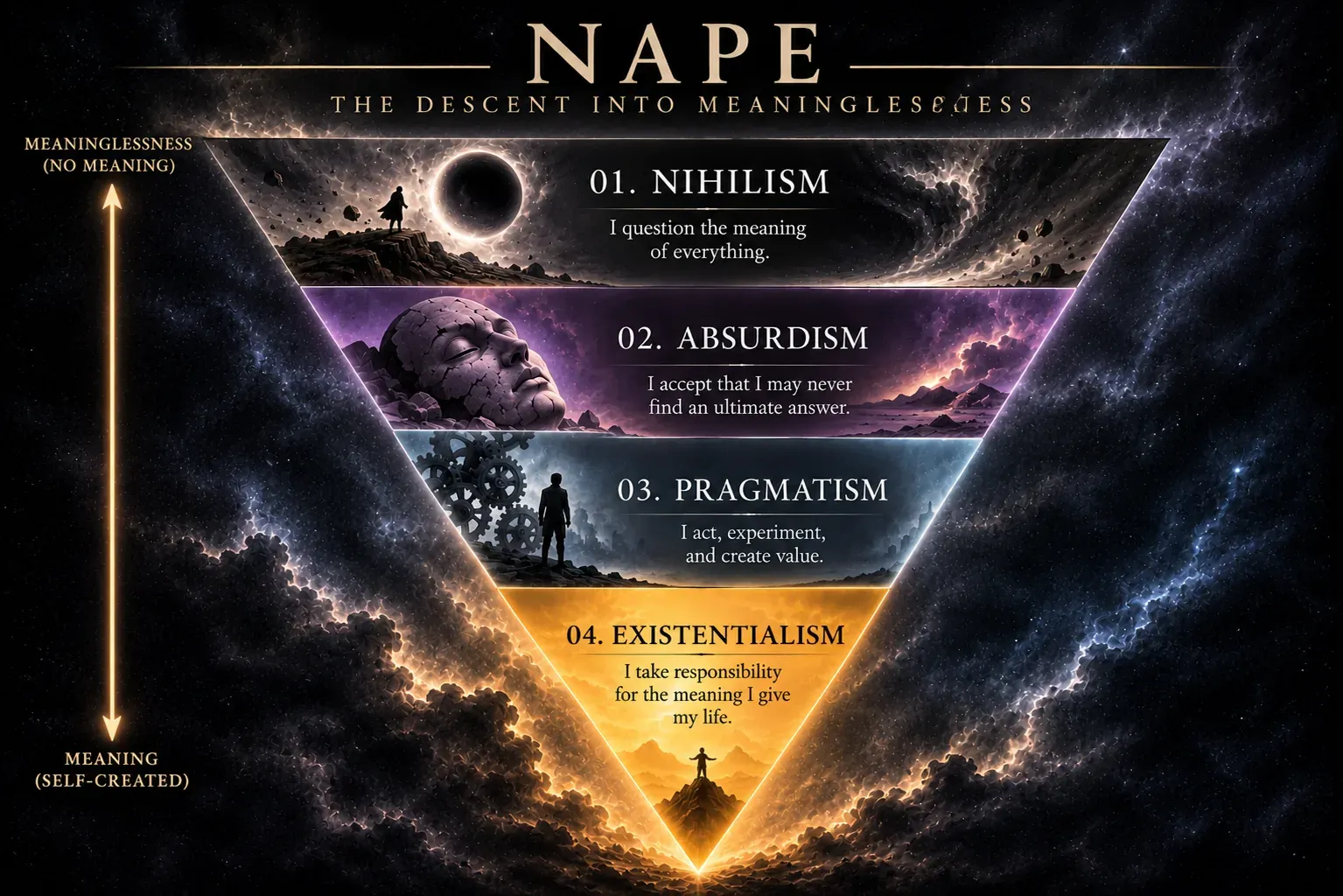
Now set the pyramid back on its base, with existentialism at the summit, and read it downward again. You start with a meaning: a purpose, a faith, a career, a love that explained everything. Then something cracks. You keep going through the motions, the motions stop adding up, and you end at the wide gray floor of nihilism, where nothing seems worth anything. That is the descent into meaninglessness.
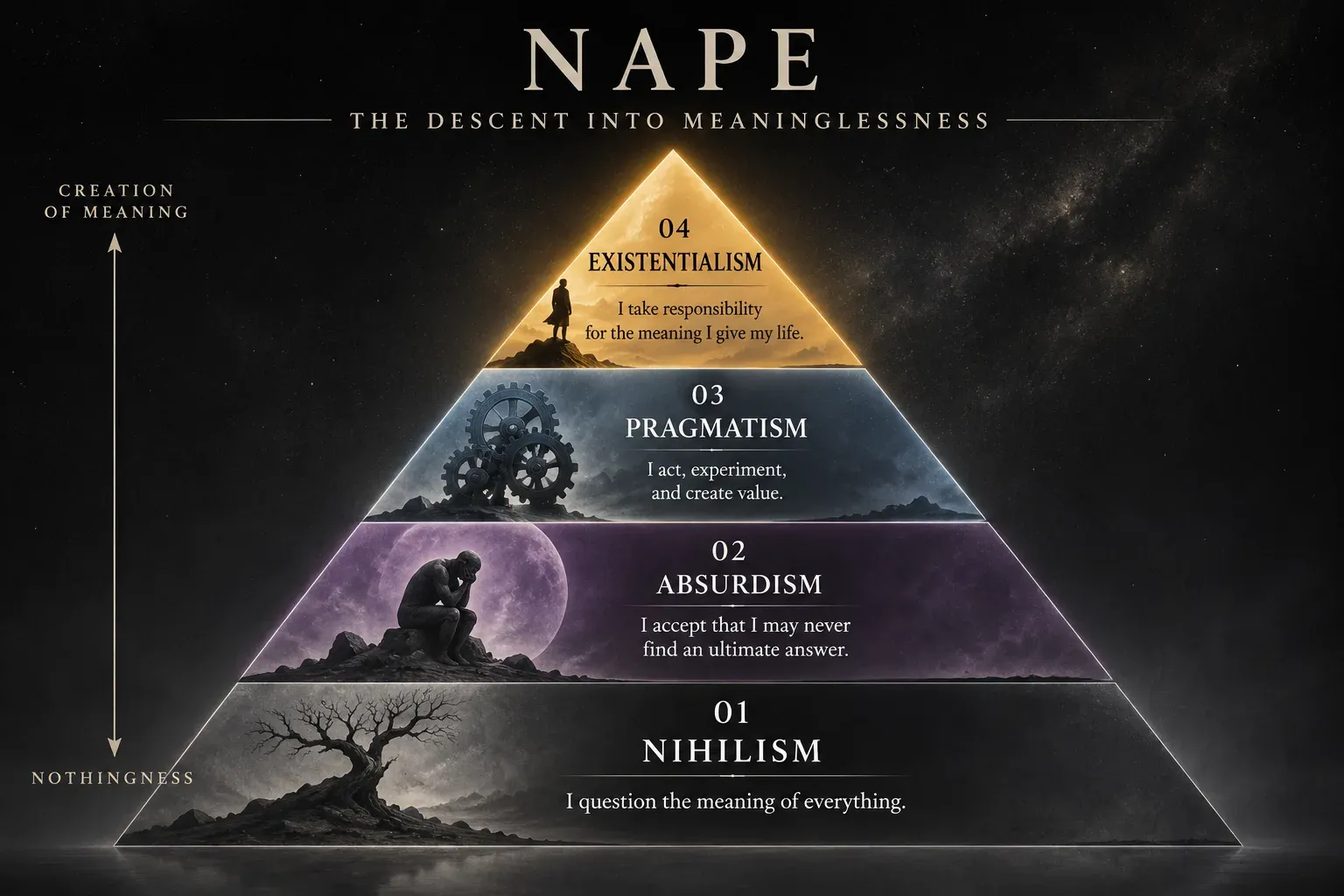
The levels are the same in both pictures. Only the direction changes, and the direction changes everything. So for each level below, I describe what it looks like from both sides.
01. Nihilism
The question: what if nothing has meaning in itself?
Nihilism refuses to take anything for granted. It questions the idea that life comes with a purpose already attached, that there is a moral order built into the universe, or that the values we inherited are true just because they are old. Nietzsche gave this its famous form when he wrote in The Gay Science (1882) that “God is dead”. He was not celebrating. He was warning that the frame that had held European values together for centuries was gone, and that most people had not yet noticed. In his notebooks he called nihilism the uncanniest of guests, already standing at the door.
He also drew the line that the whole pyramid turns on. Passive nihilism is exhaustion: nothing matters, so why bother. Active nihilism is a clearing: if the old values are dead, we are free to ask which ones deserve to replace them.
- Going into meaning, this is where you start. Active nihilism clears the ground. You see what you actually believe, and what you were only repeating.
- Going into meaninglessness, this is where you end. Passive nihilism is the gray at the bottom, where nothing is questioned any more because nothing seems worth the effort.
02. Absurdism
The question: how do I live when I want meaning and the universe gives none?
Albert Camus described the absurd in The Myth of Sisyphus (1942) as a collision. On one side is a human being who cannot stop asking why. On the other is a world that stays silent. The absurd lives in neither of them alone. It lives in the meeting.
Camus considered three ways out. You can escape physically, by giving up on life. You can escape intellectually, by jumping into a belief system that promises a final answer, which he called philosophical suicide. Or you can stay in the contradiction with your eyes open. He chose the third and called it revolt. His image for it is Sisyphus, condemned to push a rock up a hill forever, and the essay ends: “One must imagine Sisyphus happy.” Sisyphus does not win. He is happy because the struggle is his, and because he does not lie to himself about it.
- Going into meaning, absurdism is revolt. The question stays open, and you keep living anyway.
- Going into meaninglessness, the same silence becomes a shrug. It is not revolt any more. It is resignation: the answer isn’t coming, so what is the point of anything?
03. Pragmatism
The question: if nothing is guaranteed, what is worth doing?
The American pragmatists, Charles Sanders Peirce, William James and John Dewey, were less interested in what is true in some final sense than in what difference an idea makes. In Pragmatism (1907) James asked for the “cash value” of an idea: what changes in experience if it is true? Dewey thought this was simply how intelligence works. You try something, look at the consequences, keep what holds up and change what doesn’t.
Pragmatism does not say that whatever is useful to me is right. Ideas are tested against experience, and experience includes other people and what our actions do to them. A belief that “works” only because it hurts someone else has failed the test.
- Going into meaning, pragmatism is a release. You stop waiting to solve the mystery of existence and start building, learning and fixing things, and meaning begins to show up in practice.
- Going into meaninglessness, the gears keep turning but the reason has gone. Work becomes routine, habits run on their own, and “what works” shrinks to “what gets me through the week”.
04. Existentialism
The question: if meaning is not given, what will I make of my life?
Jean-Paul Sartre summed it up in his 1945 lecture Existentialism Is a Humanism: “existence precedes essence”. A paper knife is designed for a purpose before it exists. A human being exists first, and only afterwards becomes someone through what they do. There is no blueprint waiting to be discovered.
Sartre also wrote that we are “condemned to be free”, and the word “condemned” is deliberate. You cannot hand responsibility for your life to God, your parents, your boss, your country or your nature. You did not choose the circumstances you were born into, but you do choose how you respond, and those responses, added up, are who you are. Simone de Beauvoir added that this freedom only means something when we also want it for others.
- Going into meaning, this is the golden point at the end of the descent. Everything above it, the doubt, the acceptance, the experiments, comes down to a decision that only you can make.
- Going into meaninglessness, this is the summit you fall from. A meaning you built can still crack, and because it was yours, nobody else can hold it up for you.
Three ways through the pyramid
When I put the two images side by side, I see three ways through, not two.
- The descent into meaning. From nihilism down to existentialism. You begin with nothing given and end with something chosen. Gray at the start, gold at the end.
- The descent into meaninglessness. From existentialism down to nihilism. You begin with a meaning and lose it one level at a time. Gold at the start, gray at the end.
- Up and down, again and again. This is the one most of us actually live. The arrow in the pictures points both ways. A bereavement, a failure or a long illness sends you back to the gray. A new commitment brings you back toward the gold. Nobody reaches one end and stays there for good.
So I can’t tell you where this pyramid ends. It depends on which end you start from, and on which way you are facing when the next crack appears. The levels can’t make that choice for you, and neither can Camus or Sartre.
What I’m taking with me
For a long time I read the pyramid in only one direction, as if meaning were a summit you reach once and keep. Turning it over taught me that the same four steps lead both ways. I have walked both descents, and I expect to walk them again. Now when I find myself in the gray, I don’t ask how far down I have fallen. I ask which way I am facing.
Nothing is given. It can be the end of meaning, or the beginning of one.
Frequently asked questions
What does NAPE stand for?
NAPE stands for Nihilism, Absurdism, Pragmatism and Existentialism, the four levels of the pyramid. It is a personal framework for thinking about how a life gains meaning, and how it can lose it.
What are the two descents in the NAPE pyramid?
The descent into meaning starts at nihilism and moves down through absurdism and pragmatism to existentialism, ending in a meaning you build yourself. The descent into meaninglessness starts from a meaning you already have and slides the other way, ending in the gray of nihilism.
Is NAPE an established school of philosophy?
No. It is a reading framework that connects four real traditions: Nietzsche on nihilism, Camus on the absurd, William James and John Dewey on pragmatism, and Sartre and Beauvoir on existentialism. The thinkers themselves did not see their work as steps in one pyramid.
Is nihilism the same as despair?
Not necessarily. Nietzsche distinguished a passive nihilism that collapses into exhaustion from an active one that clears away dead values to make room for new ones. In NAPE, passive nihilism is where the descent into meaninglessness ends, and active nihilism is where the descent into meaning begins.
Key takeaways 5
- The same four levels can lead into meaning or out of it. The direction decides the ending.
- Going down into meaning, nihilism clears the ground, the absurd is accepted, action is tested, and you take responsibility for what you build.
- Going down into meaninglessness, a meaning cracks, action turns into routine, the absurd becomes a shrug, and everything ends in gray.
- Nietzsche's line between active and passive nihilism is the hinge between the two descents.
- Most people move up and down the pyramid many times. Where you are matters less than which way you are facing.
Sources
Read along with me
Book notes, philosophy and the ideas that shape how we build. New essays every month, no spam.
Related reading notes

Navigating Life's Abyss with Nihilism and Pragmatism: A Personal Journey
A personal journey through nihilism and pragmatism: what Nietzsche and William James teach about facing meaninglessness and building meaning.
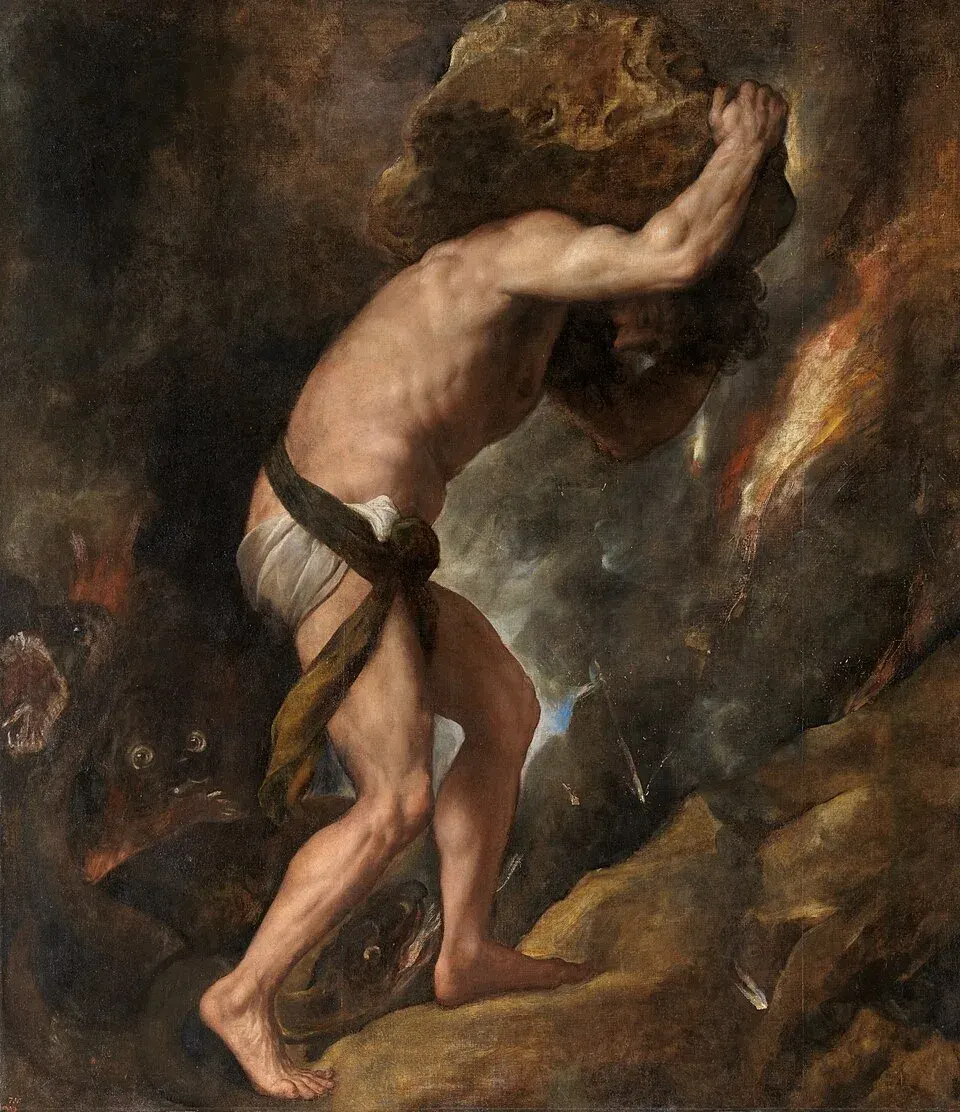
Imagining Sisyphus Happy: Camus on the Absurd
Camus' The Myth of Sisyphus explained: the absurd, why we should refuse both suicide and false hope, and why we must imagine Sisyphus happy.
From Zero to Infinity: A Playful Mathematical Journey Through Nihilism and Pragmatism
Explore a fun, mathematical journey blending nihilism and pragmatism to navigate life's complexities, inspired by influential mentors.
Comments
No comments yet. Start the conversation.