Explaining the World to Yourself: Seligman's "Learned Optimism"
In one breath
Martin Seligman's Learned Optimism shows that optimism is a learnable way of explaining events, not a fixed trait. Pessimists see setbacks as permanent, pervasive and personal, which feeds learned helplessness; by disputing those explanations, anyone can build a more resilient, optimistic style.
On this page
Martin Seligman is one of the founders of what became “positive psychology,” and Learned Optimism is the book where his shift began. Earlier in his career, Seligman had studied “learned helplessness,” the way people and animals, after repeated uncontrollable failures, give up trying even when escape becomes possible. But he noticed that not everyone became helpless; some people stayed resilient. Why? The answer, he found, lay in how people explain events to themselves, their “explanatory style.” And crucially, optimism, in this sense, is not a fixed trait you are born with but a learnable skill, a way of thinking that can be changed. The book is rigorous, grounded in research, and genuinely practical.
Here is what Learned Optimism taught me about explanatory style, about the difference between optimists and pessimists, and about learning to argue with yourself.
Key takeaways
- Optimism and pessimism are largely habits of explanation, not fixed traits.
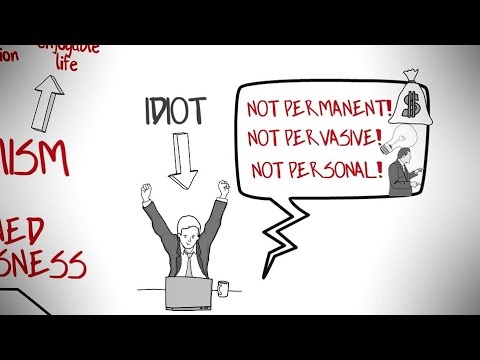
- Explanatory style turns on three dimensions: permanence, pervasiveness, and personalization.
- Pessimists explain bad events as permanent, pervasive, and personal; optimists do the opposite.
- Learned helplessness grows from a pessimistic explanatory style.
- You can learn optimism by disputing your own pessimistic thoughts.
Explanatory style
Seligman’s central concept is “explanatory style,” the characteristic way we explain to ourselves why things happen, especially bad things. He breaks it down along three dimensions. Permanence: do we see a setback as permanent (“this always happens”, “I’ll never get this right”) or temporary (“this happened this time”)? Pervasiveness: do we see it as pervasive, contaminating everything (“everything is ruined”), or specific to the one situation (“this one thing went wrong”)? And personalization: do we blame ourselves entirely (“it’s all my fault, I’m worthless”) or take a balanced view that includes external factors? Our habitual answers to these three questions, Seligman found, shape our resilience, our mood, our health, even our success. This is a precise, testable framework, far more useful than vague exhortations to “think positive.”
Optimists and pessimists
The difference between optimists and pessimists, in Seligman’s account, comes down to their explanatory styles, especially for bad events. The pessimist explains setbacks as permanent (“it will last forever”), pervasive (“it will undermine everything”), and personal (“it’s all my fault”). This style breeds the learned helplessness Seligman had studied: if bad things are permanent, all-encompassing, and your own fault, why bother trying? The optimist, facing the same setback, explains it as temporary, specific, and not solely personal, and so stays motivated and resilient. Interestingly, Seligman found that for good events the pattern reverses: optimists see their successes as permanent, pervasive, and personal, while pessimists dismiss them as flukes. Seligman is careful and honest here: he notes that pessimists are sometimes more accurate in their assessments (“depressive realism”), but that optimists, by their resilience and persistence, tend to achieve more and live healthier, longer lives. The optimistic style is not about denying reality but about not catastrophising it.
Learning to argue with yourself
The most practical part of the book is that optimism can be learned, and Seligman offers a concrete method drawn from cognitive therapy. The key is to learn to dispute your own automatic pessimistic explanations, to treat them not as facts but as hypotheses to be challenged. When you catch yourself thinking “I always fail at this, I’m hopeless,” you learn to argue back, as you would against an unfair critic: Is that really true? Is this setback actually permanent, or just this once? Does it really ruin everything, or only this? Is it entirely my fault, or were there other factors? By practising this internal disputation, you gradually shift your explanatory style from pessimistic toward optimistic. I find this genuinely empowering, because it does not ask me to lie to myself or paste on fake positivity; it asks me to examine my own catastrophic thoughts critically, and to stop believing every pessimistic story my mind tells me. We are, in effect, the narrators of our own lives, and we can learn to narrate more fairly.
What I’m taking with me
Learned Optimism is one of the more rigorous and genuinely useful books in the self-improvement field, because it is grounded in real research rather than wishful thinking. What I am taking from Seligman is the concept of explanatory style and its three dimensions, permanence, pervasiveness, personalization, which lets me see exactly how I explain setbacks to myself; the recognition that pessimism and optimism are largely learned habits of explanation, not fixed fate; and the practical method of disputing my own pessimistic thoughts rather than swallowing them whole. The deepest lesson is liberating: the way I explain the world to myself is not destiny, and I can learn to do it better.
Frequently asked questions
What is Learned Optimism about?
It is Martin Seligman’s book showing that optimism and pessimism are largely learned habits of how we explain events to ourselves, and that we can learn a more optimistic, resilient “explanatory style.”
What is “explanatory style”?
The characteristic way we explain why things happen, along three dimensions: permanence (temporary vs. permanent), pervasiveness (specific vs. global), and personalization (external vs. internal). It shapes resilience and mood.
Can optimism really be learned?
Yes, according to Seligman. By learning to dispute and challenge our automatic pessimistic explanations, treating them as hypotheses rather than facts, we can shift toward a more optimistic and resilient explanatory style.
References & further reading
- Seligman, Martin E. P. Learned Optimism. Knopf, 1991.
- Seligman, Martin E. P. Helplessness: On Depression, Development, and Death. W. H. Freeman, 1975.
- Beck, Aaron T. Cognitive Therapy and the Emotional Disorders. International Universities Press, 1976.
Watch: others on this book

Read along with me
Book notes, philosophy and the ideas that shape how we build. New essays every month, no spam.
Related reading notes

Losing Yourself in the Task: The Psychology of "Flow"
Csikszentmihalyi's Flow explained: what the flow state is, how balancing challenge and skill creates it, and why engagement beats pleasure.
Ancient Wisdom Meets Modern Psychology: Haidt's "The Happiness Hypothesis"
Haidt's The Happiness Hypothesis tests ancient wisdom about happiness against modern psychology: the elephant and the rider, relationships and meaning.

Gaining From Disorder: Taleb's "Antifragile"
Nassim Taleb's Antifragile explained: fragile, robust and antifragile, why removing all volatility backfires, and how to gain from disorder.
Comments
No comments yet. Start the conversation.