Beauty and Decay: Thomas Mann's "Death in Venice"
In one breath
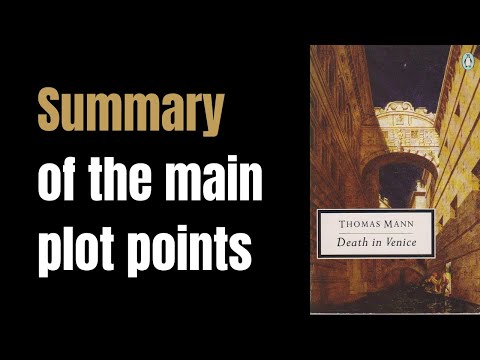
In Death in Venice, the austere writer Gustav von Aschenbach becomes obsessed with a beautiful boy while cholera spreads through the city he refuses to leave. Thomas Mann's novella shows discipline collapsing under desire, the Apollonian undone by the Dionysian, and beauty as a dangerous force.
On this page
Thomas Mann’s Death in Venice is a short, perfect, and deeply unsettling novella about the collapse of a disciplined life into obsession. Gustav von Aschenbach is a famous, austere writer who has built his entire existence on rigorous self-control and the mastery of his art. On a holiday in Venice, he becomes fixated on a beautiful adolescent boy, Tadzio, and this obsession, which he never acts on but cannot escape, gradually dissolves his dignity, his discipline, and finally his life, as a cholera epidemic creeps through the city he refuses to leave. It is a profound and troubling meditation on beauty, art, desire, and the thin line between the ordered life and the chaos beneath it.
Here is what Death in Venice taught me about the war between discipline and desire, about the dangerous power of beauty, and about the decay hidden beneath the surface.
Key takeaways
- Aschenbach’s rigid discipline collapses under the force of obsession.
- The Apollonian and Dionysian: order and reason undone by passion and chaos.
- Beauty is dangerous, capable of overwhelming reason and dignity.
- Decay is everywhere: the cholera in Venice mirrors the decay within Aschenbach.
- The artist’s relation to beauty and desire is fraught and perilous.
Discipline and its collapse
Aschenbach is, at the start, the very image of the disciplined life. His art and his character alike are monuments to self-control; he has spent his life mastering his impulses, holding chaos at bay through sheer will and routine. Mann presents this discipline with genuine respect, but also shows its cost and its fragility. For the obsession that seizes Aschenbach in Venice does not come from outside; it erupts from within, from everything his rigid order had been suppressing. The more tightly a life is controlled, Mann seems to suggest, the more violently the repressed may eventually break through. Watching this dignified, accomplished man unravel, dyeing his hair, painting his face, trailing a boy through plague-ridden streets, is excruciating precisely because his fall is the fall of discipline itself, overwhelmed by what it had denied.
The danger of beauty
At the heart of the novella is a meditation on beauty, drawing on Plato, whom Aschenbach himself invokes. Beauty, in this Platonic strand, is supposed to lift the soul toward the divine, toward higher things. But Mann shows its other, darker face. The beauty of Tadzio does not elevate Aschenbach; it intoxicates and destroys him, dissolving his reason, his self-respect, and his judgment. Mann is exploring the perilous relationship between the artist and beauty, between the contemplation of the beautiful and the unleashing of desire. Beauty, he suggests, is not safe; it carries a power that can overwhelm the very faculties, reason, restraint, dignity, that we depend on. The artist who serves beauty is always close to an abyss.
The decay beneath the surface
Mann weaves decay through every level of the story. As Aschenbach decays inwardly, his dignity rotting into degraded obsession, Venice itself is rotting: a cholera epidemic spreads silently through the canals, concealed by authorities anxious to protect the tourist trade. The beautiful city, with its splendid facades and its foul, disease-bearing waters beneath, becomes the perfect image of the whole theme, beauty and corruption inseparable, splendour resting on decay. The novella draws too on Nietzsche’s contrast between the Apollonian, the principle of order, form, and reason, and the Dionysian, the principle of intoxication, chaos, and dissolving passion. Aschenbach’s life was wholly Apollonian; in Venice, the Dionysian rises up and claims him. The order he built was always a thin skin over the chaos beneath.
What I’m taking with me
Death in Venice is a flawless and disturbing work, and it leaves me with questions rather than comfort. What I am taking from Mann is its profound exploration of the war between discipline and desire, and the warning that the most tightly controlled life may harbour the most dangerous repressions; its troubling vision of beauty as a power that can destroy as well as elevate; and its pervasive image of decay beneath the beautiful surface, in the city and in the soul. It is a reminder that the order we build over our chaos is always provisional, and that beauty, for all its glory, is never quite safe.
Frequently asked questions
What is Death in Venice about?
It is Thomas Mann’s novella about Gustav von Aschenbach, a disciplined writer whose obsession with a beautiful boy in Venice dissolves his self-control and dignity, as a cholera epidemic spreads through the city.
What is the Apollonian and Dionysian theme?
Drawn from Nietzsche, it contrasts the Apollonian principle of order, reason, and form with the Dionysian principle of chaos, intoxication, and passion. Aschenbach’s ordered life is undone by the Dionysian forces he had repressed.
What does the cholera in Venice symbolize?
The decay hidden beneath a beautiful surface. The disease creeping through the splendid city mirrors the inner corruption and dissolution overtaking Aschenbach himself.
References & further reading
- Mann, Thomas. Death in Venice. (1912; translated by H. T. Lowe-Porter, 1928; or David Luke, 1988.)
- Heller, Erich. Thomas Mann: The Ironic German. Secker & Warburg, 1958.
- Reed, T. J. Thomas Mann: The Uses of Tradition. Oxford University Press, 1974.
Watch: others on this book

Read along with me
Book notes, philosophy and the ideas that shape how we build. New essays every month, no spam.
Related reading notes
Time, Illness, and Ideas on the Mountain: Thomas Mann's "The Magic Mountain"
Thomas Mann's The Magic Mountain: time on the mountain, illness as a window onto life, Settembrini versus Naphta and Europe before the war.
The Tyranny of Beauty: Mishima's "The Temple of the Golden Pavilion"
Mishima's The Temple of the Golden Pavilion: a young monk's obsession with beauty, alienation and why he destroys what he cannot possess.
Facing the End: Tolstoy's "The Death of Ivan Ilyich" and a Life Well Lived
Tolstoy's The Death of Ivan Ilyich: a respectable life revealed as hollow, the lie of denying death, and the question of whether we lived rightly.
Comments
No comments yet. Start the conversation.